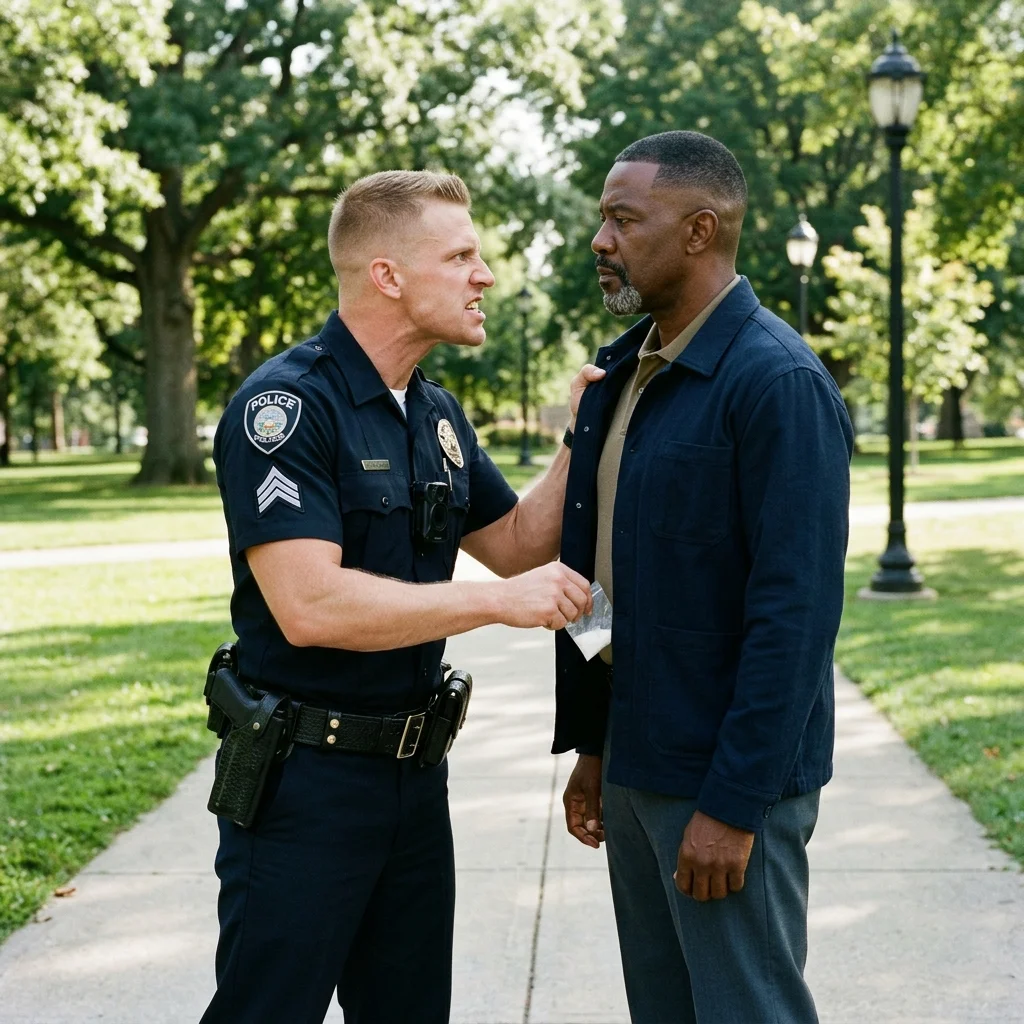
The first thing General Marcus Hale noticed was the smile on Officer Daniel Briggs’s face as the policeman slipped a plastic bag of white powder into his pocket.
It was not the smile of a man discovering a crime.
It was the smile of a man creating one.
At 3:17 on a beautiful Thursday afternoon, Bellwether Park was filled with sunlight, children’s laughter, and the gentle rustling of autumn leaves.
An elderly couple shared a sandwich beneath an oak tree.
A young mother pushed a stroller along the paved walkway.
Somewhere near the fountain, a little girl struggled to keep an orange kite in the air.
Nothing about the afternoon suggested that a man’s life was about to change.
Marcus had come to the park because he needed silence.
At sixty-three, he had spent more than forty years serving his country, first in the military and later in senior law enforcement leadership.
He had commanded thousands of personnel, survived dangerous overseas deployments, and investigated cases that had brought powerful criminals to justice.
After retiring from the National Guard as a major general, he had accepted the position of director of the State Office of Law Enforcement Accountability.
His gold identification badge carried an authority few officers in the state would ever possess.
Yet that afternoon, the badge remained hidden inside his jacket.
Marcus wore faded blue jeans, a charcoal sweater, and ordinary walking shoes.
Without his uniform, official vehicle, or security detail, he looked like any other Black man enjoying an afternoon outdoors.
That anonymity was precious to him.
Two years earlier, his wife Evelyn had died after a long battle with cancer.
Before her death, she had made him promise something.
“Marcus, when I’m gone, don’t spend the rest of your life hiding behind your responsibilities.”
He had smiled through his tears.
“And what would you have me do?”
“Walk in the sunshine sometimes.”
Today would have been her sixty-fourth birthday.
So Marcus had come to the park where they had spent countless Sunday afternoons together.
He carried a small photograph of Evelyn in his wallet.
He had planned to sit beside the fountain, remember her laughter, and allow himself a few peaceful minutes of grief.
Officer Briggs destroyed that peace with a deliberate shove.
Marcus was approaching a narrow section of the pathway when a uniformed officer suddenly stepped into his path.
Their shoulders collided hard enough to twist Marcus sideways.
“Watch where you’re going,” Briggs snapped.
Marcus caught his balance.
“Excuse me?”
“You heard me.”
The officer was a broad-shouldered white man in his late thirties, with a thick neck, narrow blue eyes, and a face hardened by habitual contempt.
His badge identified him as Daniel Briggs.
Marcus noticed that Briggs’s right hand was already moving.
The movement was quick, practiced, and almost invisible.
Something small disappeared into Marcus’s jacket pocket.
Before Marcus could respond, Briggs grabbed the pocket and produced a transparent plastic bag containing white powder.
“Well, well.”
He held the bag toward the sunlight.
“Look what we’ve got here.”
Marcus stared at him.
The surrounding park seemed to grow strangely quiet.
“Where did you get that?”
Briggs smirked.
“From your pocket.”
“You put it there.”
The smile widened.
“That’s a pretty serious accusation.”
“It is also exactly what happened.”
Briggs glanced around.
A few pedestrians had stopped walking, but none had approached.
“Possession of a controlled substance is a serious offense, buddy.”
Marcus looked at the bag again.
“Then you should be especially concerned about contaminating evidence.”
Something flickered across Briggs’s face.
He had expected fear.
He had expected pleading, confusion, perhaps even an offer of money.
What he had not expected was a man who understood police procedure better than he did.
“Hands behind your back,” Briggs ordered.
“On what legal basis are you detaining me?”
“Because I said so.”
“That isn’t a legal basis.”
Briggs stepped closer.
“You trying to teach me how to do my job?”
Marcus kept his voice steady.
“I’m asking you to do it lawfully.”
The words struck Briggs like an insult.
He seized Marcus by the collar and dragged him forward.
“You people always think you’re smarter than everybody else.”
Marcus felt the familiar cold weight of those words.
He had heard variations of them throughout his life.
In military training.
At traffic stops.
During the early years of his career, when strangers assumed the Black officer standing beside his white subordinates could not possibly be their commander.
But experience had taught him that anger was a dangerous luxury when a frightened man carried a weapon.
“Release my clothing,” Marcus said quietly.
Briggs responded by throwing a punch.
It came fast, aimed directly at Marcus’s jaw.
It was the worst decision of Daniel Briggs’s career.
Marcus shifted his weight, avoiding the blow by inches.
His left hand caught Briggs’s attacking arm.
His right hand controlled the officer’s shoulder.
Using the momentum Briggs had already created, Marcus turned and drove him down onto the grass.
The impact forced the air from Briggs’s lungs.
Before the officer could recover, Marcus had secured his wrist and pinned him safely to the ground.
“Stop resisting,” Marcus warned.
Briggs screamed.
“GET OFF ME!”
“Stop reaching toward your belt.”
Briggs’s free hand had begun moving toward his holstered pistol.
Marcus tightened his control.
“Do not touch that weapon.”
Several people screamed.
The elderly couple hurried away.
The little girl with the orange kite dropped her string.
Somewhere behind Marcus, a woman shouted that someone should call the police.
Briggs twisted violently.
“YOU’RE DEAD!”
Marcus maintained his position.
“Calm down.”
“YOU JUST ASSAULTED AN OFFICER!”
“You attacked me.”
“NO ONE’S GOING TO BELIEVE YOU!”
Those words disturbed Marcus more than the threat itself.
Briggs sounded completely certain.
He was not afraid of being caught planting evidence.
He was not worried about witnesses.
He seemed to believe that his uniform would automatically make his version of events the truth.
Then Marcus heard running footsteps.
“POLICE!”





