There was no sentence that could repair what had happened.
No official apology.
No prestigious title.
No medal from a distant battlefield.
A mother’s son was dead, and the people responsible had continued wearing their badges.
Ruth wiped her face.
Then she opened another folder.
“Your wife understood.”
Marcus looked up.
“Evelyn?”
“She came here every Wednesday.”
Ruth smiled through her grief.
“She brought lemon cake and never let anyone leave hungry.”
That sounded so much like Evelyn that Marcus almost heard her laughter.
Ruth continued.
“She listened when the police wouldn’t.”
She placed a thick notebook on the table.
The cover was blue.
On the first page, Evelyn had written a title.
THE WITNESSES THEY DIDN’T BELIEVE.
Marcus slowly turned the pages.
There were names, addresses, dates, witness statements, and copies of rejected complaints.
Some entries contained photographs.
Others included detailed timelines.
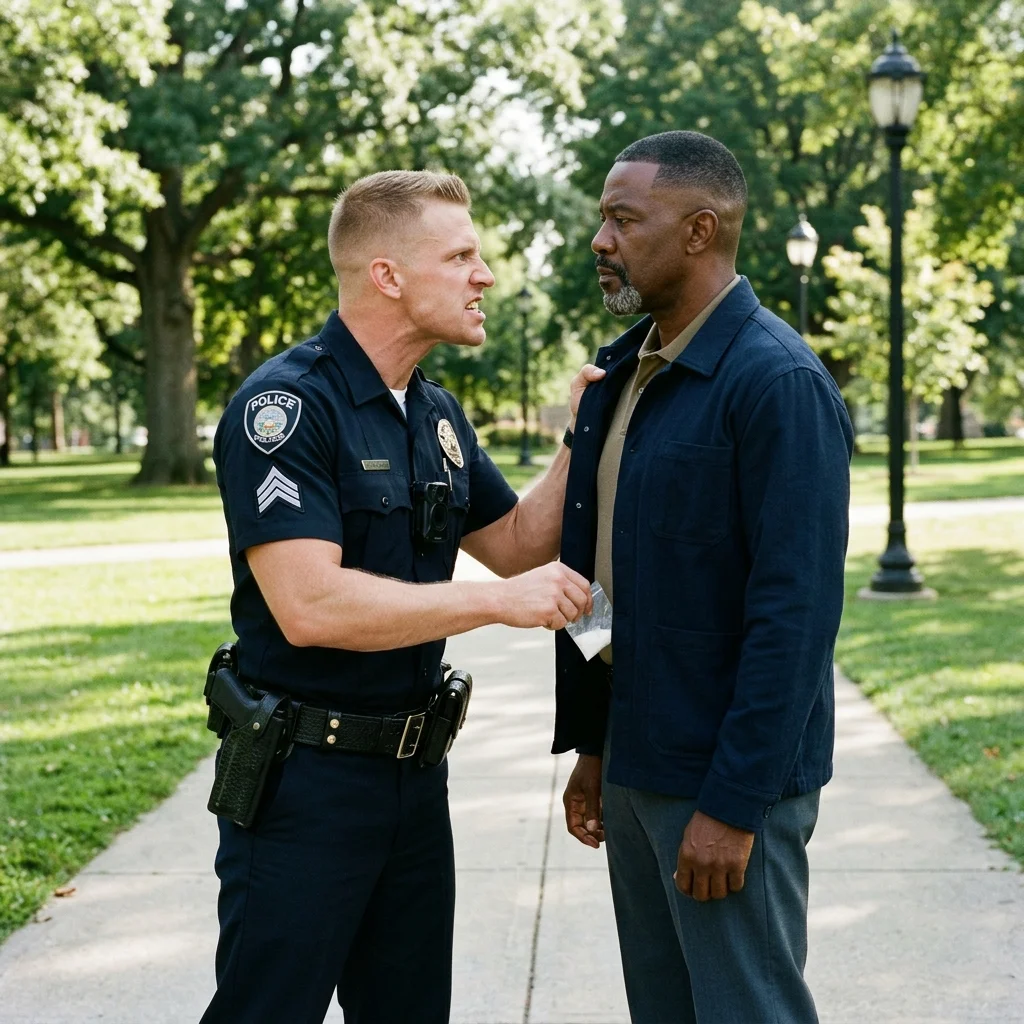
Nearly every case involved a search followed by the sudden discovery of narcotics.
And many involved the same small group of officers.
Daniel Briggs appeared repeatedly.
So did Sergeant Paul Mercer.
And Lieutenant Stephen Cross.
All three had served under Chief Halden.
Marcus reached an entry marked 004.
Darius Bell.
He studied the original paperwork.
The full police designation was District 19, Case 004.
It had nothing to do with the year of the arrest.
The number on the evidence pouch was not merely similar to Darius’s case.
It was identical.
Ruth pointed toward a forensic photograph.
“Look at the seal.”
Marcus examined it.
The same blue diamond appeared near the lower seam.
“They told the court that this evidence was destroyed years ago,” Ruth said.
Marcus nodded slowly.
“Then someone kept it.”
“Why?”
“Because it may have been useful for something other than prosecution.”
Ruth leaned forward.
“Like what?”
“Controlling people.”
He looked at the evidence photograph again.
“Or concealing what was really inside.”
Naomi opened her laptop.
“We’ve been comparing the notebook against court records.”
She turned the screen toward him.
“Forty-three arrests over six years.”
Marcus read the figures.
Twenty-eight guilty pleas.
Nine dismissals.
Four unresolved proceedings.
Two people who had died before their cases were reviewed.
Nearly every defendant had been poor.
Most were Black or Latino.
Several had no criminal history whatsoever.
Many had been stopped for minor alleged violations.
Yet their evidence files contained almost identical language.
“Suspect displayed nervous behavior, leading officer to conduct a lawful search.”
The exact sentence appeared again and again.
Marcus recognized the pattern immediately.
“Template reporting.”
Naomi nodded.
“Mom called them copy-and-paste arrests.”
She opened another document.
“And the arrests generated money.”
Marcus frowned.
“What kind of money?”
“Federal grants, municipal performance bonuses, asset seizures, and contracts for private detention services.”
Ruth spoke bitterly.
“People lost cars, jobs, homes, and years of their lives.”
Marcus studied the financial records.
The numbers were staggering.
The city’s anti-narcotics task force had received millions in funding based partly on reported enforcement activity.
A private technology contractor called CivicShield Solutions provided evidence tracking and automated performance reports.
Marcus noticed the company name.
He had approved a limited pilot program years earlier.
The system was supposed to improve transparency.
Instead, someone appeared to have used it to manufacture official credibility.
Naomi watched his face.
“You recognize the company.”
“Yes.”
“Mom thought you would.”
Marcus closed the laptop.
The shame came slowly.
Not because he had knowingly approved corruption.
But because he had believed safeguards existed without ever asking whether the safeguards themselves could be corrupted.
Ruth reached across the table.
“General, I’m not asking you to punish yourself.”
Marcus looked at her.
“I’m asking you to stop believing that the right people always find out the truth.”
He nodded.
“I hear you.”
She studied him.
“Then prove it.”
That afternoon, Nia met with an independent prosecutor named Elena Cho.
Together, they obtained an emergency preservation order covering the evidence annex, the city’s digital police records, and all communications related to the suspicious arrests.
But when investigators arrived at Annex Four, the security supervisor refused to open the main storage room.
He claimed the electronic access system had failed.
Nia demanded a physical override.
The supervisor hesitated.
Then a second security officer approached carrying a printed notice.
EMERGENCY MATERIAL DISPOSAL — AUTHORIZED BY DIRECTOR MARCUS HALE.
Nia examined the signature.
It was flawless.
Too flawless.
Marcus’s name, title, and authorization code appeared exactly as they would on a legitimate order.
But Marcus had not signed it.
Nia ordered the facility sealed and placed two independent officers at every exit.
As she prepared to leave, her phone vibrated.
A message from an unknown number appeared.
STOP LOOKING AT THE BAGS. LOOK AT WHO BOUGHT THE BUILDING.
Attached was a photograph.
It showed Adrian Voss shaking hands with Chief Halden outside Annex Four.
Beside them stood a third man wearing an expensive gray suit.
Nia enlarged the image.
The third man was Richard Fenwick, founder of CivicShield Solutions.
And according to state business records, Fenwick’s company had purchased the building housing Annex Four through a subsidiary eight months earlier.
Nia’s pulse quickened.
The contractor that managed the evidence software also controlled the property where the original evidence was stored.
She immediately called Marcus.
Before he could answer, another message appeared.
This one contained only six words.
YOUR WIFE FOUND OUT BEFORE YOU.
Nia stared at the screen.
Then the unknown sender sent a final photograph.
It showed Evelyn Hale entering Annex Four eighteen months before her death.
A man was walking beside her.
Nia enlarged the image.
The man was Adrian Voss.
And in his right hand, he carried the same blue notebook Ruth Bell had just given Marcus.
The photograph of Evelyn entering Annex Four changed everything Marcus believed about the last months of his wife’s life.
He sat alone in his study, holding the image Nia had sent him.
Evelyn looked thinner than he remembered.
Her cancer treatments had already begun.
Yet she stood upright, determined, carrying herself with the quiet dignity that had first captured his heart forty years earlier.





