Beside her walked Adrian Voss.
Marcus studied his former friend’s face.
Voss was smiling.
Evelyn was not.
Suddenly, Marcus remembered a conversation from her final winter.
She had been sitting beside their bedroom window, watching snow collect on the garden fence.
“Marcus, do you think good men can help terrible things happen?”
He had answered without much thought.
“Sometimes good people make bad decisions.”
She shook her head.
“That’s not what I mean.”
“What do you mean?”
She turned toward him.
“I mean men who never look closely because looking would cost them something.”
He had assumed she was talking about politics.
Now he understood that she had been asking about him.
And perhaps warning him about Adrian.
Marcus opened Evelyn’s photograph album.
Between two pictures of their anniversary celebration, he discovered a folded note he had never noticed.
It was written in her handwriting.
“If the day comes when your badge and the truth stand on opposite sides, choose the truth.”
Marcus pressed the paper against his forehead.
“I’m trying, Evie.”
His voice cracked.
“I’m finally trying.”
At 8:30 the next morning, Nia received a forensic report from an independent laboratory.
It established that the material planted on Marcus had a chemical profile matching samples associated with several older narcotics investigations.
More importantly, microscopic manufacturing marks linked its pouch to a batch supposedly destroyed three years earlier.
Those pouches had been listed as consumed during evidence testing.
Yet several had reappeared in later arrests.
The same equipment had been used to package evidence in different cases, sometimes years apart.
The records suggested that someone had been recycling confiscated material and repackaging substitutes to manufacture new arrests.
Nia spread the findings across a conference table.
“This was not one dishonest officer carrying a bag in his pocket.”
Prosecutor Elena Cho studied the photographs.
“It was an organized system.”
Nia nodded.
“And somebody designed the records to make that system look legitimate.”
Elena examined the financial records Naomi had supplied.
“Did Marcus authorize the CivicShield software contract?”
“He authorized a small pilot project.”
“Who approved the statewide expansion?”
Nia placed another document on the table.
ADRIAN VOSS — EXECUTIVE AUTHORIZATION.
Elena leaned back.
“So he expanded the system while Marcus believed it was still under evaluation.”
“Exactly.”
“And the software controlled the evidence logs?”
“Yes.”
“Then Voss could create an arrest record, alter its timestamps, attach a photograph, and issue a disposal order without the original file ever reaching an independent reviewer.”
Nia opened a second report.
“That’s what happened to the Darius Bell evidence.”
Elena stared at the screen.
“The evidence was marked destroyed yesterday.”
“Correct.”
“But the original electronic deletion request was prepared six days ago.”
Elena slowly lifted her eyes.
“Before Marcus went to the park.”
Nia nodded.
“Someone was planning to erase Case 19-004 before the confrontation ever happened.”
A knock interrupted them.
Officer Lena Ortiz stood in the doorway.
She looked exhausted.
“May I speak with you?”
Nia motioned her inside.
Ortiz glanced at Elena.
“I think my department has been lying about the dispatch call.”
She placed a small storage device on the table.
“My patrol vehicle maintains a local audio backup.”
Nia frowned.
“The department said all recordings were lost.”
“That’s what our administrator told us.”
Ortiz swallowed.
“But I found the backup drive before they could replace it.”
Elena sat forward.
“What’s on it?”
Ortiz looked down.
“The call that sent us to Bellwether Park.”
Nia connected the device to an isolated computer.
A burst of radio static filled the room.
Then a dispatcher spoke.
“Units Twelve and Fourteen, respond to Bellwether Park.”
A male voice answered.
“Nature of the call?”
The dispatcher replied.
“Suspicious male subject, possibly armed, reportedly attacking an officer.”
Elena frowned.
“That was before Briggs attacked Marcus?”
Ortiz nodded.
“Listen to the timestamp.”
The recording continued.
“Subject described as Black male, approximately sixty years old, charcoal jacket, blue jeans.”
Nia froze.
That was Marcus’s exact description.
Then another voice entered the transmission.
“Approach with caution.”
A pause.
“Subject is believed to be reaching for a concealed firearm.”
Ortiz stopped the playback.
Her hands were shaking.
“I was told there was an armed suspect attacking a police officer.”
Nia checked the time.
3:12 p.m.
Five minutes before Briggs confronted Marcus.
Elena rose slowly.
“Someone issued an emergency dispatch before the supposed emergency occurred.”
Ortiz nodded.
“I almost shot him.”
Her voice broke.
“When I saw Briggs pinned on the ground, I thought the call was accurate.”
She wiped her cheek.
“If General Hale hadn’t stayed calm, I might have killed an innocent man.”
Nia placed a hand on her shoulder.
“You didn’t.”
“But I could have.”
Elena looked toward the screen.
“Who entered the original dispatch request?”
Nia began searching the metadata.
Within minutes, a familiar authorization appeared.
It originated from the state accountability office’s restricted communications gateway.
The user account belonged to Adrian Voss.
The planted drugs had never been the entire plan.
Someone had arranged for two armed officers to arrive expecting a dangerous suspect before Marcus had even been attacked.
The realization made Nia physically cold.
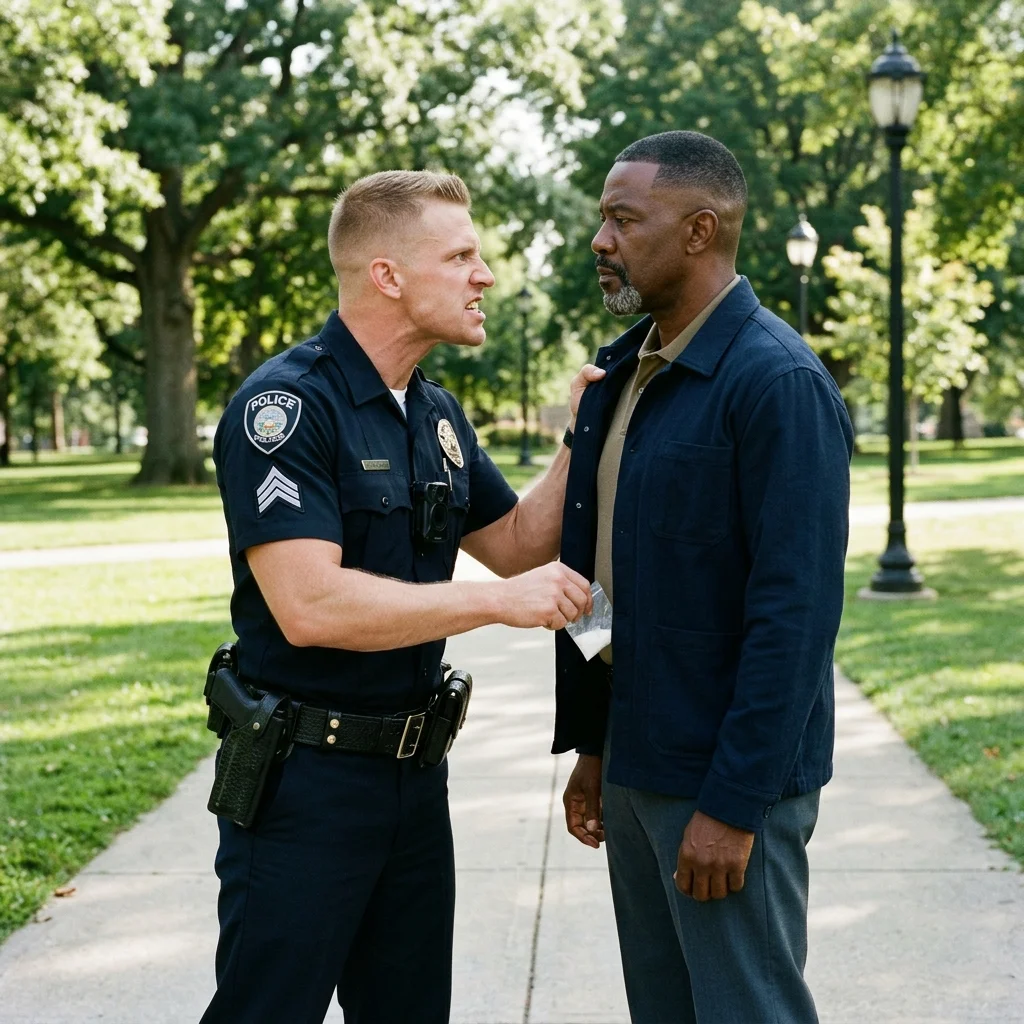
Briggs had been instructed to confront a particular pedestrian.
The responding officers had been instructed to expect a violent criminal.
The cameras had been disabled in advance.
If Marcus had reached suddenly for his badge, if Briggs had grabbed his weapon, or if Ortiz had reacted a fraction too quickly, the incident might have ended with Marcus dead on the grass.
And every official record would have described an armed confrontation.
Elena immediately requested an arrest warrant for Adrian Voss.
But Voss had disappeared.
His office was empty.
His phone was disconnected.
His official vehicle remained in the underground garage.
At 11:45, a message appeared on Marcus’s personal phone.
It came from Voss.
“You should have taken my advice and stayed home.”
Marcus stared at the screen.
Then another message arrived.
“Evelyn understood what was at stake.”
Marcus felt anger rise through him.





