It was an original copy of the software contract.
The agreement required the company to retain immutable off-site transaction logs for financial compliance.
Those records could not be altered through the ordinary police administration system.
Marcus examined the highlighted clause.
“Adrian could rewrite the visible evidence logs.”
Nia finished his thought.
“But he couldn’t rewrite the independent compliance archive without leaving a trace.”
Elena immediately requested an expanded warrant.
Within hours, investigators located the separate backup system at a commercial data center outside the city.
The records were intact.
They revealed years of altered evidence entries, fabricated timestamps, improper disposal authorizations, and suspicious payments linked to enforcement statistics.
They also showed that the credentials assigned to Marcus had repeatedly been used from devices registered to Voss.
The conspiracy began to unravel with astonishing speed.
Chief Halden was detained for questioning and later charged in connection with the evidence manipulation scheme.
Richard Fenwick was arrested after investigators discovered financial records linking his company to the fraudulent reporting.
Several officers cooperated with prosecutors.
Others attempted to deny involvement until confronted with their own electronic records.
And Daniel Briggs finally learned that the men he had served were preparing to blame him for everything.
His attorney approached Elena about a cooperation agreement.
Briggs admitted that officers had been given arrest targets and that some evidence had been planted.
He also admitted receiving instructions to confront an older Black man wearing a charcoal jacket at Bellwether Park.
But he claimed nobody had told him the man’s identity.
“I thought he was just some guy,” Briggs said during his recorded interview.
Elena looked at him.
“Some guy?”
Briggs stared at the table.
“An ordinary person.”
She leaned forward.
“And you believed that made him safe to frame?”
Briggs had no answer.
His cooperation supplied additional evidence, but it did not erase his actions.
He would still face prosecution.
Meanwhile, Adrian Voss remained missing.
For nearly thirty hours, investigators searched transportation records, financial accounts, and known properties.
Then a security alert led them to a small private airfield outside the city.
Voss had attempted to arrange a flight using another man’s identification.
Independent officers surrounded the hangar before he could leave.
When they ordered him to surrender, Voss did not reach for a weapon.
He simply stood beneath the fluorescent lights, staring at the officers approaching him.
For years, he had controlled records that determined whether other people were believed.
Now the records were being used against him.
And this time, the evidence could not be rewritten.
Three months later, the first public accountability hearing began.
The courtroom was filled with reporters, community members, officers, attorneys, and families whose lives had been damaged by the fraudulent arrests.
Marcus entered without his military decorations.
He wore a plain dark suit.
Naomi sat beside Ruth Bell in the front row.
Ivy and Safiya Carter sat behind them.
When Marcus was called to testify, the room fell silent.
The prosecutor asked him to describe the events in Bellwether Park.
He recounted everything.
The deliberate collision.
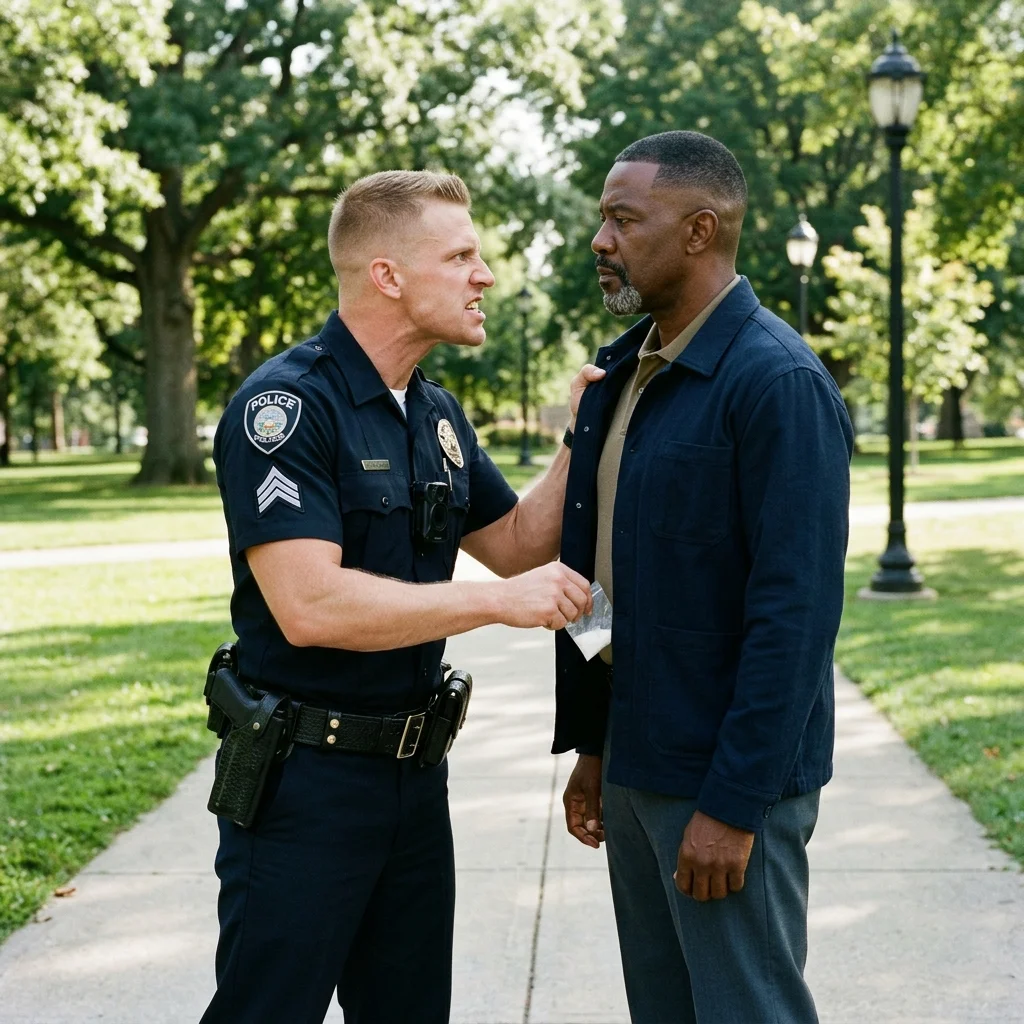
The planted packet.
The punch.
The drawn weapons.
The recognition of his badge.
Then Elena asked a final question.
“Director Hale, what do you believe prevented this incident from ending differently?”
Marcus considered the question.
“My training helped me avoid being struck.”
He paused.
“The responding officers ultimately exercised restraint.”
Then he looked toward Ruth.
“But my official identification changed how I was treated.”
The courtroom became completely still.
Marcus continued.
“I was believed because people recognized my name and position.”
His voice grew heavier.
“Darius Bell had no such protection.”
Ruth covered her mouth.
Marcus looked across the courtroom.
“He told the truth.”
He paused.
“My wife told the truth.”
He looked toward the audience.
“And dozens of other people told the truth.”
His voice rose.
“The tragedy is that we demanded extraordinary proof from ordinary citizens while accepting the unsupported claims of people wearing uniforms.”
The silence deepened.
Marcus lowered his head briefly.
“I was responsible for an office that should have questioned those claims.”
He looked toward Naomi.
“I cannot pretend that responsibility disappears because someone deceived me.”
Then he delivered the sentence that would later appear across newspapers throughout the country.
“Justice is not justice if a person must be powerful before the truth matters.”
Ruth began crying.
Naomi reached for her hand.
Across the room, several people quietly stood.
Others followed.
Within seconds, the courtroom gallery was on its feet.
Not because Marcus had revealed his rank.
Not because he had defeated a corrupt police officer.
But because a powerful man had finally acknowledged the people whose suffering his position had allowed him to overlook.
Over the following months, the criminal cases proceeded through the courts.
Briggs pleaded guilty to serious offenses connected with evidence tampering and assault and received a prison sentence.
Halden and Fenwick faced separate prosecutions supported by financial records, communications, and witness testimony.
Voss’s case involved additional conspiracy charges, including his role in arranging the false emergency dispatch that placed Marcus in danger.
The surviving victims of the fabricated arrests began receiving independent case reviews.
Several convictions were vacated.
Others required further examination.
Civil claims and compensation proceedings followed.
Marcus made certain that the process was not portrayed as one man’s personal victory.
He supported the creation of an independent civilian evidence-review board, outside the chain of command of the departments under investigation.
Witnesses would receive protection.
Evidence audits would be subject to external verification.
Complaints could no longer be quietly closed by the very officials implicated in them.
And Marcus announced that he would retire from his position once the reforms were established.
Some people urged him to remain.
Others praised him as a hero.
He declined the description.
“I’ve already worn enough titles,” he told a reporter.
“What I want now is to do something useful with the time I have left.”
But the greatest moment of his life came nine months after the confrontation in Bellwether Park.





