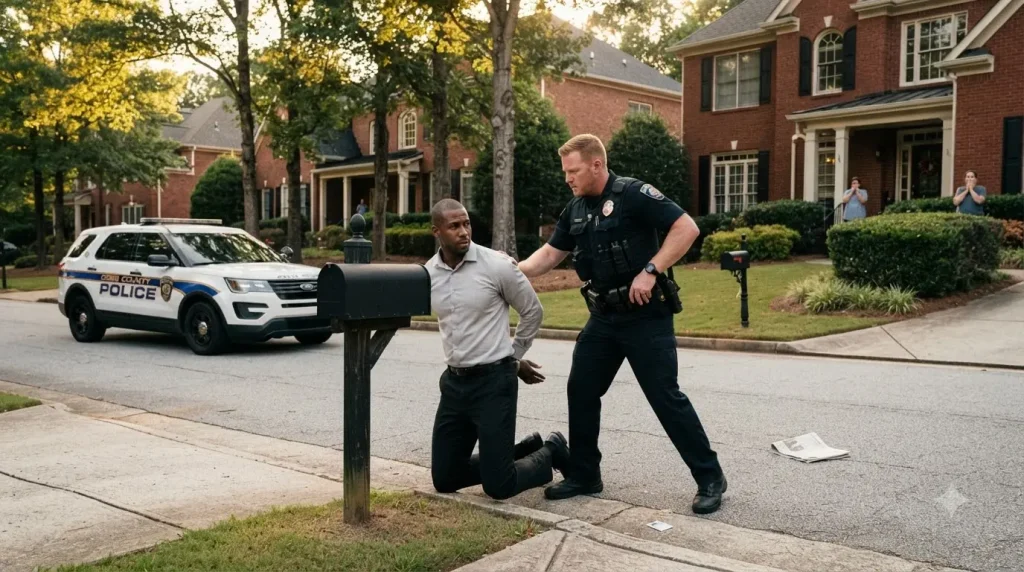
“So explain why the homeowner was on his knees.”
The officer opened his mouth.
Nothing came out.
One of the deputy chiefs stepped off the porch.
“Body camera?”
“Active.”
“From first contact?”
“Yes.”
“Good.”
The homeowner rubbed his wrists.
The senior officers behind him had become completely silent.
Nobody seemed eager to return to the workshop.
There was no need.
The workshop had walked into the driveway.
The Police Chief looked at the homeowner.
“You hurt?”
“Shoulder’s sore.”
“Need medical?”
“Not right now.”
The Chief nodded but did not look satisfied.
He turned toward the younger officer, who had returned from the cruiser.
“Registration?”
The young officer held the printout on the mobile screen.
“Registered to him. Same address.”
The first officer looked away.
The Chief asked, “Dispatch call?”
The younger officer checked his handheld device.
“Suspicious-person complaint.”
“Description?”
He scrolled.
His forehead tightened.
“That’s strange.”
The Chief looked at him.
“What?”
The young officer did not answer immediately.
He read again.
The homeowner watched.
Something about the young officer’s face shifted from discomfort to confusion.
Then concern.
The Police Chief extended his hand.
“Give me the call.”
The younger officer passed him the device.
The Chief read.
His eyes narrowed.
Then he looked at the homeowner.
“Marcus.”
Something in his voice changed.
The homeowner stopped rubbing his wrist.
“What?”
“The caller didn’t describe an unknown person.”
The homeowner felt the first real chill of the afternoon.
“What did they say?”
The Chief scrolled.
“They gave your name.”
The homeowner stared.
Behind him, a deputy chief quietly said, “What?”
The Chief continued reading.
The dispatch note identified:
Marcus Reed. Male. Black. Approx. forty. Reportedly attempting unauthorized access at residence. Caller states subject does not reside there.
The homeowner’s stomach tightened.
A stranger could mistake him.
A new neighbor might not know him.
But whoever called knew his name.
The Police Chief looked toward the patrol officer.
The officer’s expression had changed again.
Too quickly.
The homeowner saw it.
So did the younger officer.
The Chief scrolled farther.
A technical field opened beneath the call.
Callback number.
Device identifier.
Routing source.
The Chief stopped.
His thumb remained on the screen.
For several seconds, nobody spoke.
The younger officer leaned closer.
He read the line.
Then looked directly at his partner.
Not at the homeowner.
At his partner.
The Police Chief raised his eyes.
“Whose department phone is ending in four-eight-two-one?”
The patrol officer did not answer.
The Chief looked at the younger officer.
The younger officer swallowed.
“His.”
Everybody turned.
The homeowner stared at the first officer.
The officer’s face had lost almost all color.
The Police Chief held the screen up.
“The call came from your department-issued phone.”
The officer immediately shook his head.
“No.”
The Chief did not raise his voice.
“That’s what this says.”
“No, sir.”
“Is four-eight-two-one your number?”
The officer hesitated.
“Yes, but I didn’t make that call.”
The homeowner’s pulse changed.
The encounter suddenly became something else entirely.
Not misunderstanding.
Not a bad description.
Not merely bias acting through suspicion.
Somebody had used the officer’s own phone to create the call that put him in the homeowner’s driveway.
The Chief asked, “Where is the phone?”
The officer touched the front of his vest.
Then stopped.
The Chief noticed.
“Do not touch it.”
A deputy chief stepped forward.
The officer looked offended.
“You think I called myself?”
The homeowner answered before anyone else could.
“Nobody said that.”
The officer turned.
“You stay out of this.”
The Chief’s head snapped toward him.
“Do not speak to him like that again.”
The officer shut his mouth.
The homeowner watched him.
That reaction was revealing.
Even now.
Even surrounded by command staff.
Even after the call metadata appeared.
The officer’s first instinct was still to control the Black homeowner.
One of the training supervisors quietly said, “We need to preserve the device.”
The Chief nodded.
Then he looked at the patrol officer.
“Hand your department phone to the Deputy Chief.”
The officer’s jaw worked.
“This is ridiculous.”
“Phone.”
“I didn’t make the call.”
“Then preservation protects you too.”
The officer stared.
The logic was impossible to fight without sounding worse.
He removed the phone slowly.
The Deputy Chief placed it immediately into an evidence pouch.
The homeowner looked toward his house.
A workshop binder sat abandoned on the porch chair.
He could read the subtitle from the driveway.
How assumptions narrow options before evidence is complete.
He felt suddenly tired.
The Police Chief approached him.
“I am sorry.”
The homeowner looked at him.
The apology was sincere.
He knew that.
It also was not enough.
Not because the Chief had caused the detention.
Because apologies arrived quickly while answers did not.
“Don’t apologize yet.”
The Chief looked surprised.
“Why?”
“Because we don’t know what happened.”
The homeowner nodded toward the patrol officer.
“And because if he staged the call, this is bigger than the stop.”
The Chief’s expression hardened.
The patrol officer laughed nervously.
“You’re seriously taking his theory?”
The homeowner looked at him.
“I didn’t give a theory.”
“You implied—”
“I said we don’t know.”
The officer stopped.
The homeowner continued.
“That’s the difference.”
Several commanders looked down.
They all heard the lesson.
No slides required.
The homeowner looked at the Police Chief.
“Preserve dispatch audio.”
“Already being done.”
“Cruiser GPS.”
“Yes.”
“Bodycam metadata, not just video.”
The Chief nodded.
“Call logs.”
“Yes.”
“Any database searches of my name or address before the dispatch event.”
A Deputy Chief immediately took out his phone.
“I’ll have Professional Standards lock it.”
The first patrol officer’s eyes moved toward him.
Tiny movement.
The homeowner saw.
Again.
Something.
The Chief saw it too.
“Why did you react to that?”
“I didn’t.”
“You did.”
The patrol officer shook his head.
“This is turning into a witch hunt.”
The homeowner said nothing.
The Chief asked, “Did you search his name before today?”
“No.”
“Ever?”
“No.”
“Did you know who lived here?”
“No.”
“Did you know a command workshop was being held here?”
“No.”





