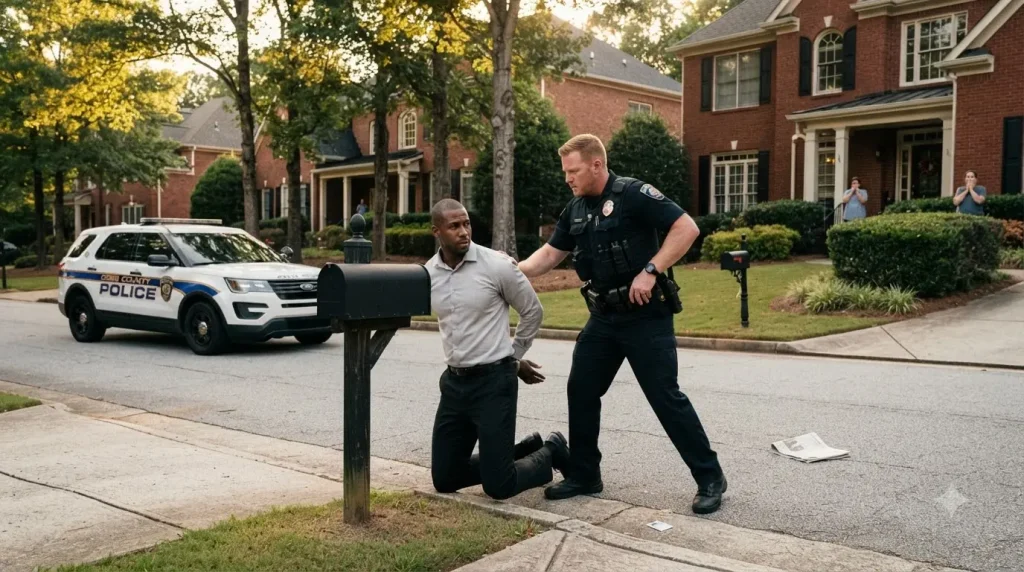
“He answered every question you asked.”
The investigator turned a page in the folder.
“He offered three separate methods of verification.”
The officer looked down at the scratched surface of the interview table.
“He gave me attitude.”
The investigator did not write that down.
He simply stared.
Behind the two-way glass, Marcus watched the man’s posture.
The officer was named Garrett Cole.
Thirty-four years old.
Nine years on the force.
Two minor department reprimands for discourtesy, but otherwise a record that commanders had called solid.
A solid officer who had decided that a Black consultant lecturing leadership on constitutional limits was an intolerable personal insult.
The investigator pressed the intercom button to pause the recording.
Inside the observation room, the Police Chief did not look at Marcus.
His eyes remained fixed on Cole through the tinted pane.
“He thought he was proving you were soft,” the Chief said in a low voice.
“No,” Marcus answered quietly.
“He thought he was proving that out on the asphalt, policy doesn’t exist unless he decides to grant it.”
Marcus leaned his good shoulder against the wall.
“He wanted to put me on my knees, take my identification, and let me go with a verbal warning.”
“Then he could go back to his chat room and brag about how the civil-rights expert did exactly what he was told when a real badge showed up.”
The Chief closed his eyes.
“We found three other calls from his sector over the last eighteen months.”
Marcus turned his head.
“Staged?”
“Unverified,” the Chief corrected.
“Anonymous reports of suspicious men walking through upscale subdivisions.”
“All three stops involved professional Black or Hispanic men.”
“None of them resulted in arrests.”
“All of them were logged as field interviews.”
“And all three had CAD callback numbers that routed through VoIP burner applications.”
Marcus let out a slow, controlled breath.
“He wasn’t improvising on my driveway.”
“He had a template.”
The Chief tapped on the glass with the knuckle of his index finger.
“He perfected it because nobody ever checked the routing data on a call that ended without an arrest.”
“Why would they?”
Marcus straightened his posture, ignoring the dull, persistent throbbing in his right deltoid.
“A clean field interview looks like proactive policing on a quarterly dashboard.”
“Nobody audits the origin of a call when the citizen just walks away humiliated and grateful they weren’t shot.”
The door to the observation room opened.
Deputy Chief Sarah Alvarez entered, carrying a thick legal dossier.
She set it on the laminate counter between them.
“The younger officer, Miller, just signed his supplemental statement,” she said.
Marcus looked at the cover sheet.
“What did he say about the driveway?”
“Everything,” Alvarez replied.
“He said Cole told him over the radio to stay back and observe how to handle an argumentative subject.”
“Miller admitted he knew the license was valid the moment he looked at it.”
“He admitted he stayed quiet because Cole was his senior training partner and had threatened his probationary review two months ago.”
Marcus nodded once.
He remembered the look in the younger officer’s eyes as the metal clicked around his wrists.
The paralysis of a rookie realizing his mentor was committing a crime, but lacking the structural courage to intervene.
“What happens to Miller?” Marcus asked.
The Chief turned from the glass.
“Department policy mandates immediate termination for failing to intervene during unlawful force.”
“Wait,” Marcus said.
The Chief frowned.
“You’re defending him?”
“I’m looking at the systemic failure,” Marcus said.
“If you fire Miller today, the message to every junior officer on this force is simple: stay silent, get fired; speak up, get fired anyway.”
“Miller didn’t make the call.”
“Miller didn’t shove me.”
“And Miller was the one who pulled up the CAD terminal and handed you the dispatch notes before Cole could wipe the log.”
Alvarez leaned against the counter, crossing her arms.
“He still watched you go down on your knees, Marcus.”
“I know what he watched,” Marcus said, his voice dropping into that calm, surgical register he had used in federal depositions.
“And he will carry that memory for the rest of his career.”
“Suspend him for thirty days without pay.”
“Require sixty hours of remedial Fourth Amendment instruction.”
“And make him stand in front of the next three recruit classes to explain the exact mechanics of his own cowardice.”
The Chief looked at Alvarez, then back at Marcus.
“You’re asking for restorative accountability in an administrative system designed for binary disposal.”
Marcus almost smiled.
“I’m asking you to run a police department instead of a public-relations firm.”
The Chief exhaled heavily and picked up the dossier.
“Consider it done.”
He turned toward the door, then stopped with his hand on the brass handle.
“The District Attorney is in Room 204.”
“She wants to know if you intend to press state charges under felony official oppression.”
Marcus looked back through the one-way glass at Officer Garrett Cole.
Cole was staring at his own handcuffed hands, his mouth set in a thin, bitter line.
“Yes,” Marcus said.
The word was quiet, absolute, and entirely devoid of anger.
“Every single charge the statute allows.”
“Because if we only prosecute the officers who pull the trigger, we tell the rest of them that casual degradation is free.”
The Chief nodded once, opened the door, and walked down the brightly lit corridor.
Two weeks later, the morning air was crisp and cool.
Marcus stood on his front porch on Briarwood Court, holding a fresh mug of black coffee in his left hand.
His right arm had regained its full range of motion, though a faint yellow bruise still lingered near the collarbone.
Down by the curb, a fresh newspaper sat inside the black metal mailbox.
The door had not been damaged.
The brick post stood straight and unyielding against the rising Georgia sun.
Across the street, Mrs. Gable was watering her rosebushes.
She saw him, paused the hose, and offered a small, tentative wave.





