The answers came faster now.
Too fast.
The homeowner had conducted enough interviews to know speed did not equal deception.
But speed could reveal preparation.
The Chief looked toward a Deputy Chief.
“Separate them.”
The first officer stiffened.
“Sir?”
“You and your partner are not discussing this incident until statements are taken.”
The younger officer nodded immediately.
The first did not.
The Chief continued.
“You are both relieved from field duty pending preliminary review.”
“Both?”
The younger officer looked startled.
The Chief said, “That protects the process.”
The young officer nodded.
“Understood.”
The first officer looked furious.
“This is because commanders happened to be inside?”
The homeowner answered quietly.
“No.”
Everybody looked at him.
He continued.
“This is because of what you did before anybody came outside.”
The officer stared.
The homeowner looked toward the neighbors holding phones.
“If that door never opened, the facts wouldn’t change.”
That sentence settled over the driveway.
The Police Chief lowered his eyes briefly.
Because that was the uncomfortable truth.
The homeowner’s credibility had exploded upward only after authority appeared behind him.
Twelve commanders.
White shirt.
Silver insignia.
Institutional witnesses.
But the license had already matched.
The vehicle already matched.
The home already belonged to him.
Nothing factual became more true when the Chief walked outside.
Only more believable to the officer.
That was exactly the problem.
A paramedic unit arrived twenty minutes later.
The homeowner tried to refuse.
The Chief insisted.
His shoulder was bruised, not seriously injured.
His wrists had superficial compression marks.
No hospital needed.
While paramedics examined him on the porch, Professional Standards investigators arrived.
The workshop attendees remained.
Nobody left.
Nobody seemed sure whether remaining was respectful or voyeuristic.
The homeowner eventually looked at them.
“We’re not holding the session today.”
One commander nodded.
“Of course.”
Another said, “Whatever you need.”
The homeowner almost smiled.
The phrase irritated him, though he knew it was meant kindly.
What he needed was thirty minutes earlier.
He needed one officer to believe a matching license.
He needed a younger officer to say “stop” before command staff appeared.
He needed the patrol officer not to decide what he looked like before checking what the evidence said.
He needed dispatch not to have been manipulated.
He needed ordinary procedure.
Not sympathy afterward.
He stood.
His shoulder protested.
The Police Chief approached.
“I’ll make sure everyone clears out.”
The homeowner shook his head.
“Give me fifteen minutes.”
“For what?”
“I want to talk to the commanders.”
The Chief frowned.
“You don’t owe anybody training today.”
“I know.”
The homeowner looked toward the living room.
“This isn’t training.”
Fifteen minutes later, twelve senior law-enforcement leaders sat in the same chairs they had occupied before hearing raised voices outside.
Nobody touched the pastries.
Coffee had gone cold.
The homeowner stood at the front of the room without his laptop.
His rolled sleeve revealed a red cuff mark.
The original presentation remained displayed on the easel.
WHEN ASSUMPTION BECOMES ACTION
He looked at the room.
Nobody spoke.
Finally, one Deputy Chief said, “You should be resting.”
The homeowner nodded.
“Probably.”
Then:
“But before everybody leaves, I want one question answered.”
The Police Chief sat in the front row.
The homeowner looked around.
“When did that officer lose the benefit of the doubt?”
No one answered.
He continued.
“When you saw the cuffs?”
Silence.
“When you saw me on my knees?”
Silence.
“When you learned the license matched?”
A training supervisor shifted.
The homeowner asked:
“Or only when you recognized me?”
That landed.
Several commanders looked away.
The homeowner did not let them.
“The officer had information before you opened the door.”
He gestured toward the driveway.
“He had my license.”
“Address.”
“Vehicle.”
“My calm explanation.”
“He had a partner recommending verification.”
The homeowner paused.
“What changed when you came outside?”
A commander answered reluctantly.
“Your credibility.”
The homeowner nodded.
“Exactly.”
The room became quieter.
“My credibility did not change.”
He looked at them.
“Your perception of it did.”
Nobody argued.
That was the real workshop.
Not because the homeowner planned it.
Because reality had stripped away the comfortable distance of hypothetical scenarios.
The homeowner continued.
“And then we learned something else.”
The department phone.
The manufactured call.
“If the call was staged, we have deliberate misconduct.”
He held up one hand.
“But do not use that possibility to make the earlier decisions easier to explain away.”
Several people looked confused.
He clarified.
“Even if the original call were legitimate, the stop still went wrong.”
The matching identification existed.
The vehicle could be checked.
The homeowner was not fleeing.
Not threatening.
Not entering through a broken window.
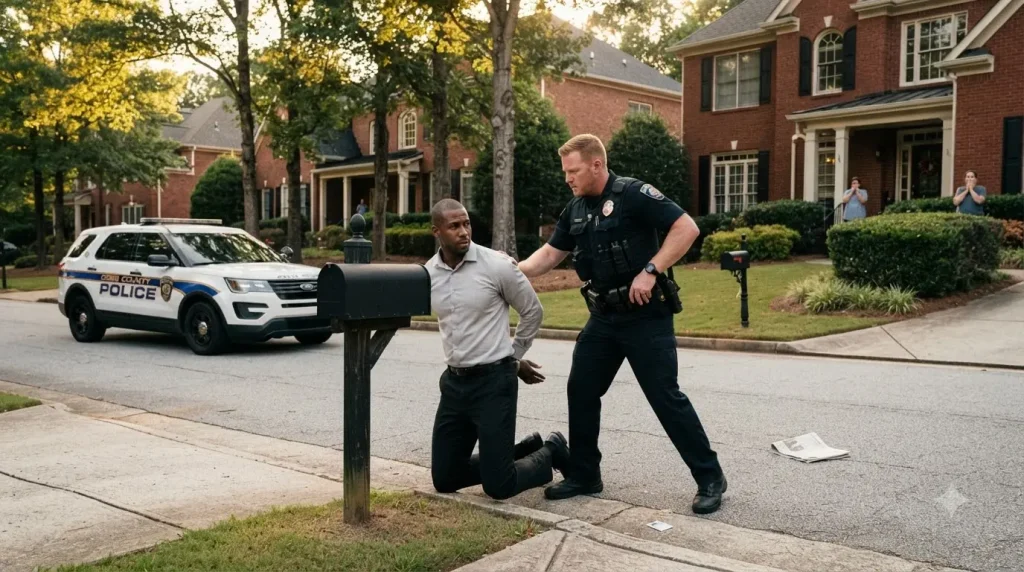
He was standing beside his mailbox holding a newspaper.
The homeowner looked toward the Police Chief.
“The staged call may explain why the officer arrived.”
Then toward the rest.
“It does not excuse what he chose after he arrived.”
The Police Chief nodded slowly.
The homeowner sat.
His shoulder hurt too much to keep standing.
“That’s all.”
No applause.
Thank God.
The commanders left one by one.
Several shook his hand.
He accepted but did not encourage conversation.
The younger patrol officer remained outside with Professional Standards.
The first officer had been transported separately to headquarters.
The homeowner watched the last command vehicle disappear.
His neighborhood became quiet again.
Then the elderly white woman from across the street approached.
She had lived opposite him for four years.
They exchanged Christmas cookies.
She complained about squirrels.
He fixed her porch light once.
She held her phone.
“I recorded it.”
“I saw.”
Her face looked troubled.
“I should have come over sooner.”
The homeowner leaned against his porch column.
“Why didn’t you?”
She looked ashamed.
“I didn’t know what would happen.”
He nodded.
Fair answer.
Not satisfying.
Honest.
She continued.
“When he said you didn’t belong here…”
Her eyes filled.
“I wanted to say something.”
“But you didn’t.”
“No.”
He did not absolve her.
She did not ask him to.
That made the conversation easier.
She handed him the phone.





