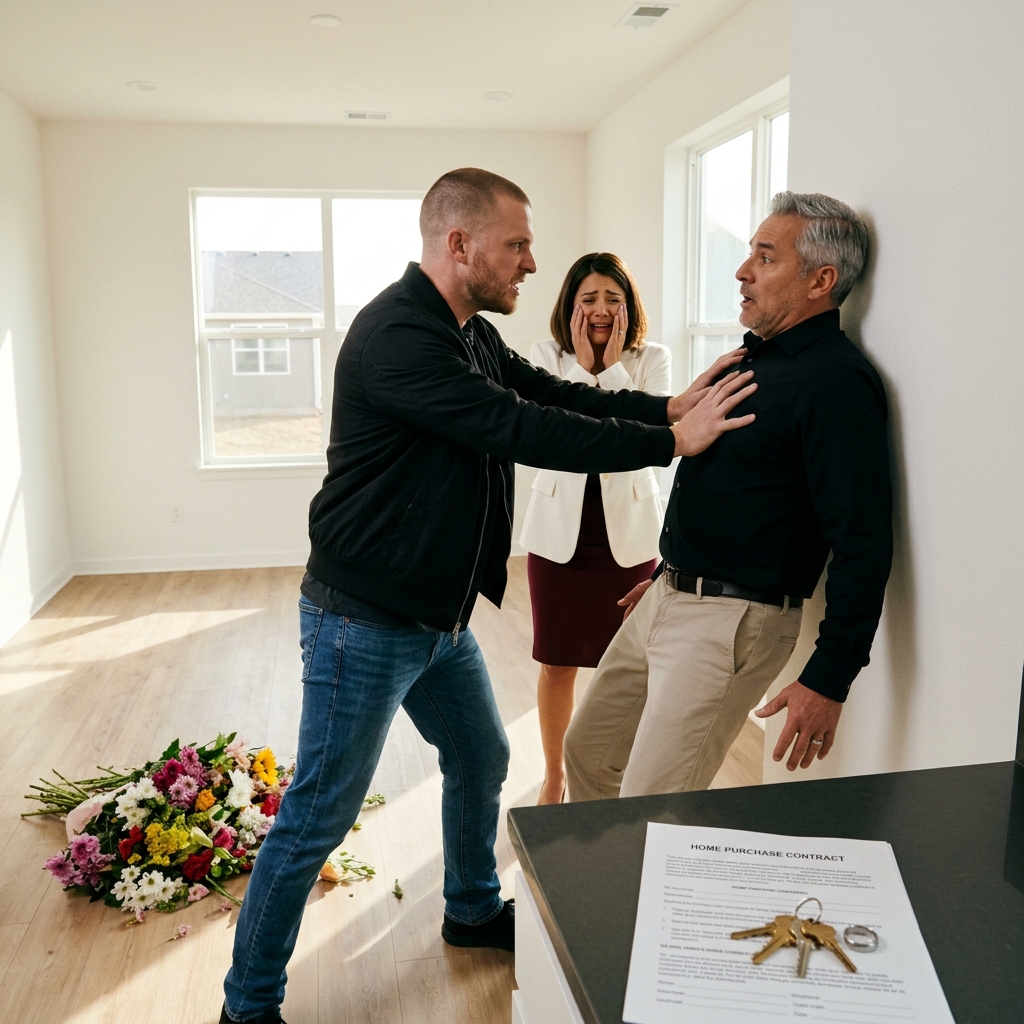
“Darien, please,” she said without looking at him. “Go into the library for a minute. Let me talk to him.”
“No,” Darien said. He didn’t move. He stood with his back to the great wall of glass, looking at Silvan with the cool, analytical scrutiny of an appraiser evaluating salvage. “We have the mobile notary arriving in twenty minutes, Amaranta. If there’s an issue with the prior tenant or the clearing of the personal effects, it needs to be settled now. The title insurance doesn’t cover third-party occupancy after five o’clock.”
Silvan felt a strange, cold vibration in his molars.
“Prior tenant?” Silvan asked.
He walked around the bluestone island. On the surface of the stone, held down against the draft by an empty tumblers of single malt, lay an accordion file of legal bond paper, bound with blue ribbon and stamped with the raised seal of the Berkshire County Registry of Deeds.
Beside the file lay an open document—thirty pages, heavy twenty-four-pound rag vellum, its edges crisp and unread except for the yellow signature flags protruding from the margins.
Silvan reached out. His fingers were stiff with cold, the dirt from the North Adams road still dark in the grain of his skin.
“Don’t touch that,” Amaranta said, her voice finally snapping, rising into that thin, frantic register he had heard only when the banks had called about the shop’s second mortgage. “Silvan, don’t. Just listen to me. Sit down and let me explain how this has to work.”
Silvan didn’t sit. He lifted the heavy paper weight—a solid bronze surveyor’s plumb bob that he had found in his father’s tool chest—and laid it aside. He turned the vellum page.
The header was printed in 12-point Caslon type:
PURCHASE AND SALE AGREEMENT: SPECIAL WARRANTY CONVEYANCE
PARCEL 14-B, HOOSAC RIDGEWAY, COMMONWEALTH OF MASSACHUSETTS
His eyes moved down the recitals. He didn’t read the metes and bounds; he knew every stone wall, every rotten red oak stump, every iron surveyor’s pin on the forty-two acres because he had walked them in snowshoes with a surveyor’s tape while she was in Boston attending “planning commissions.”
He reached the section labeled GRANTEES:
DARIEN V. STERLING, as Sole Managing Member of Hoosac Foothills Holdings, LLC, as to a sixty percent (60%) undivided interest;
and
AMARANTA VANCE, an unmarried woman, as to a forty percent (40%) undivided interest, as Tenants in Common with Right of Survivorship.
The paper did not shake in his hands. His hands were large, thick-wristed, and completely steady.
He read the words three times.
An unmarried woman.
Darien V. Sterling.
Silvan looked up from the page. He knew the name now. He had seen it on the site signs along Route 7—the high-density luxury condominiums outside Lenox, the boutique hotel conversions in Stockbridge with the minimalist black-steel fences and the imported hornbeam hedges. Sterling Development Partners.
“An unmarried woman,” Silvan said. The phrase was flat. He turned his head toward Amaranta. “We were married in the chapel at Mount Greylock eight years ago in June. Your brother gave you a silver butter dish that we sold to pay for the foundation footings on this wing.”
Amaranta closed her eyes. Her shoulders rose, held the breath, and then released it with a slow, shivering hiss. When she opened them, the pale, translucent green was gone, replaced by the gray, hard surface of an iron plate.
“The shop was insolvent, Silvan,” she said. She spoke quickly now, the arguments rolling out with the smooth, frictionless velocity of a brief that had been drafted, revised, and memorized over months of hotel-room evenings. “The IRS liens from your father’s estate were attached to your name, not mine. If we closed on this property with you on the deed, the federal tax board would have filed an automatic encumbrance within seventy-two hours. We would have lost the equity before the dry-in inspection was even certified.”
“The liens were cleared,” Silvan said quietly. “I cleared them on Tuesday. I gave the collector the proceeds from the scrap auction. Every penny of the brass inventory. Every lathe.”
“You cleared the state tax, Silvan!” she flared, stepping toward the counter, her hands coming down on the blue bond paper with a sharp, flat slap. “The federal interest is still accruing at nine percent! You don’t understand the filings! You never understood them! You think you can build a life out of two-by-fours and sweat, and you don’t even know what a mezzanine loan is!”
“I built this,” Silvan said. He looked around the room—at the tongue-and-groove ceiling, the electrical panels he had wired with copper he had pulled from his father’s scrap bins, the wide bluestone floor that didn’t have a single eighth-inch variance from the threshold to the hearth. “I lived here for four months on canned beans, Amaranta. I slept on canvas.”
“And you were paid for it,” Darien said.
The voice was cool, smooth, and utterly matter-of-fact.
Silvan turned his head toward the developer.
Darien had stepped away from the window. He stood five feet from the island, his arms crossed over his cashmere-clad chest, his head tilted with the mild, clinical curiosity of a surgeon examining an unusual cyst.
“What did you say?” Silvan asked.
“I said you were paid,” Darien replied evenly. “Hoosac Holdings disbursed forty-four thousand dollars into the joint operating account between June and September for site remediation, labor, and materials. We have every invoice. Every delivery of insulation, every yard of aggregate. Amaranta submitted the draw requests every second Friday.”
Darien looked at Amaranta, his eyes narrowing slightly with the first hint of genuine coldness.
“You told me he had already executed the quitclaim, Amaranta,” Darien said. “You told me the divorce had cleared the Berkshire Probate court in August. You said the property settlement had been signed and that he was finishing the punch-list work under an independent contracting agreement to work off his tax arrears.”





