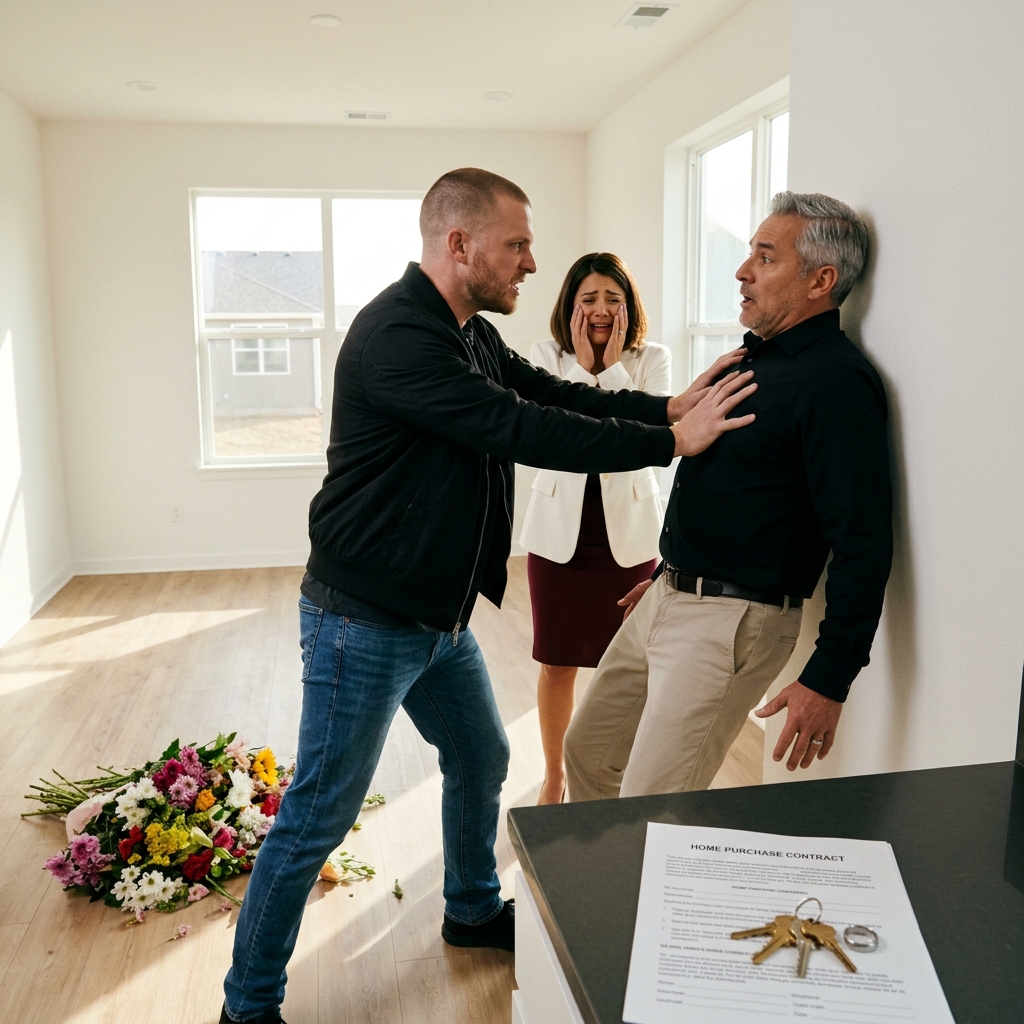
Silvan felt something inside his chest go dead and cold, like a pilot light blowing out in a winter gale.
He looked at his wife.
Amaranta did not look at him. She was staring at the bronze plumb bob on the counter, her teeth digging into the soft tissue of her bottom lip until a pinprick of dark crimson broke through the chapped skin.
“Amaranta?” Silvan whispered.
The lie was so total, so beautifully and symmetrically constructed, that it had the terrible majesty of a suspension bridge.
She had used him as the laborer. She had used his back, his trade license, his father’s remaining credit lines with the building-supply yards in North Adams, his sleepless nights in the dust and cold to double the value of a derelict parcel that Darien Sterling had acquired out of foreclosure. She had turned an unsellable, code-violating architectural ruin into a five-hundred-thousand-dollar asset—while telling the developer that her rustic, slightly pathetic ex-husband was happy to work off his marital debts for day wages, and telling her husband that they were building their fortress against the world.
“You said he signed,” Darien repeated, his voice dropping into a harsh, metallic rasp. He uncrossed his arms. For the first time, a flicker of genuine apprehension crossed his face—not of Silvan, but of the title, the covenants, the messy, litigious reality of an unrecorded spouse standing inside forty-two acres of unencumbered Massachusetts land. “Amaranta, if this deed is tainted by an undissolved tenancy by the entirety, the construction loan doesn’t fund on Tuesday. We’re in default with the Boston syndicate.”
“He will sign,” Amaranta whispered.
She looked up at Silvan then.
It was the look he had seen on her face only once before—when their seven-year-old border collie had been struck by a log truck on Route 2 and lay thrashing in the clover, its spine broken, and she had stood on the shoulder of the road telling him to use the tire iron because they couldn’t afford the veterinary surgeon in Pittsfield.
“You will sign, Silvan,” she said. Her voice was steady now, drained of all panic, cold and flat as a slate shingle. “Because if you don’t, I will file for an emergency partition sale in the morning. The court will order the property auctioned on the courthouse steps. It won’t bring half what Darien’s company is paying for it. The banks will take their primary lien, the IRS will seize the balance of the proceeds, and you will walk away from this mountain with twenty-four thousand dollars in debt and nowhere to sleep.”
She reached across the bluestone, her fingers touching the vellum agreement.
“Sign the quitclaim rider,” she said. “Darien will write you a check for thirty thousand dollars from the holding company account. Right now. You take your truck. You take your father’s tools from the shed. You go back to Cambridge, or down to Connecticut, and you start over. You’re good with your hands, Silvan. You’ll always find work.”
You’re good with your hands.
Silvan looked down at his palms. The calluses were thick, yellowed, cracked with winter dry. The right thumb still bore the blue-black stain beneath the nail where he had dropped an iron rafter bracket three weeks ago while framing the bedroom skylight—the skylight she had insisted on so she could watch the stars over the ridge from their pillow.
He looked at Darien Sterling.
The developer was watching him with an expression that had shifted from disdain to an ugly, transactional patience. He had already reached into the pocket of his vest, his gold-nibbed Montblanc pen held between two fingers like an executive thermometer.
“Thirty-five,” Darien said smoothly. “I’ll make it thirty-five thousand, Vance. Certified funds. I can have my courier bring the cashier’s check from the Pittsfield branch first thing tomorrow. You leave the keys on the counter, take the Volvo, and we forget the trespass.”
We forget the trespass.
A gust of wind caught the side of the house. The hemlocks on the ridge hissed, their dark boughs thrashing against the gray wool of the sky. The glass did not rattle; Silvan had set the structural stops with three-inch lag bolts into solid white oak. It was solid. It was the strongest thing within twenty miles.
Silvan reached into his pocket.
His fingers closed around the cold, unfinished brass key from Miller’s Hardware. He drew it out and laid it on the bluestone counter. It made a small, dull clink beside the three dozen pale roses.
Then, with his left hand, he touched the third finger of his right hand.
The gold band was old, thin, slightly out of round. It had belonged to his grandfather, who had worn it while turning brass valves for Liberty ships in the Boston Navy Yard during the war. It was scratched, the polish long since worn away by grease, sandpaper, and limestone grit.
It came off his knuckle with a dry, dragging resistance.
He held the small ring between his thumb and forefinger.
Amaranta watched him, her eyes widening slightly, her mouth tightening into a thin, defensive wire. She thought this was the theater. She thought this was the melodramatic flourish of a wounded commoner—the brokenhearted peasant returning the token before slinking away down the gravel road with his tools in a cardboard box.
Silvan laid the gold band down on the contract.
He placed it precisely over the word GRANTEES. It circled the name AMARANTA VANCE, framing the black Caslon ink like a tiny, round target.
“You’re wrong about the probate, Amaranta,” Silvan said.
The silence returned to the room, heavier than the fog against the glass.
Amaranta’s throat clicked as she swallowed. “What are you talking about?”





