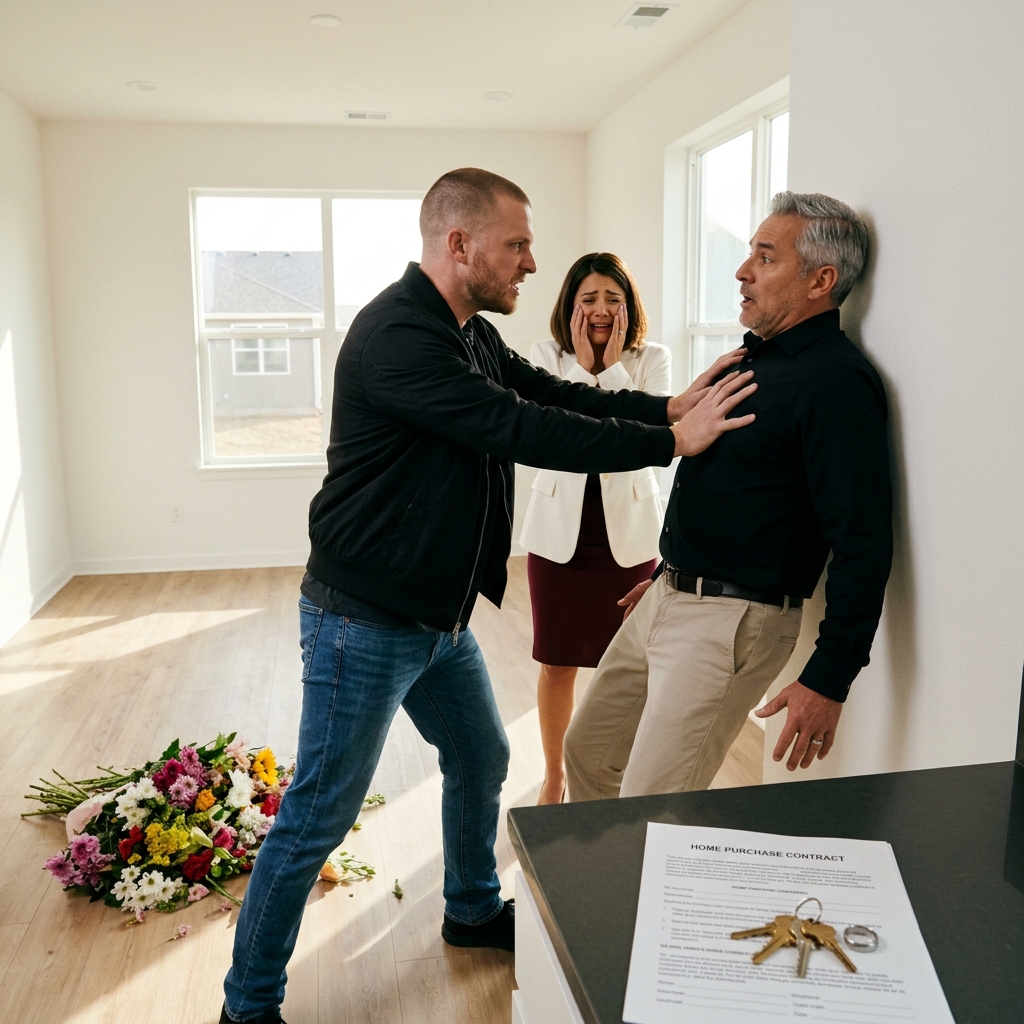
Silvan reached into the breast pocket of his canvas coat—not the deep tool pockets where he kept the chalk and the drywall screws, but the interior zipped pocket against his ribs. He pulled out a folded slip of blue carbon paper, its edges soft from three days of dampness, stamped with the raised violet ink-pad of the Berkshire County Registry.
He didn’t hand it to her. He unfolded it, smoothed the creases with his callused thumb, and laid it beside the roses.
“I didn’t go to Pittsfield to clear the liens,” Silvan said.
Darien leaned forward, his hazel eyes darting to the blue carbon. “What is that?”
“The deed to Parcel 14-B was never in the estate’s name,” Silvan said. His voice was quiet, rhythmic, completely empty of rage. It sounded like an instructor reading a shop manual to a class of boys who were about to fail. “The bank that foreclosed on the Breuer house didn’t hold the fee-simple title. They held the tax-lien certificate from 1994. My father bought the underlying underlying warrant from the town of Adams when the machine shop was still solvent. In eighty-six.”
Amaranta’s face lost the last trace of its color. She looked at the blue paper.
“No,” she said. Her voice was a dry croak. “The search—the title search through Commonwealth Land Title was clear. We had the preliminary binder issued in July.”
“You had a binder on the improvements,” Silvan said. “On the structure. Because the assessor’s office entered the parcel under the wrong map coordinate when they re-indexed the county records after the reservoir was built. My father never recorded the assignment because he didn’t want the town reassessing his machinery yards. He kept the original parchment in the green tin under his drill-press bed.”
He looked at Darien Sterling.
“The title search you paid for was run on an abandoned parcel number, Mr. Sterling. The true deed was recorded on Wednesday afternoon at two-fifteen. In my name alone. As sole heir to the Vance Iron Works.”
Darien’s hand, still holding the gold Montblanc pen, dropped slowly to his side. The hazel eyes went wide, fixed on the blue carbon seal. He was a developer; he knew the language of the Registry of Deeds better than he knew the scriptures. He knew what a wild deed was. He knew what happened to an LLC that spent half a million dollars pouring footings and framing glass on land that belonged to a machinist’s son with a recorded title and an unencumbered chain.
“You knew,” Amaranta whispered. Her voice was no longer that of a consultant. It was the raw, shrill screech of an animal whose foot had just been crushed in an iron pan. “You knew for months.”
“I knew on Tuesday,” Silvan said. “When the clerk called me to verify the signature on my father’s 1986 conveyance.”
He looked at her—really looked at her—for the last time. He saw the camel-hair sweater, the small pale hands that had never turned a screw, the cold, calculating intelligence that had been so clever it had outsmarted its own survey pins.
“I spent three days deciding what to do,” Silvan said. “I thought maybe you were just scared. I thought maybe the debt had frightened you so badly that you had lost your mind. I bought the wine, Amaranta. I bought the roses from Mrs. Hallowell. I was going to walk through that door, give you the deed, and tell you that nobody could ever take this house from us. That the mountain was ours.”
He looked at the open P&S agreement on the counter, with its sixty percent and its forty percent, its tenants-in-common, its clean, elegant liquidation of an inconvenient life.
“We didn’t close on the mortgage, Amaranta,” Silvan said.
He picked up the three dozen cabbage roses.
He didn’t throw them. He walked over to the wood-burning stove in the corner—an antique Jotul he had spent four days restoring, its black iron cold and clean, waiting for the first fire of the winter. He opened the heavy iron latch, thrust the damp, fragrant bundle of roses into the dark ash-bed, and shut the door with a dull, iron clang.
He turned back to the room.
“We closed on our marriage yesterday,” he said.
He looked at Darien Sterling.
“You have twenty minutes to remove your car from my driveway,” Silvan told him. “The gate at the bottom of the lane is cedar, and I haven’t hung the counterweights yet. If it’s still blocking the turn when the town plows come through at dusk, they’ll push it into the ditch.”
Darien didn’t argue. He didn’t look at Amaranta. He shoved the Montblanc pen back into his pocket, turned on the heel of his English boots, and walked toward the vestibule, his coat swinging from his arm. The outer door opened, the cold fog rolled in across the floorboards, and the door clicked shut behind him.
Amaranta stood alone by the island.
The silence in the room was vast, wider than the valley, deeper than the forty-two acres of hemlock and stone. Outside, the fog began to darken into the slate-colored blue of a Berkshire twilight.
“Silvan,” she choked, taking a step toward him, her hands rising, palms open, trembling. “Silvan, please… what am I supposed to do?”
Silvan picked up his keys from the counter—not the single brass Yale blank, but the heavy steel ring with his father’s shop keys, the backhoe ignition, and the padlock to the front gate.
He walked past her without touching her sleeve. He didn’t look down at the gold ring circling her name on the vellum.
“You’re a consultant, Amaranta,” he said from the threshold of the darkening hall. “Consult your files.”
The heavy fir door closed behind him, its deadbolt sliding into the frame with the dry, final snap of iron meeting oak, leaving the house to the dark, the cold, and the silence of the mountain.





