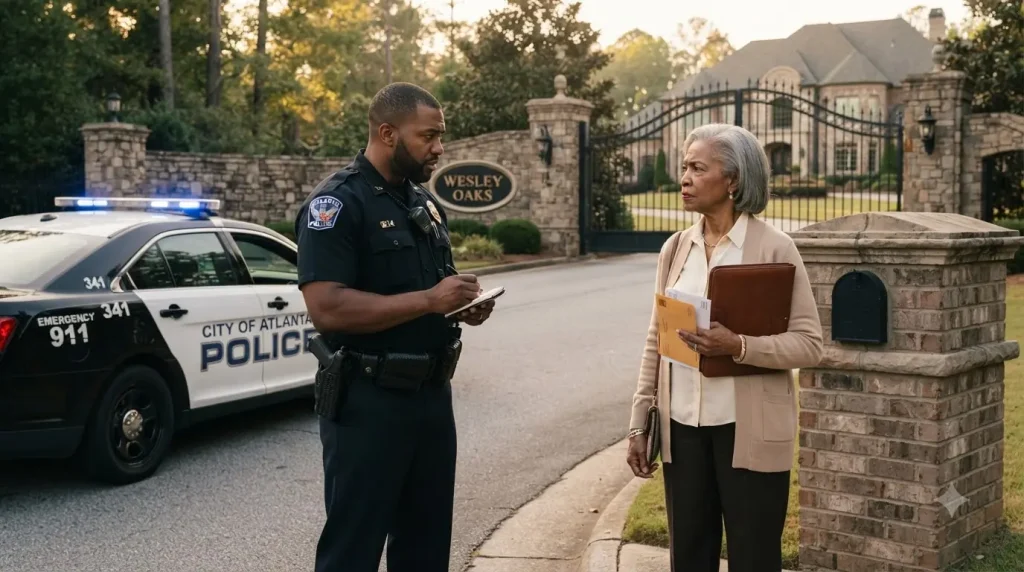
“You told me to think carefully about the next ten seconds.”
Evelyn stared.
“That occurred after you took my folder.”
“Yes.”
“So prior to physical contact?”
“No threat?”
“No.”
Rachel folded her arms.
“Did her name return on any query?”
“I hadn’t run it yet.”
“Why not?”
Darius looked down.
“I was trying to get identification.”
Evelyn said:
“That is the question.”
He looked up.
“You had my name.”
“My date of birth.”
“Three independent verification options.”
“And access to dispatch.”
“Why did you decide obtaining a physical card from my hand mattered more than verifying the information?”
Darius did not answer.
Evelyn waited.
Eventually:
“Because people lie.”
“Everyone?”
“No.”
“Who specifically did you think was lying?”
“You.”
“Why?”
Darius’s jaw tightened.
The room became still.
There it was.
The central question.
Not policy.
Not tactics.
Judgment.
Why her?
Darius finally said:
“The situation didn’t make sense.”
“What did not make sense?”
He looked toward the dining room.
The expensive house.
Artwork.
Crystal chandelier.
Everything he had seen outside compressed into one assumption.
“You didn’t look like somebody who lived here.”
The room went silent.
Chief Wallace closed his eyes.
Rachel stared at the officer.
Evelyn remained calm.
“What does somebody who lives here look like?”
Darius immediately understood the trap.
“I didn’t mean race.”
“I did not say race.”
“I know.”
“Then answer.”
He looked uncomfortable.
“Clothing.”
“Context.”
“You were walking.”
“You didn’t have a car outside.”
Evelyn nodded.
“Go on.”
“You were modestly dressed.”
“Older.”
He stopped.
Evelyn said, “Black?”
His face tightened.
“I wasn’t going to say that.”
“Was it part of your assessment?”
Darius looked directly at her.
Maybe something in him decided the truth could no longer make things worse.
“Yes.”
Chief Wallace shifted.
Rachel looked away.
Evelyn nodded once.
“Thank you.”
Darius seemed surprised.
“For what?”
“Answering honestly.”
She set down the ice pack.
“Now we can discuss the actual problem.”
Chief Wallace spoke.
“Judge, we should probably have Internal Affairs—”
“No.”
Everyone looked at her.
“Internal Affairs can begin separately.”
“This meeting concerns systems.”
She pointed toward Darius.
“He did not invent the assumptions he used.”
“That does not excuse him.”
Darius looked down.
“But if we reduce this to one bad officer, the department will congratulate itself for removing the problem while leaving every condition that produced it intact.”
Rachel nodded slightly.
Evelyn continued.
“A caller says suspicious Black woman in an affluent neighborhood.”
“Dispatch transmits the suspicion without emphasizing contradictory information.”
“The officer arrives.”
“The officer sees a person who does not match his mental model of ownership.”
“Every answer she gives is interpreted as further evidence of deception.”
“She asks questions.”
“That becomes obstruction.”
“She protects confidential documents.”
“That becomes resistance.”
“She warns him.”
“That becomes threat.”
She looked around the table.
“Where exactly does the problem begin?”
Nobody answered.
“That’s what we’re here to determine.”
The compliance analyst’s laptop chimed.
Everyone looked.
She read the update.
Then went still.
“What?”
Rachel asked.
The analyst turned the screen.
“The call originated from an internet-based number.”
“Registered through a prepaid service.”
“Account created yesterday.”
Evelyn said:
“Email?”
“Fake.”
“Payment?”
The analyst hesitated.
“Corporate card.”
Chief Wallace leaned forward.
“Whose?”
The analyst zoomed.
Nobody spoke.
The billing address belonged to Bellwood Police Department headquarters.
Darius whispered:
“What?”
Chief Wallace stood.
“That can’t be right.”
Rachel stepped closer.
The analyst refreshed.
Same result.
Corporate procurement card.
Assigned to the Office of Professional Standards.
The room changed.
Professional Standards was the very bureau responsible for implementing much of the consent decree.
Evelyn looked at Wallace.
“Who controls that card?”
The chief answered slowly.
“Deputy Chief Raymond Hale’s administrative office.”
Every face turned toward the far end of the table.
Deputy Chief Raymond Hale sat motionless.
He had arrived early.
Shaken Evelyn’s hand.
Accepted coffee.
Spent forty minutes before the incident discussing accountability metrics.
Now his face looked almost gray.
Evelyn stared.
“Deputy Chief?”
Hale’s mouth opened.
Then closed.
Chief Wallace said:
“Raymond.”
Hale stood.
“This is absurd.”
Rachel moved between him and the door.
Not physically blocking.
Just present.
Hale looked offended.
“You think I made the call?”
Evelyn said:
“I think your office paid for the number.”
“That doesn’t mean anything.”
“Then help us understand.”
Hale pointed toward the analyst.
“Those cards are used by staff.”
“Several people.”
“Purchasing.”
“Subscriptions.”
“Training accounts.”
Rachel asked:
“Who knew this meeting was happening?”
Hale hesitated.
“All command staff.”
“No.”
Evelyn corrected.
“Location.”
The chief looked toward her.
She continued.
“Who knew we were meeting at my residence rather than federal court?”
The room became silent.
Chief Wallace answered:
“Five people.”
He looked around.
“Myself.”
“Deputy Chief Greene.”
“Hale.”
“The U.S. Attorney.”
“And my executive assistant.”
Evelyn nodded.
“Officer Monroe was dispatched at three forty-two.”
“Meeting began at four.”
“Caller used my name.”
“Caller knew the address.”
“Caller apparently used a department payment method.”
She looked at Hale.
“Did you know I planned to raise the unreported-stop audit today?”
His face changed.
Barely.
Enough.
Rachel saw it.
So did Evelyn.
Chief Wallace slowly sat.
“What audit?”
Evelyn looked toward Hale.
“Perhaps he can explain.”
Hale’s composure broke.
“I don’t know what she’s talking about.”
Evelyn opened the folder Darius had seized.
From the middle, she removed a chart.
“Over eighteen months, Bellwood officers conducted seven hundred forty-one pedestrian or vehicle stops that generated no citation, arrest, field interview card, or warning record.”
The chief stared.
“That isn’t possible.”
“It is.”
Evelyn slid another page forward.
“Body-camera metadata indicates the encounters occurred.”
“CAD location data indicates officers were present.”
“But reports do not exist.”
Hale sat slowly.
Evelyn continued.
“A disproportionate number took place in three affluent neighborhoods.”
“A disproportionate number involved Black residents, workers, or visitors.”
Darius looked sick now.
He understood.
His stop of Evelyn was not a strange accident occurring beside an investigation.
It resembled the exact pattern under investigation.
Evelyn looked at Hale.
“I informed you yesterday that we would discuss this.”
Hale said:
“And you think I sent an officer to arrest you?”





