Together devastating.
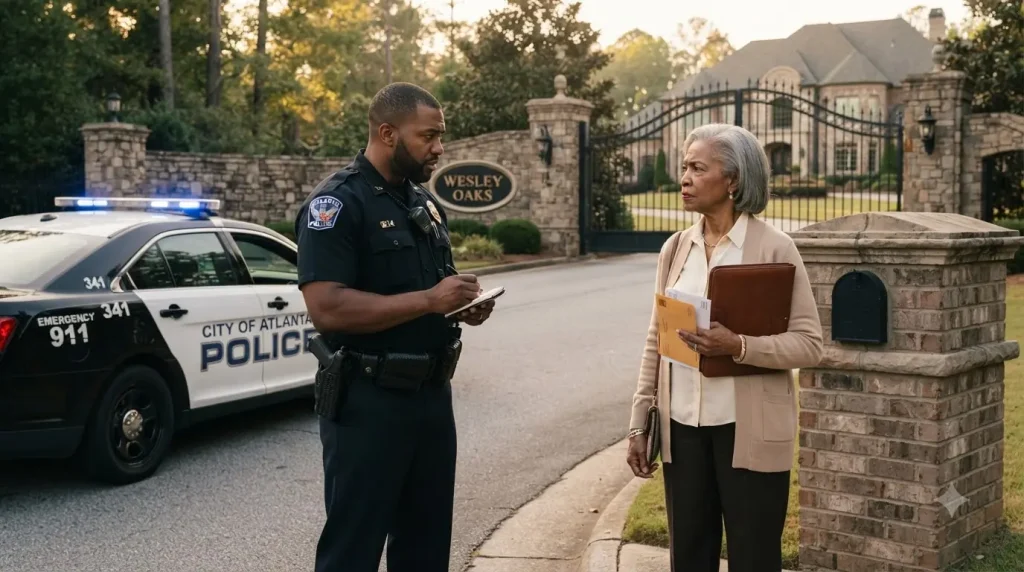
Evelyn’s home had been the latest target.
Hale knew she possessed the unreported-stop analysis.
He knew the meeting location.
Investigators recovered deleted messages from his phone.
One read:
Let’s see how objective she remains after she gets treated like everybody else.
Another:
Send a unit that won’t overthink it.
Darius’s name appeared in the response.
Evelyn read that sentence three times.
Send a unit that won’t overthink it.
Darius had been selected.
Not randomly.
Hale knew his record.
Complaints existed.
None sustained.
Several involved people who allegedly became “argumentative” during identification disputes.
One involved a delivery driver.
Another a Black college student visiting his parents.
Another involved a middle-aged Latina nurse who had been parked near an elementary school while waiting for her daughter’s practice to end.
In every single instance, Darius Monroe had insisted on an immediate physical driver’s license before verifying any narrative.
In every case, the citizen’s natural objection had been recorded in the subsequent narrative as escalating obstinance.
Hale had not needed to draft a criminal conspiracy with twenty moving parts to derail Evelyn Carter’s compliance review.
He had merely needed to aim a loaded officer at her front lawn like a guided munition.
He knew Darius’s reflexes better than Darius knew them himself.
The calculation was as cynical as it was precise.
If Evelyn cooperated meekly, she would be rattled and delayed, losing the psychological upper hand before the meeting began.
If she stood on her constitutional rights, Darius would inevitably clamp steel ratchets around her thin wrists.
Once a senior federal judge had been processed for obstruction, her objectivity would be formally tainted by active personal litigation.
Hale could file an immediate motion for her recusal as special master, freezing the impending audit for eighteen months while an appellate panel sorted through the administrative debris.
It was an ambush constructed entirely out of ordinary police discretion.
That evening, Rachel Brooks sat in the regional FBI field office in downtown Atlanta, staring at an expansive white marker board covered in connected names.
Beside her, Special Agent Marcus Vance leaned against the conference table with his arms folded across a dark tactical vest.
“The burner phone used to place the 911 call pinged a tower less than two miles from the country club where Hale had lunch that day,” Vance said.
He held up a forensic data sheet printed directly from the state’s digital telecommunications extraction lab.
“The voice modulation app he used leaves a proprietary digital watermarking artifact in the raw packet metadata.”
“We ran it through the national acoustic database an hour ago,” Vance continued, tapping the top margin of the printout.
“The underlying vocal footprint is an eighty-nine percent match to Raymond Hale’s command press conference from last November.”
Rachel adjusted her reading glasses and took a slow sip of lukewarm cafeteria coffee.
“An eighty-nine percent match isn’t a silver bullet in front of a jury, Marcus.”
“It doesn’t have to be,” Vance replied, tossing a slim silver USB flash drive onto the wooden table between them.
“Because his assistant broke completely forty minutes ago under formal proffer.”
The assistant, a thirty-one-year-old civilian named Clara Simmons, had spent three hours weeping inside an interview room before signing an immunity agreement.
She had not merely executed Hale’s verbal instructions regarding the corporate credit card.
Terrified that she was being groomed as an institutional fall guy, Clara had quietly recorded eleven voice memos on her personal Apple Watch over the preceding four months.
In the recording from Wednesday afternoon, Hale’s distinctive drawl came through with terrifying, unvarnished clarity.
“Buy the burner credentials through the virtual card, Clara.”
“Use the residence address on Briarwood, and make sure dispatch routes it to Monroe’s sector queue.”
“Darius won’t ask questions; he treats every person on the street like a potential violator until he sees plastic in his hand.”
“By the time Wallace figures out why she’s sitting in a squad car, that entire unreported-stop dossier will be tainted by an active arrest report.”
Rachel listened to the playback three times without blinking.
Her hands remained flat on the edge of the mahogany table.
“Title 18, United States Code, Section 241,” Rachel whispered into the quiet room.
“Conspiracy against civil rights under color of law.”
“And Section 1512,” Vance added smoothly.
“Tampering with a federal judicial officer and witness retaliation.”
By eight o’clock the following morning, the tactical reality in Bellwood shifted from administrative review to an active federal sweep.
A magistrate judge signed four search warrants covering Hale’s personal home, his lake house in Hall County, his administrative suite, and his private vehicle.
Chief Adrian Wallace did not wait for the morning press briefing to take executive action.
He summoned Deputy Chief Hale into his corner office at seven-thirty sharp.
When Hale walked into the room, he was wearing his pristine dark uniform, his brass insignia polished to a high mirror shine.
He expected another tedious procedural dispute over internal auditing timelines.
Instead, he found Chief Wallace standing behind the massive wooden desk beside two deputy United States marshals.
Rachel Brooks sat in the leather armchair near the window with a thick grand jury indictment folder resting across her knees.
Hale’s eyes flicked to the marshals, his jaw tightening into a sharp, defiant line.
“Adrian, what the hell is this?” Hale demanded.
Chief Wallace did not offer him a seat.
He did not raise his voice.
The disappointment in Wallace’s eyes was far colder than rage.
“You don’t wear that badge in my building anymore, Raymond,” Wallace said.
“Place your service weapon on the desk.”
Hale took an involuntary half-step backward toward the closed door.
“You’re letting a federal monitor and an aggressive U.S. Attorney orchestrate an internal coup because an officer made an aggressive stop?”
“Don’t insult my intelligence,” Wallace interrupted.
His voice cut across the room like a steel ruler.
“We have Clara’s recordings.”
“We have the voice modulator’s audio fingerprint.”
“We have the corporate card billing logs from your terminal.”
Hale’s skin paled to the color of wet river clay.
The arrogant posture he had carried for thirty-two years in law enforcement collapsed within the space of three heartbeats.
His right hand drifted instinctively toward his holster before one of the marshals stepped forward and caught him firmly by the wrist.
Not violently.
Just enough mass and leverage to end the performance.
“Unsnap the holster, Deputy Chief,” the marshal said quietly.
Hale’s fingers trembled as he released the thumb-break mechanism.
He slid the Glock 17 free, emptied the chamber with a hollow metallic click, and set the black weapon down on Wallace’s green leather desk blotter.





