“I think somebody attempted to create disruption.”
“Maybe intimidation.”
“Maybe evidence that I was difficult or confrontational.”
Rachel’s eyes narrowed.
“Or maybe somebody wanted her removed from this meeting long enough to access the documents.”
Everyone looked at the folder.
Darius whispered:
“I put it on the cruiser.”
Evelyn turned toward him.
“Yes.”
For the first time, the officer looked genuinely frightened.
“Someone could’ve taken it.”
“Exactly.”
Hale stood again.
“This is conspiracy nonsense.”
He moved toward the door.
Chief Wallace said:
“Sit down.”
Hale stopped.
The tone was different now.
Not colleague.
Chief.
Hale turned.
“You can’t detain me based on a billing record.”
“No.”
Rachel said.
“But we can preserve your devices based on federal oversight authority and probable evidence concerns while investigators verify the account.”
Hale laughed.
“You’re threatening me inside a private house?”
Evelyn’s eyes hardened.
“Interesting choice of words.”
He looked at her.
She continued.
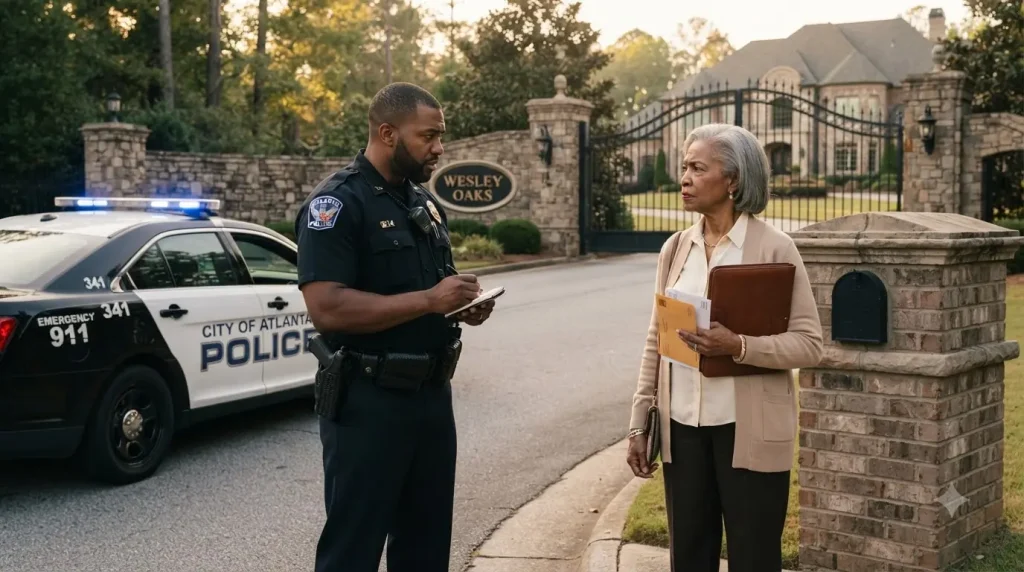
“Officer Monroe asked me for identification at my own mailbox.”
“I asked for verification.”
“I offered several methods.”
“He chose control.”
“Now you are being asked to remain while lawful verification occurs.”
“You immediately call it a threat.”
Hale said nothing.
Evelyn looked toward Darius.
“Officer.”
He looked up.
“Do you see the difference?”
He nodded slowly.
“Yes.”
For the first time that afternoon, Evelyn believed him.
Federal investigators arrived within the hour.
Hale surrendered his department phone and laptop after counsel was contacted.
Nobody arrested him.
Not yet.
Evelyn insisted on precision.
Suspicion was not proof.
Ironically, the lesson of her driveway encounter now protected the man who might have engineered it.
Verification before assumption.
Evidence before accusation.
The same rule had to apply when emotionally inconvenient.
Darius remained.
Internal Affairs arrived too.
The investigator asked whether Evelyn wanted to file a complaint.
She said:
“Yes.”
Darius looked at her.
No surprise.
No resentment.
Just resignation.
She added:
“And I want Officer Monroe’s body-camera file duplicated before anyone reviews it internally.”
The chief nodded.
“Federal copy.”
“City copy.”
“Independent monitor copy.”
“Three chains.”
Darius asked quietly:
“Judge?”
She looked at him.
“I’m sorry.”
The room went still.
Evelyn studied his face.
“Which part?”
He hesitated.
“All of it.”
“That’s broad.”
“I assumed you were lying.”
“I assumed you didn’t belong.”
“I didn’t check.”
“I put my hands on you.”
“I wrote the situation in my head before anything happened.”
Evelyn said nothing.
He continued.
“When Chief Wallace came outside…”
He looked embarrassed.
“That was when I got scared.”
“Not when you realized you hadn’t verified.”
“Not when I cuffed someone who hadn’t threatened me.”
“When I realized who you were.”
Evelyn nodded.
“That bothers you?”
“Yes.”
“Good.”
Darius looked confused.
She continued.
“Discomfort is useful when it remains attached to the right lesson.”
He swallowed.
“I don’t expect you to forgive me.”
“Excellent.”
His eyebrows rose.
She almost smiled.
“Forgiveness is not a substitute for accountability.”
“I know.”
“You may know eventually.”
“But knowing begins with what happens after today.”
Darius nodded.
Internal Affairs escorted him out.
Not handcuffed.
Evelyn watched.
Some part of her wondered how different the scene would have looked if she were simply Evelyn Carter, retired schoolteacher.
No judge.
No federal title.
No police chief inside.
Would anyone have opened the front door?
Would she have gone to jail?
Would Darius’s report have described her refusal to identify herself, her “aggressive” questioning, her attempt to “retrieve documents,” and her “physical resistance”?
Would body-camera footage have been reviewed carefully?
Would the neighbor who called have mattered?
Or would the narrative have hardened before morning?
That question mattered more than her bruised wrist.
The department announced Darius’s suspension the next day.
Evelyn disliked the press statement immediately.
It described an “isolated incident.”
She called Chief Wallace.
“Change it.”
There was silence.
“Judge?”
“You have no evidence it is isolated.”
“We need language that doesn’t prejudge the investigation.”
“Then say exactly that.”
“What do you suggest?”
Evelyn dictated:
The encounter raises serious questions regarding verification practices, discretionary stops, supervisory culture, and compliance with existing reforms. The department will investigate both the individual conduct and the systems surrounding it.
Wallace sighed.
“That sounds worse.”
“It is worse.”
He used the language.
The story spread nationally anyway.
Not because Evelyn wanted it.
Because a neighbor’s phone had captured part of the arrest from across the street.
The video showed an elderly Black woman in a beige cardigan being cuffed beside a mansion.
Then the chief emerging.
Then the cuffs coming off.
Social media supplied its own mythology within hours.
Some posts claimed Evelyn owned the police department.
False.
Others claimed she was Supreme Court justice.
False.
One said she had personally fired the officer on the spot.
Also false.
Evelyn refused television interviews.
Rachel Brooks advised one short written statement.
Evelyn wrote:
The central issue is not whether a federal judge should have been treated differently. The issue is whether any resident should be required to possess status before basic facts are verified and basic dignity is respected.
That line became the headline everywhere.
She hated that too.
Good statements often became slogans divorced from the work required to honor them.
The real work happened quietly.
Audits.
Metadata.
Dispatch reviews.
Interviews.
Personnel records.
Procurement accounts.
Body cameras.
Unreported stops.
And Hale.
The corporate card did lead back to his office.
But not directly to him.
His executive assistant had purchased the prepaid service.
Investigators initially believed she made the call.
She denied it.
Then offered something far more important.
Hale had instructed her to create several anonymous online accounts over the previous year.
He claimed they were for covert integrity testing.
No written authorization existed.
The accounts had been used to submit complaints against officers considered disloyal.
Anonymous neighborhood reports.
Internal tips.
Social-media messages.
Hale had weaponized the department’s own reporting systems.
Why?
Control.
Officers who challenged questionable stops received complaints.
Supervisors who pushed back on numbers found themselves investigated.
Residents who filed misconduct complaints sometimes became subjects of anonymous calls themselves.
The pattern was subtle.
Never enough alone.





