He had never been perfect.
That mattered.
Helen refused to rewrite him after death.
Evan skipped class occasionally.
He received two speeding tickets.
At seventeen, he came home drunk once after a party and vomited in the hydrangeas while Thomas stood behind him saying, “Enjoy this because tomorrow you’re digging up every plant you ruined.”
Evan did.
He replanted all six.
Then complained about it for three years.
He had also never been arrested.
Never sold drugs.
Never used anything stronger than marijuana a handful of times in high school, a fact Helen learned only after his attorney asked her directly.
Then came April 17.
A Thursday.
Evan left Brennan’s Auto Recovery at 10:12 p.m.
He drove six miles.
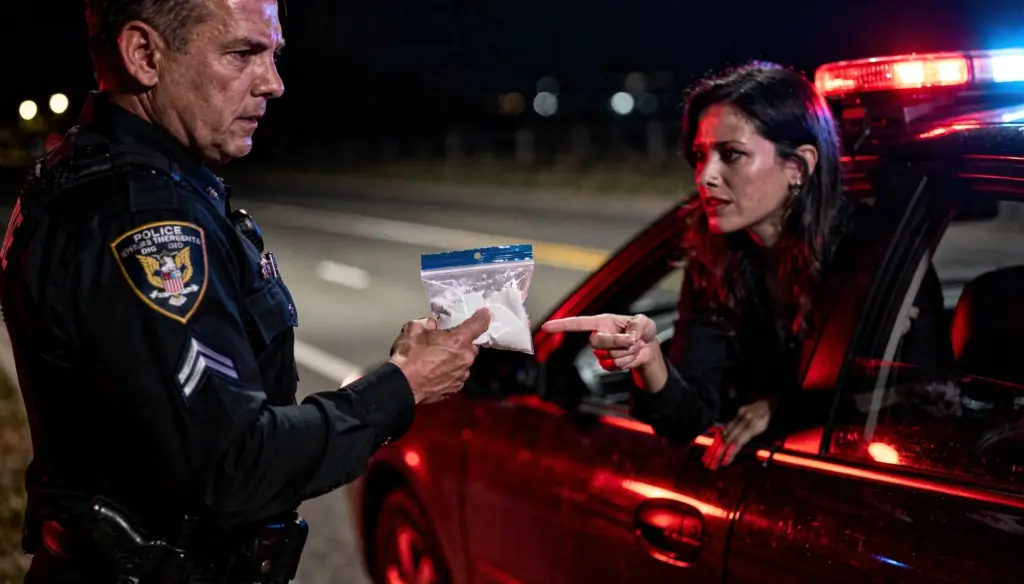
Detective Daniel Rourke and Officer Mason Pike stopped him near Beaumont Avenue.
The stated reason was a damaged license-plate light.
Body-camera footage did not exist then.
The dash camera recorded only part of the stop.
Daniel asked Evan to step out.
Evan did.
Pike searched the vehicle after claiming he smelled marijuana.
Under the driver’s seat, Pike found a clear plastic bag containing nearly eight ounces of cocaine.
The bag had a blue seal across the top.
That was unusual.
Street narcotics did not normally arrive presealed in police evidence tape.
The prosecution explained it simply.
Someone had reused an old bag.
Evan denied ever seeing it.
He said Pike leaned inside the car before beginning the recorded search.
No video proved that.
No witness supported him.
The powder tested positive.
Fingerprints were inconclusive.
Evan’s public defender argued contamination.
The jury still convicted him.
The prosecution offered seven years if he pleaded guilty before trial.
Evan refused.
“I’m not saying I sold something I never touched.”
After trial, the judge sentenced him to eleven.
Helen remembered the exact sound Thomas made when the sentence was announced.
Not crying.
Something lower.
Like air leaving a damaged machine.
At first Thomas believed their son completely.
He hired another lawyer.
Reviewed the evidence logs.
Called former colleagues.
Then something changed.
Helen never knew exactly when.
Perhaps three months after the arrest.
Maybe four.
Thomas became quiet.
When Helen asked about discrepancies, he said he had found nothing useful.
When Evan begged him to keep investigating, Thomas said they needed to focus on the appeal.
One night Evan called from county detention.
Helen put the phone on speaker.
“Dad, look at the bag number.”
Thomas went still.
“What?”
“The evidence number.”
Helen remembered.
Evan repeated it.
N-4417.
Thomas’s face changed.
He turned off speaker.
“Where did you get that?”
Evan said something Helen could not hear.
Thomas left the kitchen.
They argued privately for almost twenty minutes.
Afterward Thomas told Helen it meant nothing.
She did not believe him.
Their marriage began breaking there.
Not in one spectacular betrayal.
In small silences.
Thomas stopped discussing the case at home.
Helen accused him of protecting the department.
Thomas accused her of treating suspicion like proof.
She slept in the guest room.
He worked longer hours.
Evan called less because every conversation ended with one parent asking what the other had discovered.
Six months after conviction, Thomas resigned from the sheriff’s department.
He told everyone it was because he could no longer work beside people who believed his son was guilty.
Helen thought that was only partly true.
Two years later, they separated.
Neither filed for divorce.
They lived fourteen miles apart and spent Sundays visiting Evan together when possible.
That was the strange thing.
Their marriage failed.
Their shared love for their son did not.
Then Evan died.
Four years and three months into his sentence.
Not from violence.
Not from some dramatic prison attack.
An asthma episode became respiratory distress during the night.
By the time medical staff transferred him to a hospital, his heart had stopped.
He was twenty-four.
Helen arrived after sunrise.
She did not recognize his body immediately.
That fact haunted her more than almost anything.
Prison had changed his face.
Weight loss.
Short hair.
A small scar near his chin from an accident in the kitchen.
She touched his forehead.
Cold.
Then she turned toward Thomas.
Her husband stood beside the door.
He looked destroyed.
Helen slapped him.
Hard.
She had never hit anyone in her life.
Thomas did not defend himself.
She struck his chest with both fists.
“You knew something.”
He cried.
That confirmed more than words could have.
“What did you know?”
Thomas shook his head.
“I tried.”
“WHAT DID YOU KNOW?”
Hospital security stepped toward them.
Thomas held up both hands.
Then he whispered the sentence that ended their marriage even though they never signed divorce papers.
“I was scared they’d come after you too.”
Helen stared.
She left without hearing anything else.
Thomas spent the next eighteen months trying to tell her.
Letters.
Voicemails.
An envelope left inside her mailbox.
She returned everything unopened.
Then Thomas died.
Heart attack.
Fifty-four years old.
Alone in the small apartment where he moved after separation.
At his funeral, Helen stood beside his coffin feeling grief complicated by anger she no longer knew where to place.
She did not cry until she returned home.
Then she opened the first letter.
Thomas had written:
Helen,
The evidence number Evan told us about was not random.
N-4417 should not have existed.
Our department used N-series numbers for narcotics transferred into long-term storage before 2010. That system ended before Evan’s arrest.
I found the same number in an old destruction ledger.
The bag was listed as destroyed eighteen months before police said they found it in Evan’s car.
I should have told you immediately.
I didn’t.
I was afraid.
There were more pages.
Dozens eventually.
Thomas had discovered evidence bags listed as destroyed that appeared years later under unrelated case numbers.
Amounts of narcotics changed between intake and disposal.
Cash disappeared.
Signatures did not align.
He suspected someone inside the narcotics unit maintained a private inventory of old evidence.
Why?
Initially he believed theft.
Then Evan’s case changed his theory.





