“Don’t spend your whole life pretending otherwise.”
Adam looked toward the academy.
“I’m trying.”
“That is usually the most anyone can say.”
He nodded.
Helen drove home.
The road took her past County Road 18.
She almost continued.
Then pulled onto the shoulder.
Daylight this time.
No rain.
No lights.
She stepped out.
Trees lined the road.
A few cars passed.
Nothing marked the place.
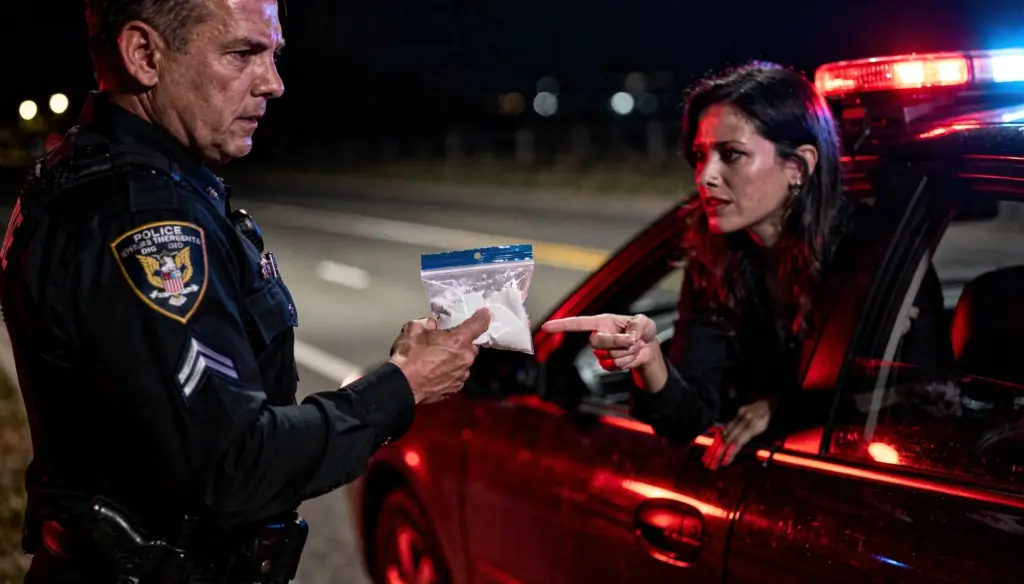
Helen walked toward where she remembered standing in handcuffs.
She pictured Adam.
Young.
Confident.
Bag raised.
“What is this?”
She remembered asking him to look at the seal.
Funny.
Such a small thing.
Blue tape.
Two initials.
A number most people would never notice.
There was a temptation to say that one detail changed everything.
Helen knew better.
The detail exposed something.
People changed what happened afterward.
Adam made a call.
Mara followed it.
Daniel surrendered files.
A prosecutor reopened cases.
A judge corrected Evan’s record.
Thomas, years earlier, copied documents.
Even frightened people eventually made choices.
Too late sometimes.
Still choices.
Helen looked toward the sky.
She did not talk to Evan often.
Not aloud.
That day she did.
“You were right.”
Wind moved through the trees.
“That’s what you wanted, isn’t it?”
She smiled.
“You would be unbearable about this.”
No answer.
Of course.
She stood there a while longer.
Then returned to the car.
At home, one of Evan’s old photographs hung near the front door.
He was seventeen.
Greasy from working on an engine.
Middle finger raised because he hated Helen taking pictures while he worked.
She had framed that one deliberately.
People always asked why.
“Because he was himself.”
Not a martyr.
Not a symbol.
Not an innocent defendant.
Evan.
That mattered.
Helen no longer wanted the worst thing that happened to him to become his entire identity.
The state cleared him.
Good.
But exoneration could become another label.
He had lived nineteen years before the arrest.
Those mattered more.
One evening Helen received an email from a journalism student asking for an interview about “the Evan Ward scandal.”
She almost deleted it.
Then replied:
There was no Evan Ward scandal.
There was a police evidence scandal that happened to Evan Ward.
Words mattered.
The student apologized.
Helen agreed to speak.
During the interview, she told stories the student did not expect.
Evan burning grilled cheese.
Evan pretending to hate his mother attending baseball games while checking the stands every inning.
Evan naming his first car Gloria for no reason anyone understood.
Evan calling from college because he forgot how long to boil eggs.
The student eventually asked, “What do you want people to remember?”
Helen thought.
“That he existed before strangers decided what he was.”
The article was good.
She sent it to Adam.
He replied:
He sounds like a pain in the ass.
Helen wrote:
He was.
Adam:
I think I would’ve liked him.
Helen stared at the message.
Then typed:
Probably.
Years later, when Helen died at seventy-eight, Adam attended the funeral.
So did Mara.
Sophie drove the old blue sedan.
Helen’s sister had already died.
Most mourners were former students.
The church overflowed.
Adam sat near the back.
Afterward Sophie approached.
“Aunt Helen left you something.”
Adam looked surprised.
“What?”
She handed him an envelope.
Inside was a photocopy.
Not of the police evidence bag.
Not of Daniel’s confession.
A photograph.
Young Daniel Rourke.
Thomas Ward.
Helen.
Toddler Evan sitting on Thomas’s shoulders during a department picnic.
On the back Helen had written:
People are more than the worst thing they failed to do.
Do not use that as an excuse.
Use it as a reason to do better next time.
Adam stood beside his car for several minutes.
Then laughed because the message sounded exactly like Helen.
Comfort followed immediately by warning.
He framed the photograph in his office.
By then Adam had become director of statewide evidence compliance.
Every new investigator saw it.
Someone once asked who the people were.
Adam pointed.
“My father.”
Then Thomas.
“A man my father failed.”
Then Helen.
“A woman who refused to let everybody forget.”
Finally Evan.
“And the reason paperwork matters.”
The employee expected more.
Adam gave none.
On his desk sat a small strip of blue evidence tape inside a clear acrylic block.
Not from N-4417B.
That tape remained archived.
This piece came from an unused roll discovered during the Bellweather evidence-room cleanup.
Same manufacturer.
Same color.
Same era.
Adam kept it for one reason.
It looked ordinary.
That was the danger.
People expected corruption to look dramatic.
Cash-filled envelopes.
Secret meetings.
Threats.
Sometimes it did.
Sometimes it looked like a strip of blue tape nobody bothered to question because the person holding it wore a badge.
Adam taught his investigators the same thing Helen once told recruits.
“Certainty is not evidence.”
Then he added something Thomas Ward had written in one notebook:
If a number feels wrong, don’t let rank make it right.
The sentence became unofficial office doctrine.
Decades after the night on County Road 18, the story people told became simpler than the truth.
A corrupt sergeant planted drugs.
A brave woman recognized old evidence.
A young officer exposed the scheme.
A wrongful conviction was overturned.
All true.
Also incomplete.
The fuller story included frightened people.
A husband who waited too long.
A captain who chose career over courage.
A son who photographed something he did not understand.
A mother who spent years being called obsessive.
A young officer who almost trusted his sergeant more than what he saw.
A dying old man who told the truth only after time became scarce.
Nobody was brave every minute.
Nobody was cowardly every minute either.
What mattered was the moment each person finally chose which direction to move.
Evan never got that luxury.
His truth had been simple from the beginning.
“That isn’t mine.”
People spent twelve years complicating it.
Helen spent the rest of her life understanding how often institutions did that.





