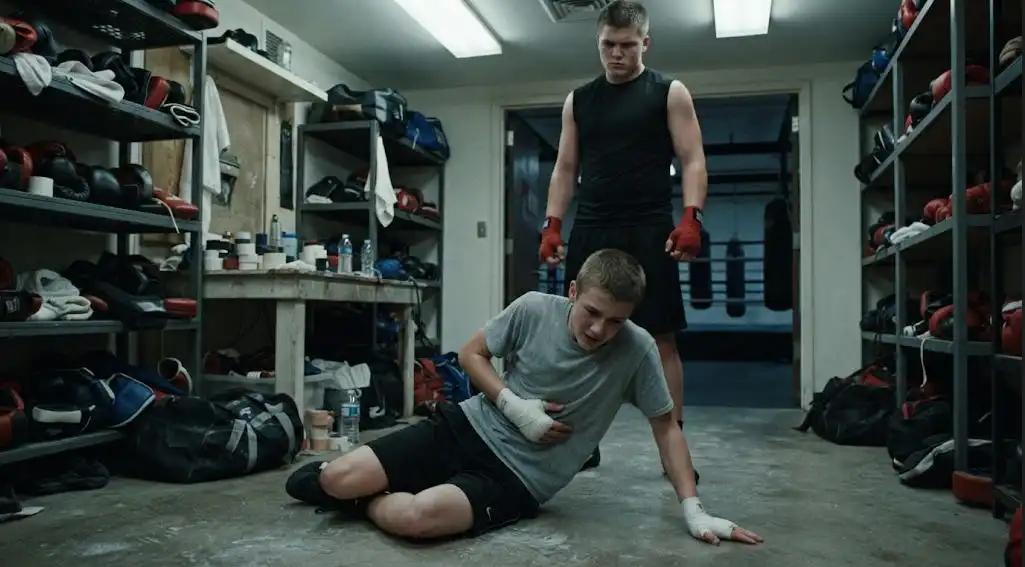
I wrote down the time, the location, what Blake had said, and the sequence of his actions. I kept my hospital paperwork and requested that the school preserve the hallway camera footage and the gym’s smart punching bag sensor records.
I wasn’t claiming that the camera had filmed the assault.
It hadn’t.
The room was outside its field of view.
But the hallway footage could establish the timeline.
The smart bag’s sensor could test Blake’s explanation if he claimed he had been training there.
And the medical report could document the injury I had sustained.
Together, those records could help investigators determine what had happened.
When the school contacted Blake, he denied deliberately attacking me.
He suggested that I had injured myself during training and was blaming him because I wanted an excuse to withdraw from the state championship.
Coach Elena Ruiz, who had trained me for months, refused to accept either version without an investigation.
She visited me after school.
“How bad is the pain?” she asked.
“Bad enough that I don’t want to take a punch there again.”
She sat beside me.
“Then you don’t take one. Not for a trophy. Not for me. Not for anyone.”
I looked down at my hands.
“I’ve worked for this championship for years.”
“I know,” she said. “But being a boxer doesn’t mean you have to ignore an injury. We get you medically reassessed. If you’re not cleared, you don’t fight.”
Her words stayed with me.
I wanted to beat Blake. I wanted to stand in the ring and prove that he hadn’t broken me.
But I didn’t want to win by making another reckless decision.
So I rested.
I followed the medical instructions, monitored my symptoms, and returned for reassessment. As the days passed, the pain improved. The physician found no indication of internal injury and cleared me to resume competition under the conditions discussed during the examination.
The championship officials would still have to examine me before I entered the ring.
I accepted that.
Meanwhile, the school collected the records I had requested.
The wide-angle hallway footage showed Blake following me toward the equipment preparation room. It showed him entering the area and leaving alone. Later, it showed me emerging slowly, bent forward and holding my abdomen.
It did not capture the punch itself.
The smart punching bag records provided another piece of the puzzle.
Blake had claimed he was working on the smart bag during the time in question. But the sensor log showed no recorded bag impacts during that interval.
The hospital report documented my abdominal contusion.
None of those records alone told the entire story. But his account no longer fit comfortably beside the timeline.
The school scheduled a sports committee review after the championship.
I knew that some people would prefer the whole matter to disappear.
Blake was talented. His uncle was influential. The school had invested in its boxing program, and the team had a reputation to protect.
I was just a student worker.
But I had no intention of allowing the issue to be reduced to a disagreement between two teenagers.
The night before the final, Coach Ruiz found me in the gym reviewing my training notes.
“You don’t have to prove anything to Blake,” she said.
“I know.”
“Then what are you fighting for?”
I looked toward the ring.
“For the championship. And because he doesn’t get to decide whether I belong here.”
She nodded.
“Then fight your fight. Nothing else.”
The next day, the arena was crowded with families, coaches, and supporters from across the state.
I passed the required medical examination and was cleared by the ringside physician.
When I entered the ring, I saw Blake waiting in the opposite corner.
He looked relaxed.
I knew that expression. It was the look he wore when he believed the outcome had already been decided.
The referee brought us together for the instructions.
We touched gloves and returned to our corners.
The first round was cautious.
Blake tested me with his jab, then tried to push me backward with heavier combinations. I moved, kept my guard high, and used my footwork to prevent him from settling into his preferred rhythm.
I could still feel a dull ache in my abdomen, but I didn’t let it dictate every movement.
The second round was harder.
Blake began attacking the body more aggressively. He wanted to exploit the injury he believed I couldn’t hide.
I protected my middle, changed angles, and answered with clean punches when he overextended.
The bell saved me from another exchange along the ropes.
Back in my corner, Coach Ruiz pressed a towel into my hands.
“Breathe. Watch his lead shoulder. He’s reaching when he gets frustrated.”
I nodded.
“Don’t chase him,” she continued. “Make him come to you.”
The bell rang for the third round.
Blake came forward smiling.
He thought I was tired. He thought the pain beneath my ribs had taken away my confidence. Most of all, he thought I would make a mistake because I wanted to beat him so badly.
He rushed toward me with a wide right hand.
I watched his lead foot move across the canvas. His shoulders turned, his balance shifted forward, and his guard opened for a fraction of a second.
There it was.
The opening.
I moved just outside the line of his attack and planted my feet.
Then I threw a straight right.
The punch traveled directly through the space Blake had left open and landed cleanly.
His forward momentum carried him off balance. He stumbled backward and fell to the canvas.
The referee stepped between us and began the count.
The crowd rose to its feet.
Blake tried to get up at eight, but his balance wasn’t steady enough for the referee to allow him to continue.
At ten, the referee waved off the bout.
The final was over.
I had won the New York State Youth Boxing Championship.





