Blake was the undisputed golden boy of the St. Jude’s boxing program. He possessed the kind of effortless, terrifying symmetry that seemed genetically engineered for a billboard. He had a devastating right cross, a cruel, charismatic smile, and an uncle who sat on the school’s Board of Trustees. Blake moved through the world with the absolute, frictionless certainty of a boy who had never once been told the word ‘no.’ Coaches fawned over his power. Administrators paraded him in front of local sports reporters. He was the reigning darling of the private school circuit.
But inside the ring, where bank accounts and bloodlines evaporated into the smell of sweat and leather, Blake had a fatal flaw. He believed his own myth. He believed that victory was an inherent right, not a condition negotiated through suffering.
Our dynamic shattered permanently during an interschool open exhibition meet just weeks before the New York State Youth Boxing Championships.
It was supposed to be a showcase for Blake, a light, public sparring session against the hired help to entertain the visiting coaches from rival districts. We touched gloves in the center of the ring under the glaring, heat-generating halogen lights.
Blake came out fast, his custom, metallic-blue sixteen-ounce gloves blurring as he threw heavy, looping power shots. He wanted a highlight-reel knockout. He wanted to fold me in half in front of his sycophants.
But I had spent months surviving him. I wasn’t stronger than Blake; if we stood toe-to-toe and traded blows, he would put me to sleep. But boxing is rarely about who hits the hardest. It is about who sees the matrix of movement. I watched the microscopic drop of his left shoulder before he threw the hook. I learned the heavy, predictable cadence of his footwork.
When he surged forward, attempting to overpower me with sheer mass, I didn’t retreat in a straight line. I pivoted off the center axis, slipping his jab so closely I felt the synthetic leather brush my ear, and answered with crisp, controlled, three-punch combinations to his ribs and jaw. Pop. Pop. Pop.
When he grew frustrated and chased me toward the ropes, aiming to trap me in the corner, I ducked under his sweeping right hand and spun out, leaving him to crash chest-first into the turnbuckle.
I didn’t throw with lethal power. I threw with humiliating precision. I picked him apart.
By the final bell, Blake was gasping for air, his face flushed a dark, furious crimson, his chest heaving. The three ringside judges—independent officials brought in for the exhibition—tallied their scorecards.
The referee grasped our wrists. He raised my hand toward the ceiling.
A profound, suffocating silence fell over the St. Jude’s gymnasium. The visiting teams murmured in surprise. I had beaten the golden boy. I had outboxed the untouchable prince of the academy.
Blake stood beside me, his jaw clenched so tightly the muscles fluttered beneath his skin. He didn’t offer a congratulatory tap of the gloves. He didn’t make eye contact. As I slipped through the ropes to walk back to the locker room, I heard him hiss to his cornerman, his voice vibrating with a toxic, fragile rage.
“The judges are blind. He ran the whole time. It was a mistake.”
I didn’t turn around. I didn’t gloat. I kept my head down, retreating to the shadows, falsely believing that the humility of my silence would protect me.
The retaliation arrived three days later.
We were both officially qualified for the upcoming state championship. The bracket placed us on a collision course for the final match. I was consumed by preparation. Blake was consumed by vengeance.
It was late Friday afternoon. The school was mostly abandoned, save for the rhythmic, distant thud of basketballs echoing from the auxiliary courts. I had finished a grueling two-hour jump-rope and shadow-boxing session. I was drenched in sweat, my muscles trembling with that satisfying, hollow exhaustion that comes from leaving everything on the mat.
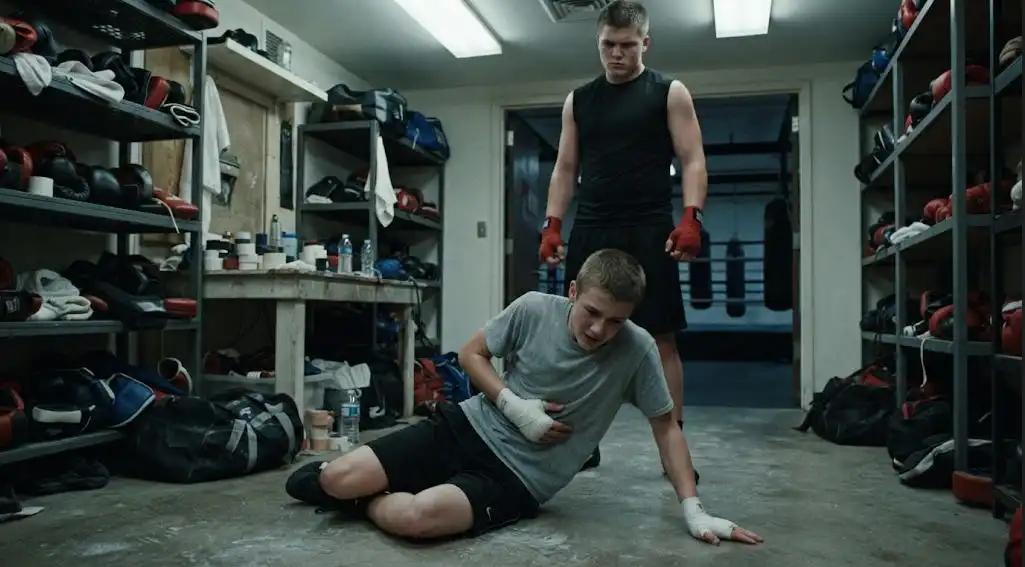
I pushed through the heavy metal door into the equipment preparation room—a windowless, concrete bunker situated between the locker room and the main gym. It was a narrow space, smelling heavily of damp canvas, rust, and ozone, lined with metal cages holding heavy bags, medicine balls, and sparring gear.
I was unwrapping the sweat-soaked cotton hand wraps from my knuckles, lost in the rhythm of my own breathing, when the heavy metal door clicked shut behind me. The deadbolt slid into place with a sharp, metallic clack.
I turned.
Blake Mercer stood blocking the only exit. He was wearing his tailored school blazer over a sweat-wicking athletic shirt. His eyes were completely devoid of the charming, charismatic warmth he projected for the cameras. They were flat, dark, and shark-like.
“You’ve been enjoying yourself this week, haven’t you, Bennett?” Blake asked. His voice was dangerously quiet, a velvet sheath sliding off a knife.
I kept my hands at my sides, my heart rate spiking. The primal, reptilian part of my brain screamed at me that I was trapped in a cage with a predator. “If you’re talking about the exhibition match, Blake, I won it fairly. The judges scored the hits.”
His expression hardened into a mask of pure aristocratic disgust. “You embarrassed my family. In front of the district recruiters.”
“I boxed you,” I corrected him, keeping my tone perfectly level, refusing to betray the fear spiking in my blood. “That is what we were both in the ring to do.”
He took a slow, measured step toward me. “You really think slipping a few punches makes you somebody? You think because you got lucky on a scorecard, you suddenly belong in the same room as me?”
“I don’t care about belonging in your room,” I said, shifting my weight onto the balls of my feet, preparing for a confrontation. “I care about the championship.”
I started to speak again, to tell him to unlock the door, but he didn’t wait.





