For a moment, I couldn’t hear anything clearly. The noise of the crowd seemed to come from somewhere far away.
Then Coach Ruiz reached the ropes.
I walked toward her, exhausted and shaking with relief.
She gripped my shoulders.
“You trusted your training,” she said.
I nodded, unable to speak.
When the referee raised my hand, I looked across the ring at Blake.
He wasn’t smiling anymore.
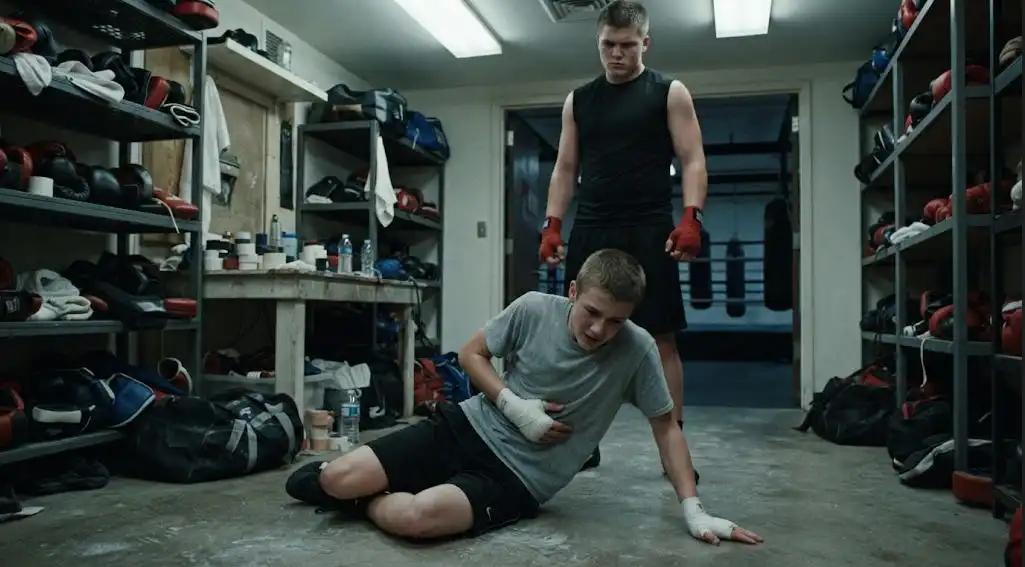
But I knew the victory in the ring did not erase what he had done in the equipment room.
The sports committee review was scheduled for the following week.
I arrived carrying the hospital report and the documents relating to the gym’s smart bag sensor records. The committee had also obtained the original hallway footage.
Blake arrived with his family and a school representative.
His expression suggested he expected the meeting to end quickly.
The committee chair began by reviewing the incident and asking each side to explain its account.
Blake repeated that I had hurt myself during training.
Then the chair displayed the hallway footage.
The room watched Blake follow me toward the equipment preparation room and leave alone. A short time later, the footage showed me emerging, bent forward and clutching my abdomen.
The chair then reviewed the smart bag records.
The sensor log did not support Blake’s claim that he had been hitting the bag during the period in question.
Finally, the committee examined the medical documentation.
My diagnosis was consistent with the injury I had reported.
The chair turned toward Blake.
“Can you explain why your account of the training session does not match these records?”
Blake shifted in his seat.
“I wasn’t trying to seriously hurt him,” he said.
The room fell silent.
The chair waited.
Blake looked toward his school representative, then back at the committee.
“I just wanted to scare him. He made my uncle look stupid.”
It was the first time he had acknowledged that the confrontation was deliberate.
His attempt to minimize the attack had exposed the reason behind it.
He had not been protecting the sport. He had not been defending himself against an accident.
He had wanted to punish me for beating him.
The committee reviewed the evidence, his statement, the documented injury, and the school’s obligations to protect students.
The decision was announced after the review.
Blake’s enrollment was revoked, and he was expelled from the school. The youth boxing governing body imposed a two-year suspension from sanctioned competition.
His family connection did not exempt him from the consequences.
The school also confirmed that its boxing facilities and reporting procedures would be reviewed to ensure that future complaints could not simply be dismissed because a student was popular or influential.
I didn’t celebrate Blake’s expulsion.
I had wanted him to understand that no one had the right to use violence to control another person. I wanted the school to take student safety seriously, and I wanted the sport I loved to be governed by discipline rather than privilege.
That was enough.
When the championship awards ceremony began, I stepped beneath the bright arena lights.
The official placed the gold championship belt in my hands.
Its weight felt different from what I had imagined during all those evenings of training. It represented the early mornings, the sore muscles, the money I had saved, and the moments when quitting would have been easier.
It also represented a choice.
I could have let anger control me. I could have retaliated in the equipment room. I could have allowed fear of Blake’s family to silence me.
Instead, I had trained, recovered, competed, and presented the evidence through the proper process.
I raised the belt as the crowd applauded.
Then I turned toward Coach Ruiz and bowed deeply.
She returned the gesture with a proud smile.
For the first time in a long while, I didn’t feel like the poor kid standing outside somebody else’s world.
I was a state champion.
I had earned my place in that ring.
And no one could take that away by throwing a punch when the cameras weren’t watching.
The next morning, I would still have work to do. I would still need to study, train, and earn money for school.
My life had not suddenly become easy.
But I had learned that dignity does not come from a family name, a trophy, or the ability to intimidate someone weaker.
It comes from how you act when doing the right thing costs you something.
Blake had believed that power meant making other people afraid.
I had learned that real strength meant refusing to become the person who hurt you.
Choose your side: SHOULD A STAR ATHLETE GET SPECIAL TREATMENT, OR SHOULD EVERY STUDENT FACE THE SAME RULES?
The air inside the St. Jude’s Preparatory Academy athletic complex always smelled of floor wax, bleached towels, and unearned entitlement. It was a scent I had intimately acquainted myself with over the past three years. I wasn’t a legacy student. My last name, Bennett, wasn’t etched into the bronze donor plaques flanking the gymnasium doors, nor was it embroidered on the varsity jackets of the boys who drove German luxury sedans to zero-period classes.
I was a ghost who occupied the margins. I was seventeen, a lightweight boxer attending the elite New York academy on a razor-thin academic scholarship. To bridge the gap between my financial aid and the suffocating cost of textbooks, uniforms, and equipment, I traded my physical well-being for hourly wages. I was a professional sparring partner. For twenty-five dollars an hour, I stepped into the canvas ring and allowed the sons of hedge-fund managers and real estate tycoons to practice their combinations against a living, breathing, resisting target.
Mostly, I allowed Blake Mercer to practice his combinations on me.





