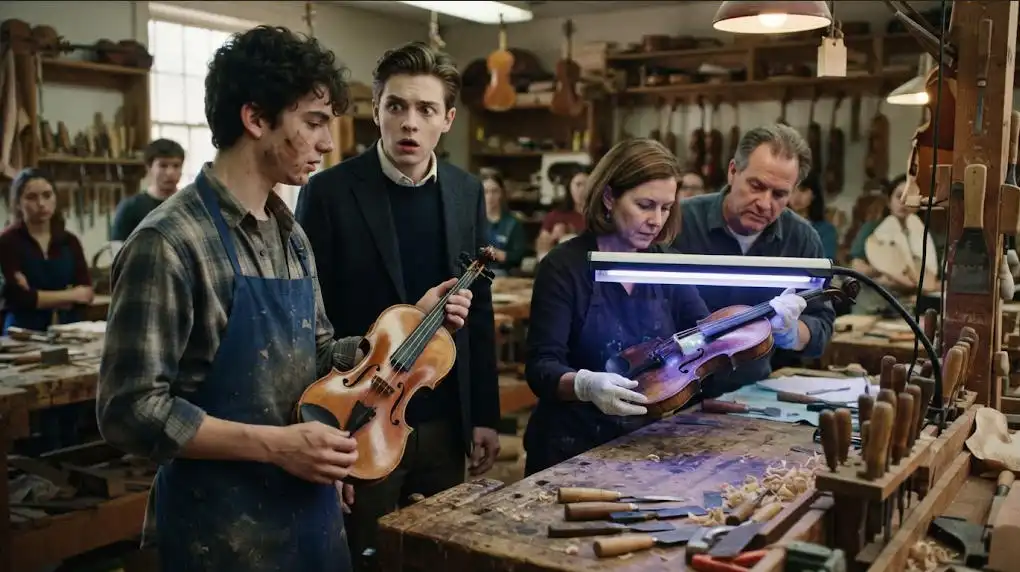
Grant Whitmore opened his mouth, but no answer came.
The chief judge kept the inspection camera trained on the inside of the violin. On the large screen, a modern factory batch code was clearly visible beside a pale line of synthetic adhesive.
Ethan Cole stood across the judging table with his own violin held carefully against his chest.
His face was still red from the previous night’s ordeal. A faint brown stain remained near his hairline, and his fingers bore the familiar marks of a young craftsman who had spent years working with wood, glue, and varnish.
Grant looked toward his father.
His father looked at the screen.
Neither man spoke.
Less than eighteen hours earlier, Grant had been certain that Ethan’s refusal to lie would cost the boy everything.
Ethan was seventeen and a senior at a Massachusetts arts high school known for its traditional violin-making and restoration program. He came from a working-class family and earned tuition credits by preparing animal-hide glue, repairing student instruments, cleaning workbenches, and helping maintain the school’s collection.
He didn’t complain about the work.
He loved the workshop.
He loved the smell of freshly carved spruce, the delicate curls of wood that fell from a sharp finger plane, and the way a carefully shaped piece of timber could transform into something capable of filling a concert hall with music.
His ambition was to become a professional violin maker.
For four months, he had been building his competition violin almost entirely by hand. He had selected the spruce for the soundboard, measured its thickness along carefully mapped contours, and carved the internal bass bar to match the plate’s stiffness and weight.
Every adjustment mattered.
Remove too much wood, and the plate could become weak. Leave too much, and the instrument might lose responsiveness. The bass bar needed to support the soundboard while helping it vibrate in a balanced way.
Ethan had learned to judge the wood with his fingers and ears, then verify his instincts with acoustic measurements.
He wasn’t simply building a violin that looked beautiful.
He was trying to build one that sounded beautiful.
Winning the school’s annual instrument-making competition would earn him a full scholarship from the National Violin Makers Association. It was the opportunity he had worked toward for years.
Grant Whitmore wanted something else.
At eighteen, Grant was the orchestra’s first chair and the school’s most celebrated student musician. His family was wealthy, and his father was a major sponsor of the school orchestra.
Grant had grown accustomed to getting the best instruments, the best opportunities, and the benefit of every doubt.
But he had little interest in the patient craft behind a handmade violin.
He wanted the recognition without the work.
The school’s century-old music fund had announced a special $5,000 instrument-care grant. Applicants could submit a historically significant instrument for authentication and receive funding toward its preservation.
Grant saw an opportunity.
He had purchased a factory-made violin for approximately $300. It had a decorative label claiming nineteenth-century Italian origins and a deliberately aged finish that made it look far more valuable than it was.
He intended to present it as a rare handmade antique.
If the school approved the instrument, Grant would receive the grant money, the prestige of owning a supposed historical masterpiece, and another reason for the music department to favor him.
He needed an authenticity certificate.
And Ethan, as the workshop’s leading student apprentice, had been assigned to conduct the preliminary inspection.
The previous afternoon, Ethan placed Grant’s violin on a padded workbench and examined it under a bright inspection lamp.
The varnish initially seemed convincing.
The label looked old.
But when Ethan examined the edges and internal structure with a small inspection camera, he noticed irregularities.
The wood layers were inconsistent with the solid spruce construction claimed for the instrument. The internal joints showed rough factory assembly, and pale synthetic adhesive was visible along a seam.
Ethan adjusted the camera and checked again.
There was no reasonable basis for calling the violin a nineteenth-century handmade Italian masterpiece.
He photographed the relevant details, recorded his findings, and prepared a preliminary report.
When Grant arrived to collect the instrument, Ethan handed him the report.
Grant skimmed the first page.
Then he looked up.
“What is this?”
“The violin doesn’t match the description on the submission form.”
Grant laughed as if Ethan had made a childish mistake.
“That’s an antique. You can see the label.”
“The label isn’t enough to establish authenticity. The internal construction doesn’t match the claim.”
“You repair broken school instruments. You don’t authenticate valuable antiques.”
“I’m responsible for what I sign.”
Grant leaned over the workbench.
“Then sign it.”
Ethan shook his head.
“I can’t certify it as a nineteenth-century handmade instrument.”
Grant’s expression hardened.
“Do you understand what you’re doing? My father supports this program. He knows the trustees. You think they’re going to take the word of a scholarship kid over mine?”
“They can inspect the evidence themselves.”
For several seconds, Grant stared at him.
Then he picked up the report, tore it in half, and dropped the pieces onto the floor.
“You’re going to regret this.”
Ethan should have realized that Grant wasn’t finished.
At four thirty that afternoon, Grant returned to the violin-making workshop with two orchestra students.
Ethan was working at the central bench, carefully checking the unfinished spruce soundboard of his competition violin.
The plate was not yet joined to the instrument’s body. Its underside remained accessible, allowing him to inspect and adjust the bass bar before final assembly.
Grant approached without greeting him.
“You’re going to sign the certificate.”
“No.”
Grant snatched the preliminary inspection form from the bench and tore it apart.
“Do you have any idea how much my family has done for this school?”
Ethan put down his carving tool.
“That doesn’t make the violin an antique.”
Grant’s two companions exchanged uneasy glances.
Grant stepped closer.
“You think you’re better than me because you can carve a piece of wood?”





