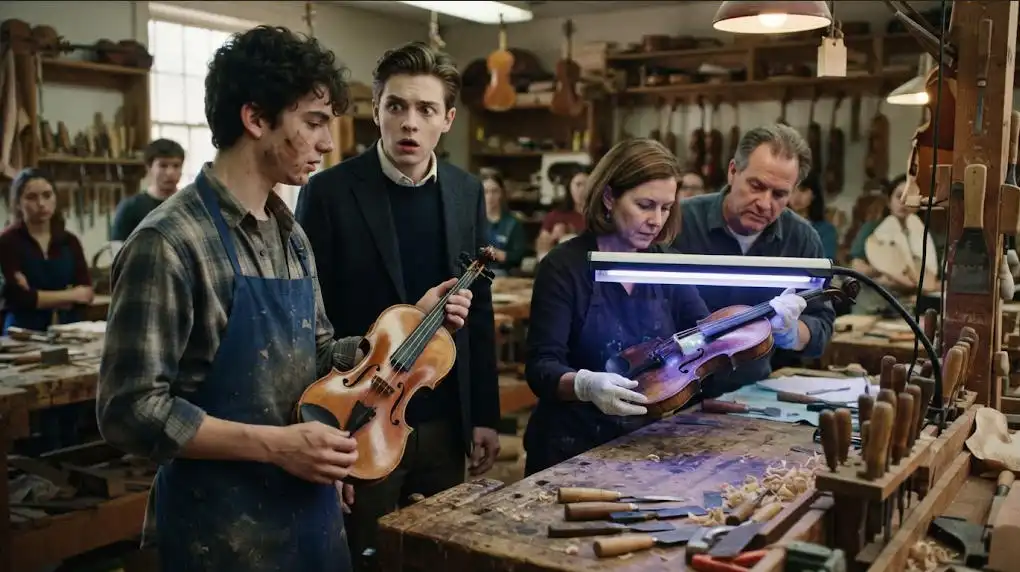
“No. I think the instrument should be described honestly.”
Grant shoved him.
Ethan stumbled backward and fell into a pile of hard wood shavings and offcuts.
Before he could stand, Grant grabbed a bowl from the temperature-controlled water bath. It contained warm fish glue mixed with dark shellac varnish.
He lifted it above Ethan’s head.
Then he poured the contents over him.
The thick, foul-smelling mixture ran across Ethan’s forehead, hair, face, and shirt. He squeezed his eyes shut and turned away, coughing as the sticky liquid covered his cheeks and neck.
“That’s what happens when a repair boy forgets his place,” Grant said.
Ethan reached for the workshop’s emergency eyewash and carefully rinsed his eyes. The glue clung to his hair and skin, while the shellac left dark, stubborn stains on his clothes.
He could hear Grant moving behind him.
Then came a sharp crack.
Ethan turned.
Grant had swept the unfinished soundboard off the bench and onto the floor. He raised his foot and stomped on the delicate spruce bass bar attached to its underside.
The wood fractured.
Grant ground his shoe down once more before stepping away.
“Tomorrow, your little masterpiece will be firewood,” he said. “Let’s see who believes you after that.”
He left with his companions.
Ethan remained beside the broken soundboard.
For a moment, the workshop seemed unbearably quiet.
The violin had consumed four months of his life. He had saved the best pieces of spruce for it, measured the plate repeatedly, and adjusted the bass bar with the care of someone who knew he couldn’t afford to start over.
Now the bass bar was split.
The competition began at ten the following morning.
Ethan sat on the floor, staring at the damaged wood.
He could withdraw. The judges would understand that the instrument had been damaged.
But Grant would have an easier time claiming the inspection report was an act of jealousy. The $5,000 grant could be approved, and the school’s music fund would be deceived.
Ethan also knew that simply gluing the broken pieces together without examining the damage could leave the soundboard unevenly stressed. A rushed repair might hold for a few hours but compromise the instrument’s resonance or structural stability.
He wiped his face, collected the torn inspection report, and photographed the damaged soundboard.
He recorded the time and condition of the instrument. He also noticed the distinctive imprint of Grant’s custom loafer sole on the wood near the broken bass bar, where the shoe had pressed against the plate.
Dark red spruce dust and the workshop’s iron-oxide marking compound clung to the sole’s imprint.
Those details would matter later.
First, he had to save the violin.
Ethan washed the remaining glue from his hair and skin, taking care not to rub the irritated skin around his eyes. He then returned to the workbench and examined the damage under magnification.
The soundboard itself remained usable.
The bass bar did not.
Rather than trying to force the fractured bar back into alignment, Ethan decided to remove it carefully and carve a replacement from a matching piece of spruce.
He warmed the old hide glue with controlled heat and moisture, working slowly to avoid damaging the thin soundboard. Once the damaged bar had been removed, he cleaned the bonding surface and examined the wood grain.
He selected a replacement blank with similar stiffness and grain orientation.
Then he began shaping it.
The work demanded patience. He had to fit the new bar to the slight curve of the soundboard, maintain the correct contact along its length, and remove wood in small increments.
He used traditional hot hide glue, which was appropriate for the instrument and could be reversed by a qualified restorer in the future.
He checked the fit repeatedly before applying the adhesive.
When the new bass bar was secured, he allowed the joint to set under controlled conditions. He then refined the bar’s shape and checked the soundboard’s response with his acoustic testing equipment.
A poor repair could have changed the plate’s behavior.
A careful repair could preserve the design he had spent months developing.
At midnight, he was still working.
At two in the morning, he began fitting the soundboard to the ribs.
At four, he completed the assembly and checked the joints.
By dawn, the violin was ready for its final acoustic assessment.
Ethan was exhausted. His eyes were sore, his hands ached, and his stained clothes lay folded in a corner of the workshop.
But when he drew the bow across the strings, a clear, balanced tone filled the room.
He stopped and listened.
Then he played again.
The instrument responded.
It was not perfect, and no honest maker would claim that any violin was. But the soundboard remained structurally sound, the bass bar was secure, and the instrument had retained the responsive character he had worked so hard to achieve.
Ethan carefully packed the violin.
He also packed the preliminary inspection photographs, his written report, and the records documenting the damage to his own work.
He had no intention of letting the judges decide the case on his word alone.
At nine thirty, the music department’s judging hall began to fill.
Members of the school’s music fund committee sat beside professional instrument makers and acoustic evaluators. Students gathered along the walls, eager to see the competition and learn which instrument would win the scholarship.
Grant arrived wearing an immaculate formal suit.
He carried his supposed antique violin in a polished case.
His father sat among the fund’s sponsors.
Grant took the stage first.
He described the instrument as a nineteenth-century Italian masterpiece, allegedly made by a celebrated workshop and preserved through generations.
He spoke confidently about its age, rarity, and supposed historical value.
Then he turned toward the judges.
“Unfortunately, a jealous student in the restoration workshop has been spreading rumors about this instrument,” he said. “He damaged his own project last night and is trying to blame me because he couldn’t compete with my submission.”





