At seven-fifteen, as the pale, greasy light of a New England dawn began to filter through the basement windows, Ethan set the soundpost through the treble f-hole using a notched steel setter.
He adjusted the spruce post two millimeters behind the bridge foot, squinting through the endpin hole to ensure it stood dead-plumb, perpendicular to the plates, holding the back and belly in acoustic communion.
He strung the instrument with a set of plain gut strings, wrapped the peg-heads, and hooked the tailgut over the ebony button.
His hands were trembling so badly he dropped the tuning wrench twice.
He stood in the center of the cold workshop, his clothes stiff with dried glue and pine dust, and lifted the violin to his collarbone.
He drew the bow across the open D string.
The note was not small. It did not choke.
It tore into the cold air of the cellar with a rich, dark, cavernous roar—a sound that carried the low hum of the mountain spruce and the stubborn, unbreakable resistance of the boy who had refused to let it die.
Ethan lowered the bow. He closed his eyes, his forehead resting against the scroll.
Then he reached into his cabinet for his inspection camera, his black formal suit, and his evidence sleeves.
The Great Hall of the St. Jude Academy had been designed to mimic the Thomaskirche in Leipzig: barrel-vaulted plaster ceilings, stained glass depicting the muses of counterpoint, and forty rows of high-backed walnut pews.
At nine-forty-five, the room was packed with two hundred students, faculty members, and patrons in dark wool and cashmere. On the raised dais stood a long table draped in green baize, behind which sat the three judges of the National Violin Makers Association.
At the center sat Master Luthier Robert Hayes—seventy-four years old, five decades of instrument evaluation behind him, his fingers gnarled from thousands of scrolls carved in the workshops of Mittenwald and London. To his right was Dr. Elena Rostova of the Boston Symphony; to his left, the regional dean of historical preservation.
In the second row of the audience sat Arthur Whitmore, Senior Vice President of the Atlantic Maritime Bank, wearing a charcoal three-piece suit with an antique gold watch chain looping into his vest pocket. Beside him sat Grant, his violin case resting across his knees like an ivory scepter. Grant wore a midnight-blue tuxedo jacket, his hair slicked with pomade, smiling easily at the junior faculty members who stopped to pay their respects to his father.
When Ethan Cole entered through the side door, a low ripple of whispers stirred the front three rows.
Ethan wore his only dark suit—an off-the-rack polyester blend his mother had bought him for his uncle’s funeral three years ago, the sleeves an inch too short for his long forearms. But it was not his suit that drew their stares.
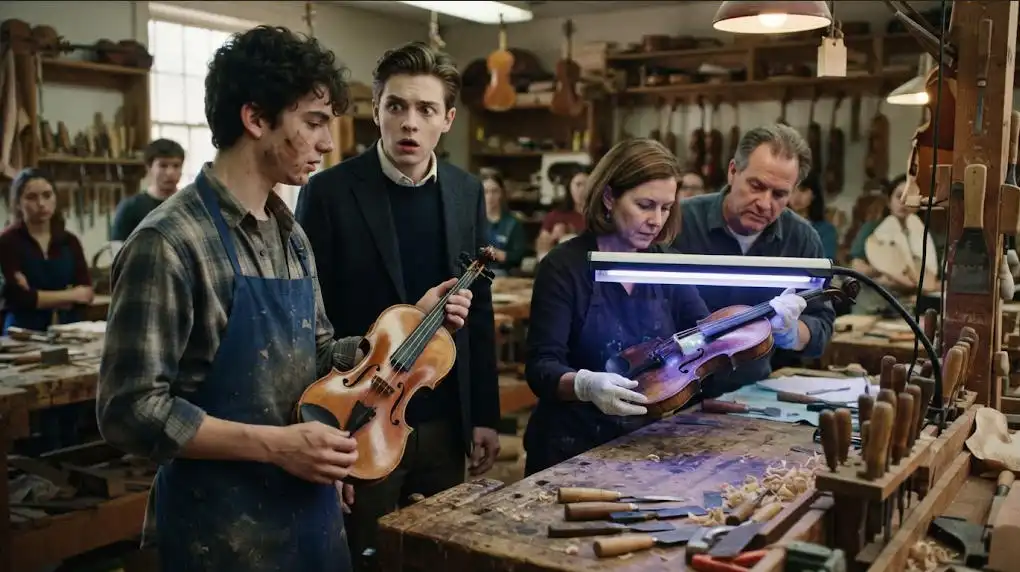
His face was scrubbed raw, the skin along his cheekbones inflamed to an angry, bright scarlet. Across his hairline and behind his left ear, the unmistakable dark brown crust of dried walnut stain was still visible where it had bonded to his skin. His eyes were sunken, dark-circled from thirty hours without sleep, and his right index finger was wrapped in white linen tape.
He carried his unfinished violin in an open pine transit tray, wrapped in a square of raw silk. In his left hand, he carried an accordion folder stuffed with black-and-white documents.
Grant didn’t look at Ethan. He simply smoothed the lapel of his jacket and leaned over to whisper something to his father. The elder Whitmore smiled thinly, an indulgent, dismissive tilt of the head.
“We will begin the session with the Historical Instrument Preservation Submissions,” Master Luthier Hayes announced, his German accent dry and clear through the hall’s acoustic envelope. “First entry: Mr. Grant Whitmore, presenting an alleged mid-nineteenth-century Italian masterwork for certification under the Century Fund Grant.”
Grant rose with fluid, unhurried grace. He carried his violin to the green baize table, lifting it from its velvet interior with both hands, presenting it to the judges as though it were the skull of an ancestor.
“Distinguished panel,” Grant began, his voice carrying effortlessly toward the vaulted ceiling, “this instrument was acquired by my family from the collection of the late Marchese di San Pellegrino. It is a preserved 1840 concert violin from the workshop of Giovanni Dollenz of Trieste, pupil of Storioni. The varnish is original, an amber-oil preparation characteristic of the Adriatic school. We are requesting the five-thousand-dollar preservation grant to conduct minor stabilization of the upper rib linings and re-secure the original bass bar.”
He laid the instrument on the padded evaluation rest. The violin looked magnificent under the stage spotlights: a deep, glowing golden-orange, with wide, sweeping purfling and a label visible through the sound-hole that read, in weathered, faded script: Giovanni Dollenz, fece in Trieste, anno 1840.
Dr. Rostova leaned forward, her silver half-glasses resting on the tip of her nose. “A remarkable surface, Mr. Whitmore. The wear patterns on the upper treble flank suggest extensive thumb-position playing.”
“The instrument has been played by masters for three generations, Dr. Rostova,” Grant said smoothly. “Unfortunately, its certification was delayed yesterday due to… administrative irregularities in the student intake shop.”
Grant cast a brief, cool glance toward the side of the stage where Ethan stood beside his wooden tray.
“A work-study apprentice, perhaps overwhelmed by the value of the piece, attempted to challenge its provenance,” Grant added, his voice dropping into a tone of pained, noble regret. “He even went so far as to damage his own student competition instrument in the workshop last night in a fit of frustration, attempting to attribute his own lack of progress to our family’s presence in the department. I trust the committee will assess this heirloom on its acoustic and historical reality, rather than on the grievances of an under-qualified technician.”
Arthur Whitmore nodded approvingly from the second row, folding his hands over his watch chain.





