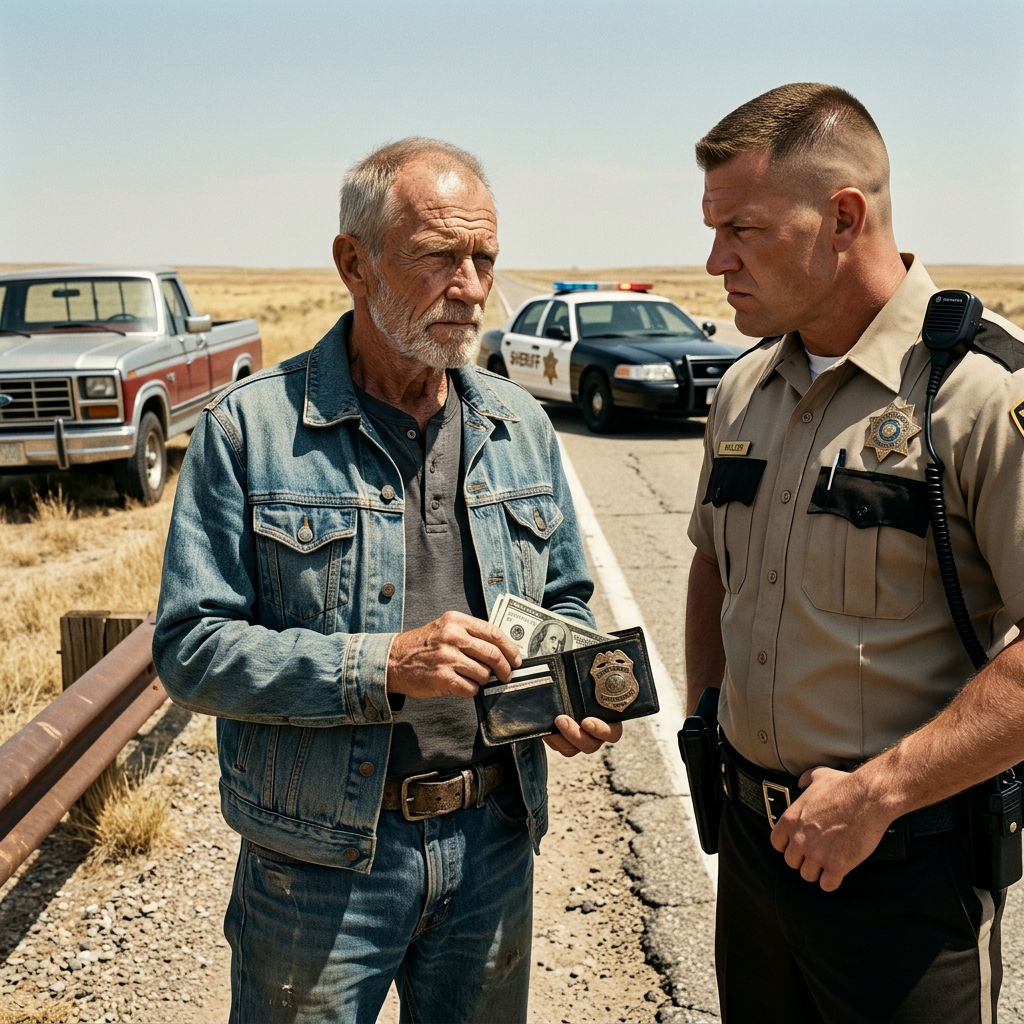
I walked up to the thick bulletproof glass separating the police front desk from the lobby. A bored-looking desk sergeant with the nameplate MILLER was scrolling through his phone. He didn’t look up until I tapped my knuckles against the glass.
“Can I help you?” he asked, hitting a button to activate the two-way speaker.
“I need to file a formal public records request,” I said. “Under the state transparency statute.”
Miller sighed, sliding a clipboard beneath the slot in the glass. “Fill out the blue form. Requests take four to six weeks to process, depending on the volume of municipal inquiries.”
“The statute requires a preliminary response within seventy-two hours for dashcam and bodycam footage,” I corrected mildly.
Miller finally looked at me, really looked at me, taking in my faded jacket and gray hair. “What exactly are you looking for, buddy?”
“Yesterday afternoon, at approximately 3:15 PM, I was pulled over on Interstate 70 by Officer Keller and Officer Pike. Cruiser number four. I am requesting the unedited dashcam video and both officers’ body-worn camera audio and video for the duration of the stop.”
Miller’s hand paused over his keyboard. His eyes flicked down to the paperwork I hadn’t even filled out yet, then back up to my face. The boredom vanished, replaced by a sharp, defensive caution.
“Hold on,” he muttered. He turned his back to the glass, picked up a desk phone, and dialed a short extension. He spoke quietly, his hand cupped over the receiver.
Two minutes later, a door behind the desk opened. A lieutenant in a crisp white shirt stepped out, holding a ceramic coffee mug. He didn’t approach the glass. He just stood near the filing cabinets, watching me with cold, flat eyes while Miller hung up the phone and turned back to the speaker.
“Sorry to waste your time,” Miller said, his voice dripping with forced politeness. “I just checked the digital server logs. Cruiser four had a catastrophic storage failure yesterday morning. The hard drive corrupted. There is no footage of your stop.”
“Both the dashcam and two separate body-worn cameras all suffered simultaneous catastrophic failures?” I asked.
“System-wide error,” Miller said smoothly, picking his phone back up. “Happens with these cheap municipal contracts. Nothing we can do. Have a good day, sir.”
He reached out and clicked the two-way speaker off. The lieutenant took a slow sip of his coffee, offered me a faint, mocking smirk, and walked back through the heavy wooden door.
I didn’t argue. I didn’t pound on the glass. I just picked up a blue pen, filled out the formal request anyway, and slid it back through the slot. I walked out of the building into the crisp morning air, fully understanding the landscape now. It wasn’t two rogue cops on a highway. The desk sergeant knew. The lieutenant knew. The blue wall was fully constructed and heavily reinforced.
As I unlocked my truck, my cell phone vibrated in my pocket.
“Marcus,” I answered.
“I pulled the data,” Marcus said, and his voice was tight. “Elias, it’s worse than we thought. Keller alone has logged forty-two suspected narcotic asset seizures this year. Totaling over eighty thousand dollars. No drugs found. No arrests made. Just cash, seized and deposited into the township’s general discretionary fund.”
“Did he log my thousand dollars yesterday?”
“I’m looking at the live system ledger right now,” Marcus said. “He logged a stop for your license plate at 3:14 PM. Speeding warning issued. But there’s no seizure record. The cash log from his shift is completely zeroed out.”
I leaned against the rusted door of my pickup. I pulled the white bank withdrawal slip from my pocket and stared at the string of numbers printed at the bottom.
If Keller had logged the money into evidence, it would have been nearly impossible to get back without a prolonged, expensive legal fight. But he hadn’t logged it. He had gotten greedy. He assumed I was a nobody, a tired old man who would just drive away and swallow the loss.
He didn’t log it because he kept it for himself.
“Marcus,” I said quietly. “Are you free on Tuesday?”
“I’m the Deputy Director, Elias. I can be free whenever I want. Why?”
“Because,” I said, tracing my thumb over the serial batch numbers printed on the slip, “Oakhaven Township holds an open municipal town hall on the first Tuesday of every month. I think it’s time we attend.”
CHAPTER 2 CONTINUED
At a quarter past three, the side door of the precinct opened. Officer Keller stepped out into the afternoon sun. He was out of uniform, wearing a tight gray t-shirt, jeans, and aviator sunglasses. He didn’t look over his shoulder. He didn’t scan the lot. He walked with the relaxed, rolling gait of a man who owned the pavement beneath his boots.
He climbed into a late-model, lifted Chevy Silverado parked in the reserved section. It had a custom matte-black paint job, oversized all-terrain tires, and a heavy steel brush guard. It was an eighty-thousand-dollar truck, heavily modified. Not exactly the standard commuter vehicle for a municipal patrolman making fifty thousand a year.
The Silverado’s heavy exhaust rumbled to life, echoing off the brick building. Keller pulled out of the lot and headed south toward the commercial edge of town.
I gave him a three-block lead, letting a delivery box truck slide into the lane between us. Tailing someone in a small township requires distance, but I didn’t need to stay close. Keller drove aggressively, riding the bumper of a sedan in front of him before jerking into the oncoming lane to pass. He wasn’t checking his mirrors for a tail. He believed he was the apex predator in Oakhaven.
Ten minutes later, Keller’s brake lights flashed. He pulled into the wide concrete bay of a large commercial garage on the edge of the county line. The faded painted letters above the open bay doors read: Dixon’s Tires & Custom Auto.





