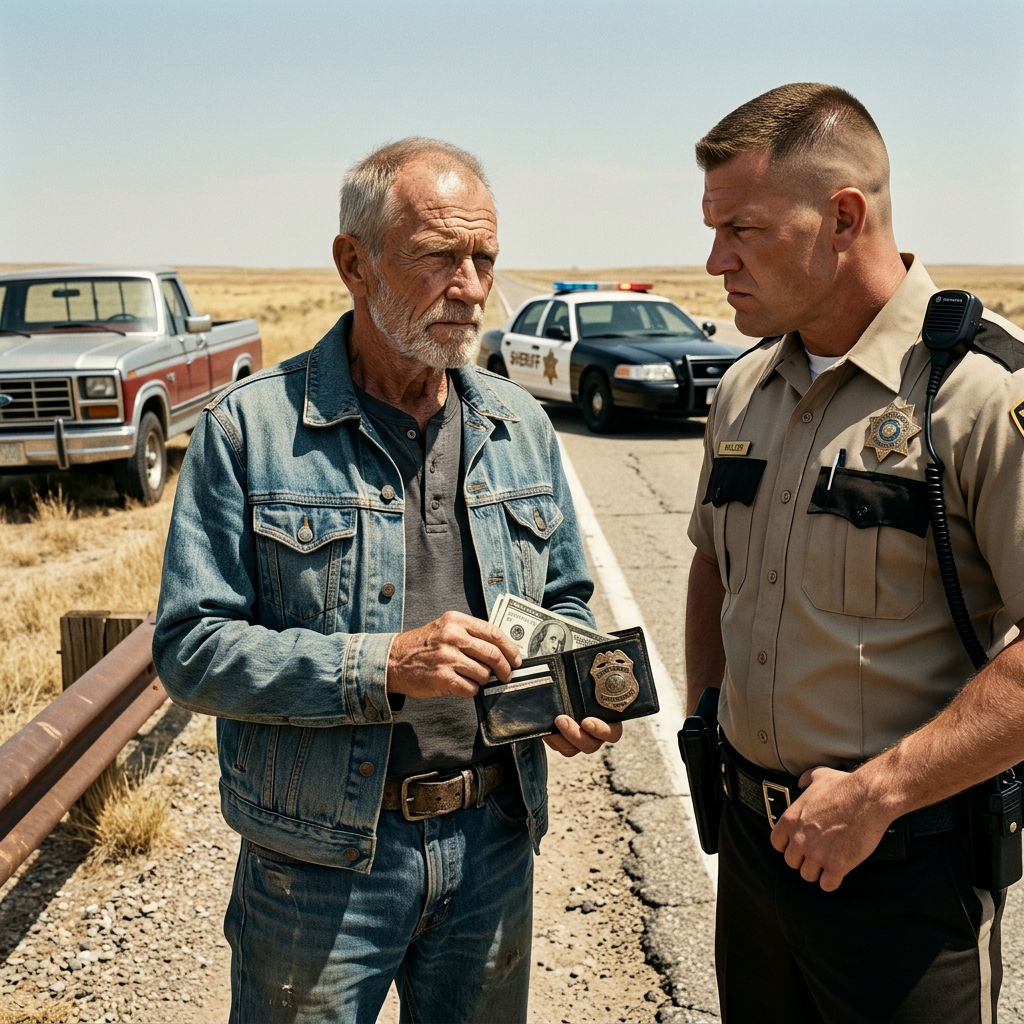
“Mr. Mayor, members of the council,” Hodges began, his voice echoing through the small room. “This year, the Oakhaven Police Department has taken a proactive stance against the transportation of illicit funds through our township. Interstate 70 is a known corridor for organized crime. Through aggressive interdiction, we have seized over eighty thousand dollars in suspected narcotic proceeds this year alone.”
Hodges clicked a remote. A bar graph appeared on the screen, showing a massive spike in seized cash.
“Because these funds are seized under civil asset forfeiture,” Hodges continued smoothly, “they are deposited directly into the township’s discretionary public safety fund. This program doesn’t just hurt criminals; it pays for our equipment without raising local property taxes.”
A few people in the folding chairs murmured in approval. The town council members nodded, looking pleased at the prospect of free money.
“And the tip of the spear in this initiative,” Hodges said, turning to the front row, “is Officer David Keller. Officer Keller alone accounts for over forty individual seizures this year. His instincts on the highway are unmatched. Tonight, I am proud to present him with the department’s Meritorious Service Plaque.”
The room offered a polite round of applause. Keller stood, buttoned his dress jacket, and walked to the podium. He shook Hodges’s hand, took the wooden plaque, and turned to the crowd, flashing a bright, camera-ready smile. He looked exactly like a man who believed he was untouchable.
“Thank you, Lieutenant,” Keller said into the microphone. “I’m just doing my job. Keeping our community safe.”
Keller returned to his seat. The mayor leaned forward. “Thank you, Officer. Now, before we vote on the cruiser budget, the floor is open for public comment. Three minutes per citizen. I have one name on the registry.” The mayor squinted at his sheet. “Elias Vance?”
I stood up. The folding chair squeaked against the linoleum.
I walked down the short aisle and stepped up to the public microphone. I adjusted the gooseneck stand, bringing the mic down to my level. I didn’t look at the mayor. I looked directly at the back of Officer Keller’s head.
“Good evening,” I said. My voice was calm, pitched at the low, even resonance I had spent three decades perfecting in interrogation rooms. “My name is Elias Vance. For thirty-five years, I served as a Senior Investigator for the State Office of the Inspector General, specializing in departmental corruption and financial crimes.”
The casual murmuring in the room instantly died.
Keller stiffened in his chair. He didn’t turn around, but I saw his shoulders lock. Lieutenant Hodges, who was walking back to his seat, froze in the aisle. He slowly turned to look at me, the blood draining from his face as he finally recognized the “tired old man” from the lobby.
“I am not here as a resident of Oakhaven,” I continued, projecting my voice clearly. “I am here as a victim of a highway robbery conducted under the color of law. And I am here to formally object to the commendation of Officer David Keller.”
“Excuse me,” the mayor interrupted, his tone sharp and defensive. “Mr. Vance, this is a budget hearing. If you have a grievance with an officer, you need to file a formal complaint with internal affairs.”
“I attempted to do exactly that on Friday morning,” I replied, keeping my eyes fixed on Hodges. “I filed a formal public records request for the dashcam and bodycam footage of my traffic stop, which occurred on Thursday at 3:14 PM at mile marker eighty-two. Lieutenant Hodges, could you please tell the council what your desk sergeant told me regarding that footage?”
Hodges swallowed hard. He looked at the mayor, then at the town council. He had no choice but to maintain the lie he had already logged into the system.
“The department experienced a catastrophic server failure on Friday morning,” Hodges said, his voice tight. “All digital footage from Thursday afternoon was corrupted and permanently lost. It was an IT issue.”
“An IT issue,” I repeated into the microphone. “How convenient. And Officer Keller, could you please stand and confirm for the public record what your official shift log states regarding my traffic stop?”
Keller stayed in his seat. He turned around, his face flushed with sudden, aggressive anger. “I gave you a warning for crossing the yellow line. That’s what the log says. I didn’t write you a ticket. I did you a favor, old man.”
“So your official position, logged into the township server, is that no property was seized from my vehicle?” I asked.”Nothing was seized,” Keller snapped. He looked up at the mayor. “Sir, this man was agitated on the highway. He’s clearly confused. He shouldn’t be allowed to hijack a municipal meeting.”
“Mr. Vance,” the mayor warned, reaching for his gavel. “Your three minutes are almost up. Unless you have proof of these allegations, I’m going to ask you to sit down.”
“I have the only proof that matters,” I said.
I reached into the inside pocket of my coat. I pulled out the crumpled white bank withdrawal slip and held it up by the corner.
“On Thursday at 1:15 PM, two hours before Officer Keller pulled me over, I withdrew one thousand dollars from my personal bank account to help my daughter pay for a broken water heater. This is the bank’s timestamped receipt.”
I walked the two steps to the dais and laid the receipt flat on the mayor’s desk, right next to his microphone.
“If you look at the bottom right corner, Mr. Mayor, you will see a string of alphanumeric characters. My bank uses a dot-matrix system that automatically records the sequential serial numbers of all high-denomination bills dispensed by the teller. Ten hundred-dollar bills. Ten serial numbers.”
The mayor frowned, looking down at the slip. He adjusted his glasses.





