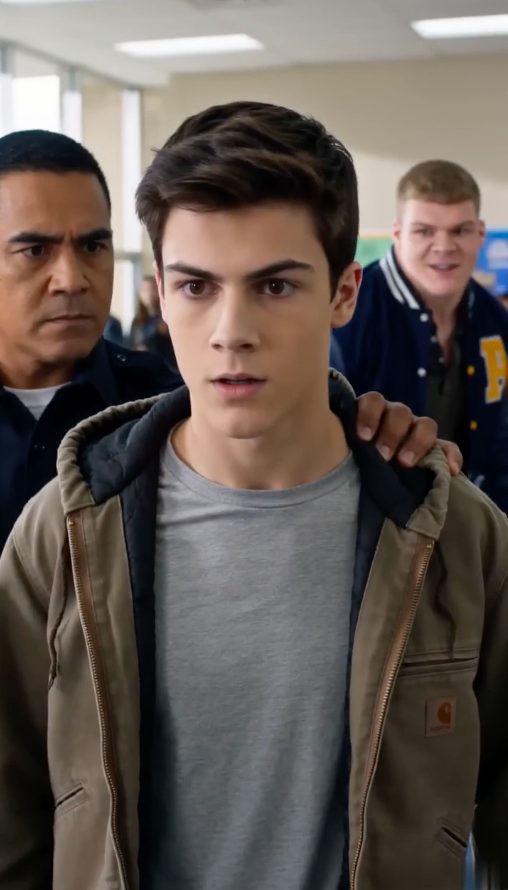
I walked past the apartment buildings and along a narrow sidewalk bordered by winter-brown grass.
Beyond the road, the evening sky was pale blue, and the lights of distant businesses had begun to appear.
I thought about how quickly my life had changed.
Before the cafeteria incident, I had considered myself ordinary.
I wasn’t the strongest student in my Judo classes, and I wasn’t particularly good at making friends.
I liked quiet places, predictable routines, and the feeling of finishing homework before dinner.
I didn’t want a dramatic life.
I didn’t want to be remembered for throwing somebody.
Most of all, I didn’t want my mother looking at me with that frightened expression again.
When I returned, she was making soup.
She asked whether the walk had helped.
“A little.”
“Good.”
I sat at the counter.
“Mom?”
She glanced over.
“Do you wish we’d never moved?”
The spoon stopped in her hand.
She turned toward me.
“No.”
“Even now?”
“Even now.”
I looked down.
She came around the counter.
“This move wasn’t supposed to make every difficult thing disappear,” she said.
“It was supposed to give us a chance to build something better.”
“Doesn’t feel better.”
“I know.”
She rested one hand against my cheek.
“But what happened at school doesn’t decide what our entire life here will become.”
I wanted to believe her.
For the first time, I thought I might eventually be able to.
The meeting began the following morning at nine.
This time, the district administrator was a woman named Ms.
Bennett, who introduced herself as responsible for reviewing serious student disciplinary matters.
She had a calm voice, a thick folder, and the slightly tired expression of someone who had already spent several hours reading documents before arriving.
Mr.
Davis sat opposite us.
He avoided looking directly at me.
The assistant principal occupied the chair beside him, her hands folded over a legal pad.
Ms.
Bennett began without ceremony.
“We’ve received additional video footage and witness information.”
My mother nodded.
“We understand.”
“The materials establish that there was physical contact before the defensive action described in the original referral.”
Mr.
Davis shifted.
“I’ve never disputed that there may have been some contact.”
I stared at him.
He had described me as the aggressor for more than a week.
Ms.
Bennett opened the folder.
“The original referral specifically states that the incident was unprovoked.”
The room became quiet.
Mr.
Davis adjusted his glasses.
“That was based on the information available at the time.”
“Who provided that information?”
“School personnel.”
“Which personnel?”
He named the security guards.
Ms.
Bennett looked down at her notes.
“Both guards stated that they arrived after the student was already on the damaged table.”
The principal said nothing.
My mother leaned forward.
“Then neither of them could have established who started the confrontation.”
Ms.
Bennett nodded slightly.
“That is one of the concerns we’re reviewing.”
I looked at Mr.
Davis.
He still hadn’t acknowledged me.
She continued.
“The new footage shows the senior student making repeated physical contact before the throw.
It also shows the younger student attempting to maintain distance.”
My mother pressed her palms together.
“What does that mean for the suspension?”
Ms.
Bennett turned a page.
“We’re considering a revision to the disciplinary finding.”
Mr.
Davis straightened.
“I want to emphasize the severity of the throw.”
“We are not ignoring that,” Ms.
Bennett replied.
“The other student could have been seriously injured.”
“That is true.”
He seemed encouraged.
“Exactly.”
She looked directly at him.
“But a fair review must consider what happened before it.”
For the first time, his expression faltered.
I felt my heartbeat quicken.
Then Ms.
Bennett asked a question that changed the atmosphere in the room.
“Mr.
Davis, why was the initial referral classified as an unprovoked assault before the relevant footage and witness statements had been reviewed?”
The principal glanced at the assistant principal.
“That is standard administrative procedure.”
Ms.
Bennett looked down at another document.
“Is it?”
Nobody answered.
She turned the page.
“Because I’ve reviewed several other referrals in which the same language appears.”
My mother lifted her head.
“What other referrals?”
Ms.
Bennett paused.
“I can’t discuss individual students’ records.”
“Of course,” my mother said.
“But I can tell you that the classification process itself requires further examination.”
Mr.
Davis leaned forward.
“I don’t see how other matters are relevant here.”
Ms.
Bennett closed that section of her folder.
“They may be very relevant.”
I looked between them.
Something had shifted.
The meeting was no longer entirely about me.
We didn’t learn the full significance of that exchange until later.
At the time, Ms.
Bennett simply explained that my suspension would be reconsidered and that any final decision would be communicated in writing.
She asked my mother for copies of the original emails, photographs, and notes.
My mother handed over the folder.
Then she asked whether the district would review how the school had handled Lena’s attempt to provide a statement.
Ms.
Bennett wrote something down.
“Yes.”
“And why the cafeteria footage was initially described as unavailable?”
“Yes.”
“And why my son’s account wasn’t included in the original referral?”
Ms.
Bennett looked directly at her.
“Yes.”
Mr.
Davis crossed his arms.
“This is becoming an unnecessary interrogation.”
The administrator turned toward him.
“Mr.
Davis, the purpose of this conference is to establish an accurate record.”
He glanced toward the door.
“I have a school to run.”
“And we’re trying to determine whether the procedures used at that school were followed.”
The principal fell silent.
I had never seen an adult speak to him that way.
For someone who had spent the previous week imagining the principal as an untouchable authority, it was a strange sight.
He looked suddenly less powerful.
Not harmless.
But human.
A man who could be asked questions.
A man who might have to answer them.
As we prepared to leave, Ms.
Bennett asked my mother to remain for a moment.
The assistant principal stepped into the hallway.
Mr.





