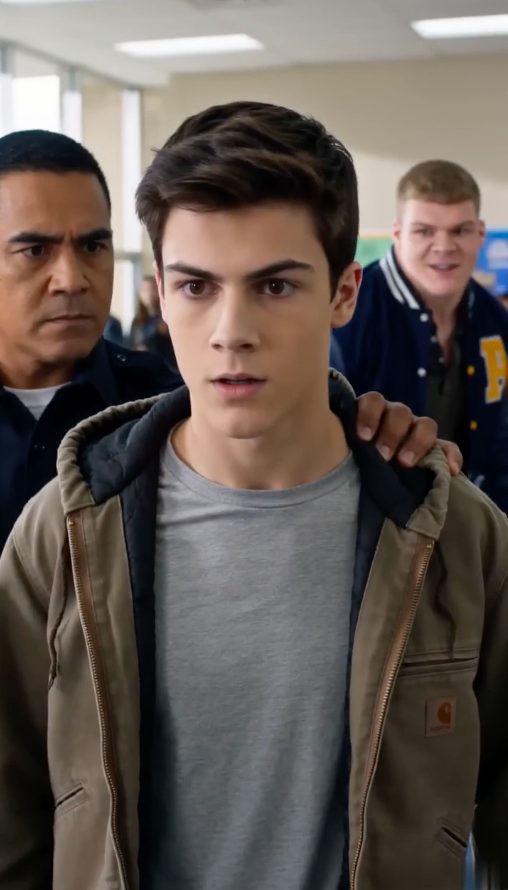
We were taken into a small conference room behind the principal’s office.
Mr.
Davis sat at the far end of the table.
Beside him was the assistant principal, a woman with neatly arranged papers and an expression that revealed almost nothing.
A district administrative representative joined by video call from another office.
My mother sat beside me.
She placed our notes on the table.
Mr.
Davis began speaking before anyone asked a question.
“We take student safety extremely seriously.”
My mother nodded.
“So do I.”
“The behavior demonstrated in the cafeteria was unacceptable.”
“Which behavior?”
He looked at her.
“The violent attack.”
“I’m asking which part of the incident you’re referring to.”
The assistant principal shifted in her chair.
Mr.
Davis leaned back.
“Mrs.
Mercer, we are not going to debate terminology.”
My mother opened her folder.
“Then let’s discuss the timeline.”
She asked whether the principal had spoken to anyone who saw Trent approach the table.
He said several students had been interviewed.
She asked whether those students were questioned about the first physical contact.
He said the interviews were confidential.
She asked whether school security had witnessed the beginning.
He acknowledged they had arrived after the disturbance was reported.
Then she asked about the cafeteria cameras.
Mr.
Davis glanced toward the screen.
“The system was experiencing technical difficulties.”
The district representative leaned forward slightly.
“Which system?”
The principal hesitated.
“The cafeteria cameras.”
“Was that reported to technology services?”
“I believe so.”
The representative made a note.
My mother remained quiet for several seconds.
Then she placed a photograph on the table.
It showed the loose sleeve of my jacket, the stretched seam, and the strip of white athletic tape still caught in the canvas.
“This came from the other student’s hand,” she said.
Mr.
Davis looked at it.
“We’re aware the jacket was involved.”
“Then can someone explain how his hand ended up inside the sleeve?”
The assistant principal leaned forward to examine the photograph.
Mr.
Davis did not.
“That doesn’t change the fact that your son used force.”
“No,” my mother agreed.
“It doesn’t.
But it may help explain why.”
For the first time, I saw the district representative studying something other than the paperwork in front of him.
He asked to receive the photograph.
Mr.
Davis moved his hand across the table.
“We don’t need to prolong this.”
The representative looked at him.
“I’d still like a copy.”
My mother sent it before the meeting ended.
The conference lasted nearly an hour.
It accomplished less than I had hoped, but more than Mr.
Davis seemed to want.
The suspension remained in place pending a higher-level review.
The district representative said he would request the original footage status from technology services and ask that witness statements be preserved.
My mother insisted that my account be included in the disciplinary record.
The principal reluctantly agreed.
When we stood to leave, I noticed the framed photograph of Trent visible through the open office doorway.
He was holding a football helmet beneath the stadium lights.
Mr.
Davis followed my gaze.
“Trent has a very promising future,” he said.
My mother stopped.
“So does my son.”
The principal looked uncomfortable.
“I wasn’t suggesting otherwise.”
“Then please stop making decisions as though one future matters more than the other.”
She opened the conference-room door.
I followed her into the hallway.
For a moment, neither of us spoke.
Then I noticed someone standing near the water fountain.
It was the boy who hadn’t laughed when Trent approached me.
He wore a school athletic jacket and held a notebook against his chest.
When he recognized me, he looked toward the office, then quickly lowered his eyes.
I almost walked past.
But he spoke.
“Hey.”
I stopped.
He swallowed.
“I’m sorry.”
I waited.
He glanced at my mother.
“I was sitting with them.”
“I remember.”
He shifted the notebook between his hands.
“I didn’t know he was going to do that.”
I thought about the laughter, the phones, and the way his teammates had surrounded Trent afterward.
“Did you see him hit me?”
The boy looked toward the principal’s office.
“Yes.”
My pulse quickened.
“Did you tell anyone?”
He didn’t answer.
My mother remained beside me.
The boy’s face tightened.
“Coach said we shouldn’t get involved until the school finished investigating.”
“Did Coach see it?”
I asked.
“No.”
“Then why would he tell you not to speak?”
The boy stared at the floor.
“I don’t know.”
He clearly did know something, but fear had settled so firmly across his face that I couldn’t bring myself to press him.
My mother spoke gently.
“You can still tell the truth.”
He nodded once.
Then he hurried away.
I watched him disappear around the corner.
My mother touched my arm.
“He’s afraid of something.”
“Losing his place on the team,” I said.
“Maybe.”
I looked back toward the office.
For the first time, I wondered whether Trent’s reputation existed partly because other students had learned how expensive it could be to challenge him.
That night, my mother helped me organize my assignments.
We sat at the kitchen table while rain tapped against the windows and traffic hissed along the road outside.
My chemistry textbook lay open between us, but I had spent ten minutes reading the same paragraph without understanding a word.
She noticed.
“You don’t have to pretend you’re concentrating.”
I closed the book.
“I hate this.”
“I know.”
“I didn’t even want anybody to notice me.”
She smiled sadly.
“I remember.”
“I thought if I kept quiet, nothing would happen.”
My mother folded her hands.
“That must have seemed reasonable.”
“It worked everywhere else.”
“Until it didn’t.”
I leaned back.
“Why does being quiet make people think they can do whatever they want to you?”
She considered the question.
“Sometimes it doesn’t,” she said.
“Sometimes somebody has already decided what they want to do, and they’re looking for a person they think won’t resist.”
I looked at my jacket hanging by the kitchen doorway.





