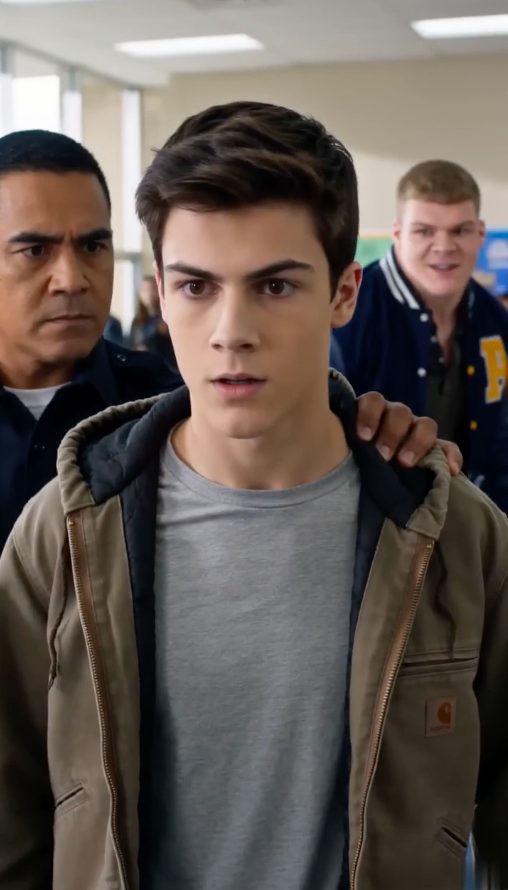
“Maybe I should’ve just given him the seat.”
“Maybe he would have left you alone that day.”
“Then none of this would’ve happened.”
“Perhaps.”
Her answer surprised me.
I had expected her to insist that I had done everything correctly.
Instead, she reached across the table.
“But remember what you’re saying.
You’re asking whether giving up something ordinary might have stopped another person from choosing to hurt you.
You can learn from what happened without pretending his choices were yours.”
I stared at our joined hands.
“What if I go back and it happens again?”
She didn’t offer an easy promise.
“We’ll make a plan for that.”
“And if the school doesn’t change?”
“Then we’ll keep asking questions until we understand what options we have.”
I looked at her tired face.
There were shadows beneath her eyes that hadn’t been there before the move.
“I’m making everything harder.”
She squeezed my hand.
“No.
Someone made a terrible decision in that cafeteria.
Now some adults are making other decisions about it.
You’re allowed to expect them to be fair.”
I wanted to tell her how afraid I was.
Not of Trent.
Not even of another physical confrontation.
I was afraid of watching my future become something strangers could destroy with a few sentences on an official form.
I was afraid that every explanation would sound like an excuse, every silence like an admission, and every attempt to defend myself like further evidence that I was dangerous.
But the words wouldn’t come.
My mother seemed to understand anyway.
She came around the table and hugged me.
I held on longer than I had in years.
The first significant change came the following morning.
Officer Ramirez called my mother.
He said he had spoken with several students and was still reviewing information.
Although he couldn’t disclose every detail, he wanted to confirm whether I still had the jacket from the cafeteria.
My mother said yes.
He asked whether it had been washed or altered.
“No,” she replied.
“Please keep it that way for now.”
She looked at me.
I sat up straighter.
“Has something changed?” she asked.
The officer paused.
“I have information that the other student was using athletic tape on his hand before the incident.”
My mother glanced toward the sleeve.
“There’s a piece of that tape caught in the fabric.”
“I’d like to document it.”
She arranged a time.
When the call ended, she sat quietly for several seconds.
I could barely contain myself.
“Does that mean he believes me?”
“It means he’s checking something.”
“But the tape—”
“It’s important,” she said.
“We just don’t know how important yet.”
I looked toward the kitchen doorway.
The jacket hung where we had left it.
For three weeks, it had been something I wore to make myself disappear.
Now it was the first physical detail that someone investigating the incident seemed genuinely interested in understanding.
Later that day, Lena sent another message.
I told my mom.
I stared at the screen.
What did she say?
That I need to tell the truth.
My hands felt suddenly warm.
Are you going to?
Yes.
A second message followed.
But I think you should know something.
I waited.
There’s a video that starts earlier.
I sat perfectly still.
Do you have it?
No.
Someone else does.
I looked toward the living room, where my mother was sorting documents.
Who?
Lena hesitated.
One of Trent’s friends.
I thought immediately of the phone angled beneath the table.
Why hasn’t he shown it?
Her reply appeared after a long silence.
Because it shows everything.
I read those words until they seemed to lose their meaning.
For days, I had been fighting against a recording that began after Trent had already attacked me.
Now someone might possess the missing moments.
The boot.
The earphones.
The first strike.
The attempted punch.
The truth might exist somewhere on a teenager’s phone, carried through the same hallways where people were calling me a violent stranger.
I showed my mother.
She read the message and carefully placed her documents aside.
“Don’t ask anyone to steal it,” she said.
“I wasn’t going to.”
“And don’t threaten anybody.”
“I know.”
She looked at me.
“If someone has the complete recording, they can choose to share it with the officer or the district.
We can ask them to preserve it.”
I nodded.
But I was thinking about the boy in the hallway, the way he had looked toward the principal’s office before admitting that Trent hit me.
Fear wasn’t always loud.
Sometimes it looked like a teenager holding a notebook too tightly.
By Friday, the original cafeteria clip had become old news for most students.
For me, every day was still connected to it.
I completed assignments at home while my mother worked and checked the school portal for messages.
A few teachers sent brief, polite notes.
Others said nothing beyond listing the pages I needed to finish.
The silence made ordinary schoolwork feel strange.
I had always liked chemistry because its problems contained rules that remained true regardless of how anyone felt about them.
If a calculation was wrong, you could find the error.
If an experiment produced unexpected results, you could examine what happened.
There was something comforting about that.
I wished people were as willing to check their assumptions.
Around lunchtime, a district email arrived.
It acknowledged my mother’s request to preserve relevant evidence and confirmed that technology services were reviewing archived recordings from the cafeteria system.
The message stated that the school administration would be informed if additional material became available.
My mother read it aloud over the telephone during her break.
“Archived recordings,” I repeated.
“Yes.”
“So the cameras were working?”
“We don’t know yet.”
“But Mr.
Davis said they had technical problems.”
“He did.”
I could hear office noise behind her.
“Mom?”
“Yes?”
“Do you think he lied?”
She didn’t answer immediately.
“I think he has told us several things that don’t fit together.”





