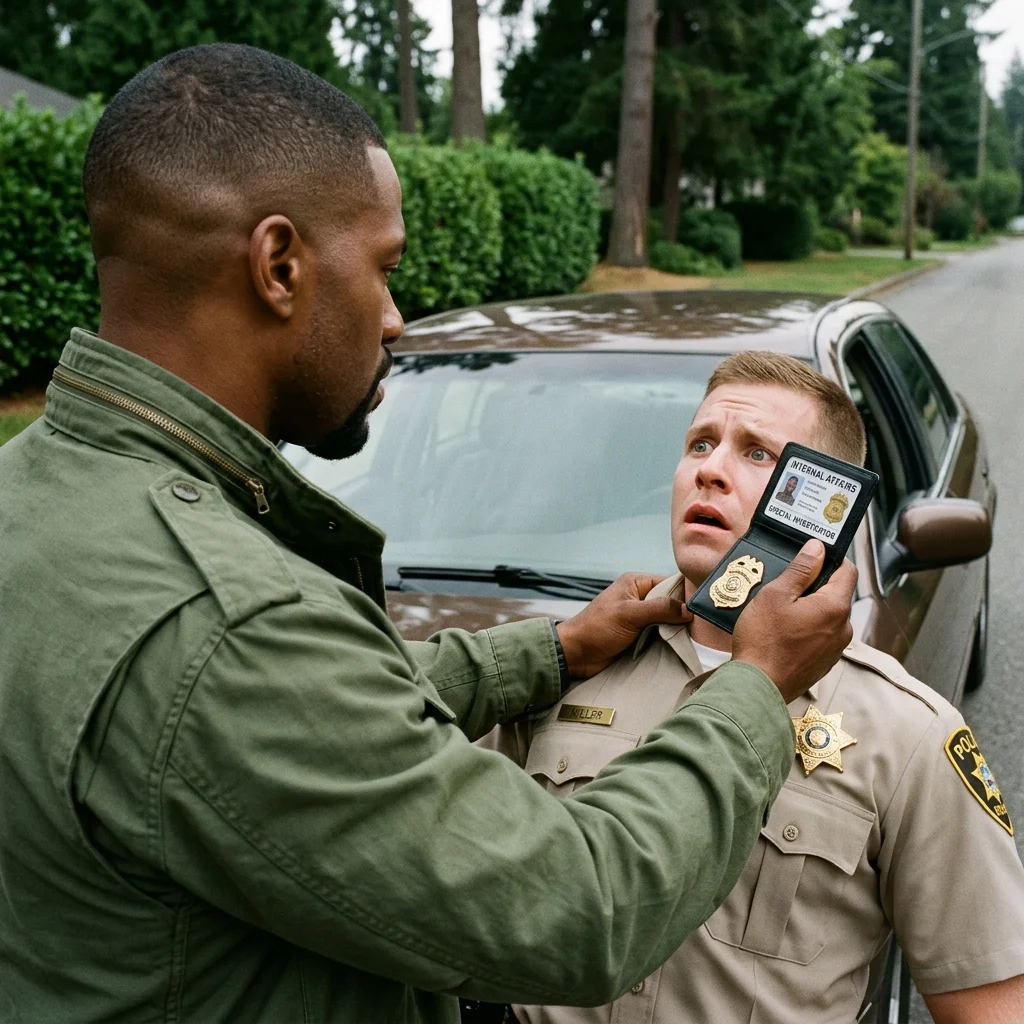
His cooperation reduced some of his potential punishment, but it did not erase his responsibility.
He received a substantial prison sentence.
During his sentencing hearing, the judge asked whether he wished to address the victims.
Calder stood slowly.
His voice shook.
“I told myself I was following orders.”
He looked toward Daniel Whitcomb.
“I told myself the people I arrested would somehow be okay.”
Then he began to cry.
“But I knew what I was doing.”
He swallowed.
“I knew they were innocent.”
Marcus watched from the back of the courtroom.
He felt no satisfaction in seeing another man cry.
There had already been too many tears.
Too many birthdays missed.
Too many families broken.
Too many years that could never be returned.
The judge listened before delivering the sentence.
Calder was taken away in handcuffs.
This time, the evidence was real.
Warren Sloane and Lucinda Vale were later convicted of major offenses connected to the conspiracy, including corruption and fraudulent conduct.
Their appeals continued through the courts.
Civil proceedings resulted in financial settlements for several victims and restoration of property rights where legally possible.
Nothing happened quickly.
Some families had already moved away.
Some homes could not be recovered.
And no court order could restore a stolen childhood or erase the terror of being imprisoned for something one had never done.
But the community had finally gained the power to decide its own future.
The largest surprise came when the property litigation was resolved.
After reviewing the original covenant and the fraudulent conveyance, the court ruled that the attempted transfer had violated the trust agreement and that the trust’s reversion rights were enforceable.
The city ultimately settled the remaining dispute, transferring its interest in the annex building to the trust as part of a broader resolution.
The Fourth Street police annex would no longer belong to the police department.
It would be controlled by the community land trust.
When that news reached Ada Whitcomb, she sat silently at her kitchen table.
Then she began laughing through her tears.
“They spent millions trying to take it from us.”
She shook her head in disbelief.
“And now we get to decide what happens inside.”
Marcus sat across from her.
“What would you like to do with it?”
Ada considered the question.
Then she smiled.
“Your mother always wanted a place where people could walk through the door and be heard.”
Marcus looked at her.
“A community center?”
“More than that.”
She reached for his hand.
“A place where people who can’t afford a lawyer can find one.”
“A place where children can study safely.”
“A place where nobody gets pushed out because they don’t have money or connections.”
Marcus smiled.
“I think she’d like that.”
Ada squeezed his hand.
“I think she’d love it.”
One year later, the former Fourth Street police annex reopened.
The boarded windows were gone.
The brick walls had been restored.
Flowers grew along the entrance.
A new sign stood above the doors.
EVELYN HALE COMMUNITY JUSTICE CENTER
FOUNDED ON THE PRINCIPLE THAT JUSTICE BELONGS TO EVERYONE
Inside were legal aid offices, classrooms, counseling rooms, and a community history archive.
Ada ran a small kitchen in the renovated ground floor.
Daniel helped organize employment programs for people returning from prison.
Rosa coordinated educational services.
Leonard volunteered to transport elderly residents to appointments.
Arthur Vale, now moving mostly by wheelchair, attended the opening ceremony with tears in his eyes.
He had lived long enough to see the promise he helped write become real.
Marcus arrived carrying a small wooden frame.
Inside was the original 1968 photograph.
Four women stood smiling outside the old brick building.
His mother stood on the far right.
He placed the photograph near the entrance.
Then he stepped back.
For a moment, he could almost hear her voice.
He remembered the years they had disagreed.
He remembered the words he wished he had spoken before she died.
He remembered how desperately he had wanted her to be proud of him.
Elena appeared beside him.
“She would be.”
Marcus smiled faintly.
“I hope so.”
“Marcus, you stood up to people who believed nobody could stop them.”
He shook his head.
“No.”
He looked across the room.
Ada was laughing with her son.
Tessa was helping children register for tutoring.
Aaron Brooks was speaking with volunteers.
Arthur Vale sat beside a display of the trust’s founding documents.
“They stood up long before I did.”
Elena followed his gaze.
Marcus continued.
“My mother.”
“Ada.”
“The trustees.”
“The people who filed complaints nobody wanted to read.”
He looked back at the photograph.
“All I did was finally listen.”
A little boy approached him.
He was perhaps eight years old, wearing a yellow jacket and carrying a library book.
“Excuse me, mister.”
Marcus smiled.
“Yes?”
The boy pointed toward the photograph.
“Was that your mom?”
“Yes.”
“Did she own this building?”
Marcus considered the question.
Then he knelt beside the child.
“She helped make sure it belonged to the people who needed it.”
The boy looked around.
“Does that mean we can come here whenever we need help?”
Marcus felt his throat tighten.
“That’s exactly what it means.”
The boy smiled brightly and ran toward the classroom.
Marcus watched him disappear through the open doorway.
Outside, afternoon sunlight fell across Fourth Street.
Cars passed.
Children laughed.
Neighbors gathered beneath the trees.
And standing where a corrupt officer had once believed his badge made him untouchable, Marcus finally understood the lesson his mother had spent her life trying to teach him.
A badge could command obedience.
A title could create fear.
Money could buy influence.
But none of those things could turn a lie into the truth.
He reached into his jacket and removed his Internal Affairs credentials.
For a moment, he looked at the badge.
Then he returned it to his pocket.
He still had work to do.
There were other complaints to investigate.
Other people waiting to be heard.
Other officers who needed to be held accountable.





