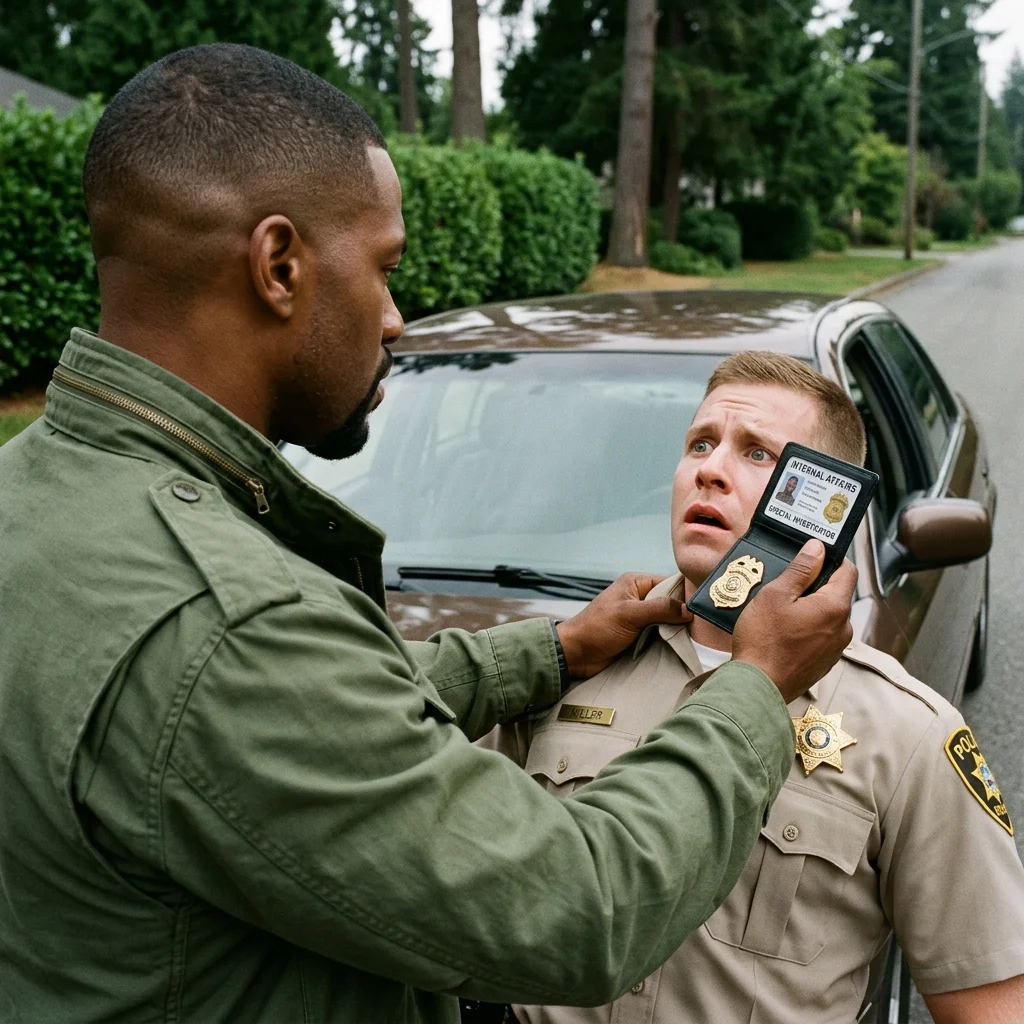
The officer’s hand entering Marcus’s jacket.
The plastic bag appearing seconds later.
The unprovoked strike.
The failed attempt to overpower him.
And finally, the moment Marcus displayed his Internal Affairs credentials.
People replayed that moment again and again.
Some celebrated.
Others demanded explanations.
But Marcus refused to watch the video.
He had seen enough.
What troubled him was not the public outrage.
It was the photograph resting on his desk.
Four women.
One brick building.
One number.
004.
The Internal Affairs headquarters occupied the fifth floor of a government building overlooking Bellhaven’s financial district.
Normally, Marcus found comfort in its quiet hallways and orderly offices.
That evening, however, the place felt strangely exposed.
Every ringing telephone sounded urgent.
Every approaching footstep made him look toward the door.
Elena entered carrying a thick folder.
“We’ve identified the first three numbers.”
Marcus stood.
“Tell me.”
She spread three photographs across his desk.
The first showed a middle-aged Black man wearing a blue mechanic’s uniform.
“Daniel Whitcomb,” Elena said.
“Fifty-one years old.”
“Convicted three years ago after officers claimed they found narcotics in his vehicle.”
“Officer involved?”
“Calder.”
Marcus studied the photograph.
“Sentence?”
“Eight years.”
Elena placed down the second photograph.
It showed a woman with tired eyes and a gentle smile.
“Rosa Delgado.”
“Former school counselor.”
“Arrested eighteen months ago after a traffic stop.”
Marcus frowned.
“Another drug charge?”
“Yes.”
“And Calder?”
“Same officer.”
The third photograph showed an older man standing beside a little girl in a yellow dress.
“Leonard Price,” Elena continued.
“Retired bus driver and neighborhood volunteer.”
“His arrest happened nine months ago.”
Marcus looked at her.
“Let me guess.”
Elena nodded.
“Calder again.”
Marcus sat slowly.
Three people.
Three suspicious arrests.
Three lives disrupted.
And now somebody had attempted to make him the fourth.
But there was something else connecting the defendants.
Daniel Whitcomb had lived on Fourth Street.
Rosa Delgado had owned a townhouse near the police annex.
Leonard Price had been a trustee of a community-owned property fund.
Marcus looked up sharply.
“What kind of property fund?”
Elena opened another file.
“The Fourth Street Community Trust.”
Marcus felt his pulse quicken.
“Founded in 1968?”
“Yes.”
He reached for the photograph Ada had given him.
Elena stared at it.
“Where did you get that?”
“From Ada Whitcomb.”
Elena studied the four women.
“Marcus, one of those women is your mother.”
“I know.”
“And the trust?”
“I’ve never heard her explain it.”
Elena hesitated.
“Then there’s something you need to understand.”
She turned her laptop toward him.
Displayed on the screen was a scanned municipal record from 1968.
The document described an unusual agreement between the City of Bellhaven and a group of neighborhood families.
At the time, Fourth Street had been threatened with demolition under an urban redevelopment program.
Residents had organized to protect their homes and create a community health and safety center.
Four women had led the campaign.
Evelyn Hale.
Margaret Whitcomb.
Isabel Delgado.
Dorothy Price.
They had eventually established a community land trust and negotiated a long-term agreement with the city.
Several connected parcels had been placed under collective stewardship.
One parcel had been leased to the city for public safety services, provided it remained dedicated to the surrounding community.
That parcel later became the Fourth Street police annex.
Marcus stared at the screen.
“My mother helped create the trust?”
Elena nodded.
“She was one of its original trustees.”
He looked again at the photograph.
All his life, he had believed his mother’s disagreements with the police were mainly ideological.
He remembered arguments across the dinner table.
He remembered her disappointment when he entered the academy.
He remembered the evening she had asked him whether he would still recognize injustice if the person committing it wore the same uniform he did.
He had answered angrily.
He had told her that not every officer was corrupt.
She had agreed.
Then she had asked a question he had never forgotten.
“And what will you do when you meet the ones who are?”
Marcus had spent most of his career trying to answer that question.
Yet he had never understood what she had been protecting.
Elena pointed to the document.
“Here’s where things get complicated.”
“The trust still holds enforceable interests in several properties.”
“Any permanent transfer of the annex property to private ownership requires the trustees’ consent or a valid court order terminating their rights.”
Marcus leaned forward.
“Has the city proposed a transfer?”
Elena opened another document.
“The mayor’s office announced the Bellhaven Renewal Initiative last month.”
“A commercial district with luxury apartments, offices, and a new technology campus.”
“The annex occupies the most valuable section of the proposed development.”
Marcus read the numbers.
The project was estimated at $186 million.
He looked at Elena.
“Who is buying the land?”
“Blue Harbor Development.”
“Who owns it?”
“That’s what we haven’t established.”
Marcus stood and walked toward the window.
Below him, the lights of Bellhaven flickered across the streets.
He had spent years investigating officers who accepted bribes or falsified reports.
But this was something different.
The officers might not have been planting drugs simply to make arrests.
They might have been destroying the legal rights of people standing in the way of a fortune.
His phone rang.
The caller was Director Helen Ward, the head of Internal Affairs.
“Marcus, I need you upstairs.”
He looked at Elena.
“Director Ward.”
Elena closed the laptop.
“I’ll continue checking the property records.”
“Don’t access anything through the city network.”
“Already moved the working copies to our secured evidence system.”
“Good.”
Marcus headed upstairs.
Helen Ward was waiting behind a large wooden desk.
She was a severe-looking woman in her late fifties, with silver-framed glasses and an expression that rarely revealed her thoughts.
She had recruited Marcus into Internal Affairs eight years earlier.
He respected her more than almost anyone in law enforcement.
But tonight, she looked unusually troubled.
“Close the door.”
Marcus obeyed.
Ward motioned toward a chair.





