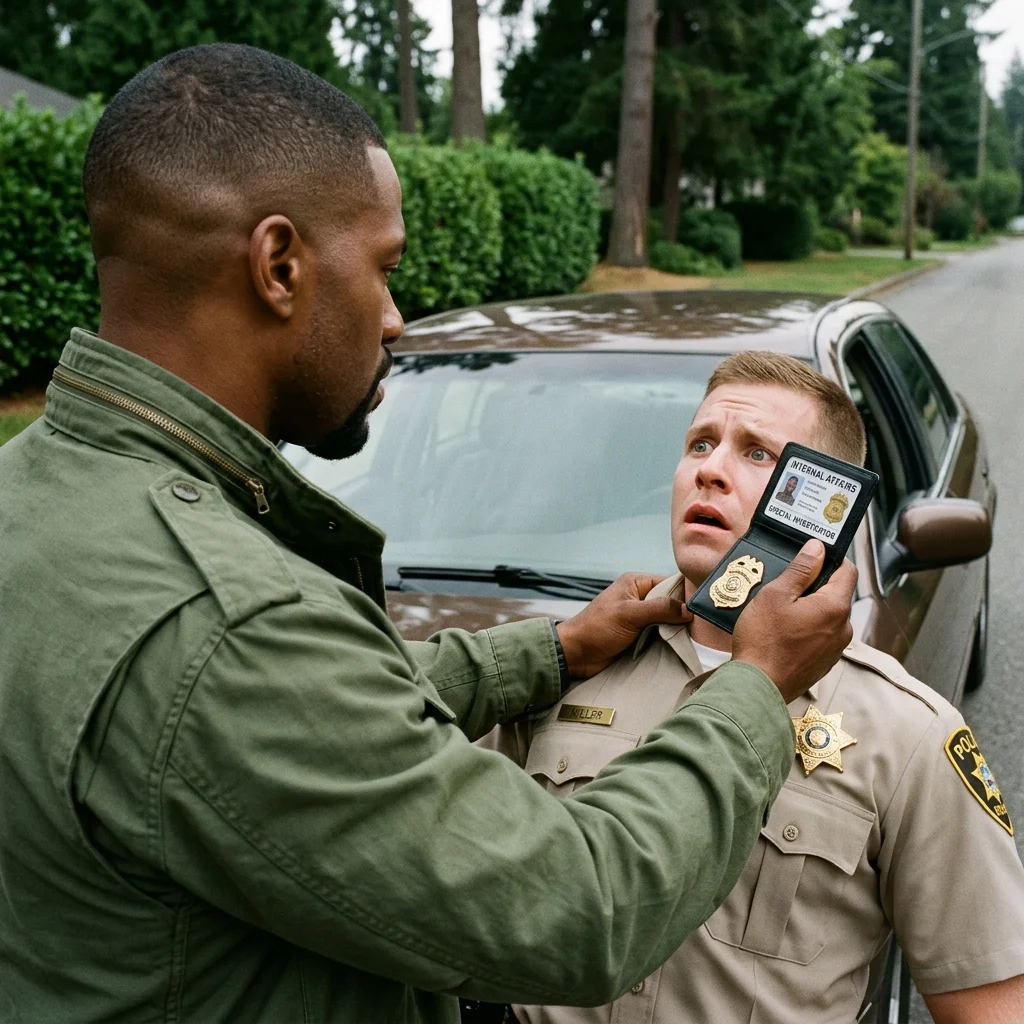
Park studied him carefully.
“Who else is involved?”
Calder swallowed.
“The city attorney.”
“Lucinda Vale?”
He nodded.
“She’s the one who knows where all the original documents are.”
Park leaned forward.
“Where?”
Calder looked toward the camera.
For the first time, he seemed truly desperate.
“Before I tell you, I want protection.”
“From whom?”
Calder closed his eyes.
“From the people who made a nineteen-year-old kid disappear when he filed a complaint against me.”
Marcus remembered the eleven-year-old report.
Aaron Brooks.
The young student whose complaint Warren Sloane had dismissed.
Park’s voice sharpened.
“Are you telling me Aaron Brooks was murdered?”
Calder began to cry.
“I don’t know.”
“But Sloane made sure nobody ever heard from him again.”
Then he whispered the name of a place.
“The basement of Annex Four.”
At 3:17 the following morning, Marcus stood outside the Fourth Street police annex and looked up at the building his mother had spent much of her life trying to protect.
It was an ugly structure now.
Its brick walls were stained by decades of rain.
Half its windows were boarded.
A weathered sign announced that the building would soon be demolished as part of the Bellhaven Renewal Initiative.
For years, Marcus had passed this place without giving it much thought.
Now he understood that its foundations held more than concrete and steel.
They held the history of families who had fought to keep their neighborhood alive.
Elena stepped beside him.
“The state warrant covers the basement archive, records storage, and all evidence connected to the trust.”
Marcus nodded.
“Park’s leading the search?”
“Yes.”
“Good.”
He glanced toward the police vehicles waiting behind them.
The state investigators had arrived without using the Bellhaven Police Department’s dispatch system.
That decision was deliberate.
Deputy Chief Warren Sloane still commanded hundreds of officers.
Until the extent of the conspiracy became clear, nobody could be certain which employees were involved or who might warn him.
Elena looked at Marcus.
“You shouldn’t be going inside.”
“I know.”
“Your recusal matters.”
“I’m not participating in the search.”
“Then what are you doing?”
Marcus looked toward the old building.
“Trying to understand why my mother spent twenty years afraid of it.”
Elena’s expression softened.
“You can do that when the evidence is secured.”
He nodded reluctantly.
Park approached with a team of state investigators.
“Marcus, I need you outside the restricted area.”
“Understood.”
She looked toward the annex.
“We’ll keep you informed through the appropriate channels.”
Then she entered.
The first hour passed without incident.
Investigators photographed storage rooms filled with broken furniture, abandoned filing cabinets, and boxes of water-damaged records.
They found evidence disposal forms dating back more than a decade.
Many were incomplete.
Others contained signatures from officers who had supposedly been on leave.
Then Park discovered a steel door hidden behind shelving at the far end of the basement.
Its lock had recently been replaced.
The door carried a small metal plate.
ROOM 004 — RESTRICTED ARCHIVE.
Park requested the key.
The building supervisor claimed he did not have one.
When investigators examined his access records, however, they found that the door had been opened less than forty minutes earlier.
Someone was still inside.
Park ordered the door opened under the warrant.
A locksmith began working.
From the hallway came a sudden metallic crash.
A fire alarm sounded.
Smoke appeared beneath the door.
“Fire!” an investigator shouted.
The team moved quickly.
Fire extinguishers were brought forward.
The door finally opened.
Inside, a man in a gray maintenance uniform stood beside an overturned metal wastebasket.
Burning documents lay scattered across the floor.
He raised his hands immediately.
“Don’t shoot!”
Park ordered him away from the fire.
The flames were extinguished before they spread.
The man identified himself as Thomas Reddick, a contracted maintenance supervisor.
He claimed someone had ordered him to destroy the files.
“Who?” Park demanded.
Reddick stared at the floor.
He said nothing.
Park showed him the warrant.
“Destroying evidence during an authorized search is a serious offense.”
Reddick’s hands shook.
“He told me nobody would come until morning.”
“Who told you?”
“Deputy Chief Sloane.”
Park stepped closer.
“Where is he?”
Reddick hesitated.
“City Hall.”
“With whom?”
Reddick swallowed.
“The attorney.”
Within minutes, Park contacted the state attorney general’s command center.
Emergency orders were prepared to preserve records at City Hall and the offices of Blue Harbor Development.
A judicial order temporarily blocked the disputed property transfer.
But the basement investigation had already uncovered something more disturbing.
Behind the steel door, investigators found hundreds of folders organized by neighborhood and property address.
Many contained copies of police complaints.
Others included photographs of residents, financial records, medical information, and handwritten notes evaluating whether a person could be pressured into signing legal documents.
One folder was labeled WHITCOMB — LEVERAGE.
Another read DELGADO — FAMILY EXPOSURE.
A third carried Leonard Price’s name.
Inside it was a photograph of his grandson walking to school.
Park stared at the documents.
These were not ordinary police records.
They were files designed to identify people’s vulnerabilities and turn those vulnerabilities into weapons.
In another cabinet, investigators found copies of laboratory reports corresponding to the arrests.
Several lacked the raw testing data required to support their conclusions.
Other reports contained identical language, including the same spelling mistakes.
The laboratory had allegedly certified multiple samples as controlled substances without valid supporting tests.
Park ordered every document preserved.
Then she found a thin folder marked BROOKS, AARON — CLOSED.
Inside was the original complaint Aaron Brooks had filed eleven years earlier.
The statement described Calder planting drugs, threatening him, and demanding a confession.
Attached was a handwritten memorandum from Warren Sloane.
SUBJECT HAS CONTACTED OUTSIDE ADVOCATES.
FURTHER COMPLAINTS MUST BE PREVENTED.
Below it was the name of the advocate Aaron had contacted.
EVELYN HALE.
Marcus’s mother.
When Park sent a photograph of the page to Director Ward, Ward immediately recognized its significance.





