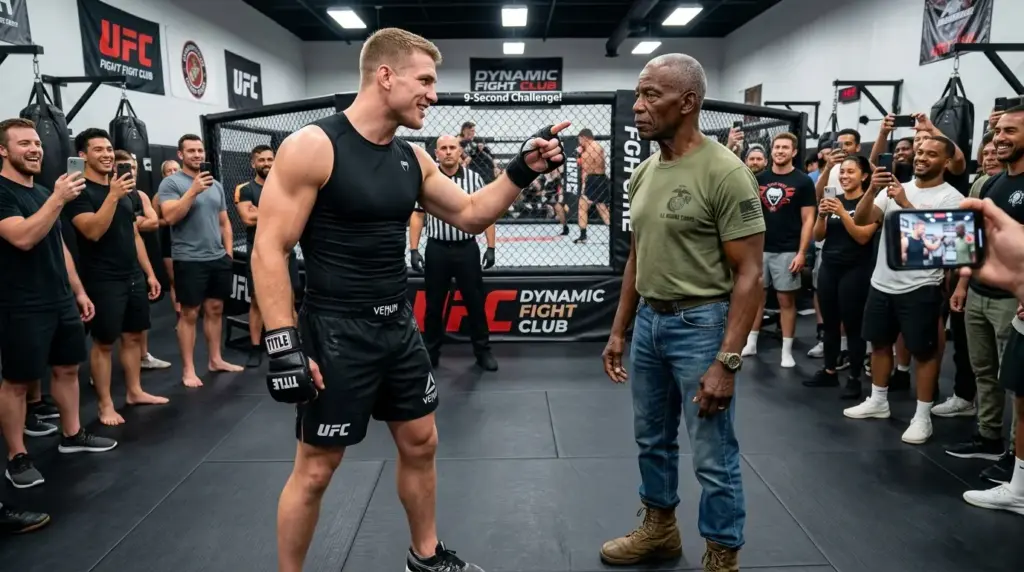
“Fletcher,” Wade said one evening, tossing a set of keys across the front desk, “Colt’s got a private session at midnight. Make sure the back lot is clear and the cameras in Hall B are off. He doesn’t like being recorded during training.”
Byron caught the keys without a word.
“And stay out of the main floor,” Wade added. “Colt says you make the place look old.”
Byron nodded.
He walked to the back lot, cleared the cars, and stood in the cold for forty minutes until the session ended.
When he came home that night, he sat on the edge of his bed and looked at the photograph on the shelf.
Eight men.
Three were gone now.
Two never came home from Fallujah. One had taken his own life in 2011.
Byron’s hands rested on his knees.
The same hands that had once ended a close-quarters fight in under four seconds.
He closed his eyes.
Not because he was tired.
Because remembering took effort, and he had learned to ration it.
The worst of it started on a Tuesday night.
Byron was sitting on a metal folding chair near the back entrance, eating the sandwich he had packed from home. White bread. Ham. Nothing fancy. It was his thirty-minute break before the late-session crowd arrived.
Colt walked in through the main doors with two sparring partners and a camera crew. He was filming content for his YouTube series, a behind-the-scenes show Wade had titled Champion Life.
Colt spotted Byron immediately.
“What is this?” Colt said, loud enough for the cameras. “You eating on my floor?”
Byron lowered the sandwich.
“I’m on break, Mr. Brennan.”
“Your break is outside with the rest of the strays.”
One of the sparring partners laughed. The cameraman shifted his angle.
Colt walked over and kicked the chair out from under Byron.
The metal scraped across the concrete. Byron went down on one knee. His sandwich landed face down on the mat.
He did not say a word.
He picked up the chair.
He picked up the sandwich.
He stood.
Colt stepped closer.
“Still here? I said get out. You’re stinking up my gym.”
Nora appeared from the striking room.
“He has every right to—”
“Shut up, Nora,” Colt snapped. “Nobody asked the B team.”
Nora’s jaw tightened, but she held back. She knew what Colt could do to her career with one phone call to Wade.
And Wade arrived right on schedule.
He walked in behind the camera crew, looked at the scene, and made his calculation in less than two seconds.
“Fletcher,” Wade said, “apologize to Colt. Now.”
Byron looked at Wade. Then at Colt. Then at the camera still recording.
“I’m sorry, Mr. Brennan.”
Colt grinned.
“Louder, for the camera.”
Byron’s voice stayed flat.
“I’m sorry.”
Colt patted him on the shoulder like a dog.
“Good boy.”
The crew laughed. The sparring partners clapped. Wade nodded and walked away.
Byron stood in the hallway for a long time after they left.
His right hand was shaking.
Not from fear.
From something he had spent decades learning how to control.
Nora found him ten minutes later. She did not speak. She just handed him a bottle of water and stood beside him until the shaking stopped.
After the chair incident, Colt did not stop.
He got worse.
It became a routine.
Every night Colt trained at Apex, Byron became part of the show. Not as a person. As a prop.
On Monday, Colt threw a sweaty hand wrap at Byron’s face as he passed the front desk.
“Hold that for me, Grandpa.”
Byron caught it without flinching. It was soaked with sweat and smelled like salt and rubber. Two trainers nearby looked away.
Neither said a word.
On Wednesday, Colt ordered Byron to hold the heavy bag during a filmed session. Not for training. For content.
“Stand behind it,” Colt told him. Then he smiled at the camera. “Let’s see if the old man can take a punch through the bag.”
He hit the bag so hard Byron stumbled backward into the wall. His shoulder blade cracked against the drywall.
The crew laughed.
Colt posted the clip with the caption:
When the security guard becomes the punching bag.
It got four hundred thousand views in two days.
The comments were ruthless.
This old dude is hilarious.
Someone get Grandpa out of there.
Colt is savage for this.
Three million followers and climbing. Brand deals doubling. More engagement. More money.
Colt was winning.
On Thursday, he dropped his mouth guard on the floor, stepped on it with his full weight, and told Byron to pick it up.
Byron bent down. His knees cracked loud enough for the nearest trainer to hear.
“Hear that?” Colt said to his sparring partner. “That’s the sound of something that should have been thrown out years ago.”
On Friday, Colt spat water near Byron’s shoes during a live Instagram session.
“Oops,” he said, grinning at the phone. “Didn’t see you there. Probably because you’re irrelevant.”
The clips kept coming.
Every humiliation became a thumbnail. Every insult became engagement. Every time Byron bent down to pick something up, Colt’s analytics ticked upward.
From Colt’s perspective, Byron was perfect content.
Reliable.
Quiet.
Harmless.
The perfect victim for a brand built on dominance.
He never once considered that Byron might be anything other than what he appeared to be: a tired old Black man too broke to quit.
Wade made it worse in his own way.
Not with insults.
With paperwork.
He cut Byron’s hours from forty to twenty-eight. He moved Byron’s shift from six in the evening to eleven at night, which meant Byron lost the overtime he relied on for rent. He removed Byron’s name from the building access list for the front entrance, forcing him to enter through the loading dock in the back.
When Byron asked about the changes, Wade did not look up from his laptop.
“Budget adjustments.”
Nora overheard him.





