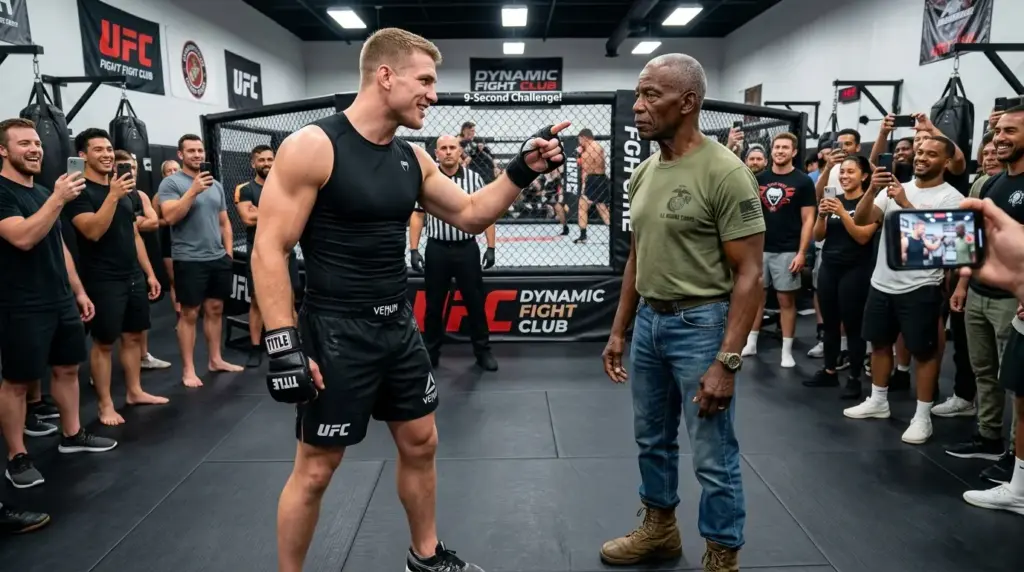
Not the full live-stream footage.
A clip pulled from Apex’s internal security system.
Edited.
The version Wade released began the moment Byron grabbed Colt’s arm. Everything before that was gone: Colt pointing at him, the insults, the order to get in the ring, the physical grabbing, the forced walk to the mat.
Wade also deleted the original security footage from the gym server. He told the front desk staff the system had crashed. He told the police the same thing.
In Wade’s version, Byron was the aggressor.
A violent old man attacking a champion without provocation.
The headline hit local news by noon.
Elderly Security Guard Assaults MMA Champion During Live Event.
By Tuesday, the story was national. Cable news ran the edited clip on loop. Commentators called it disturbing. A former prosecutor said the technique showed training, and training suggested intent.
Talk radio picked it up.
A seventy-year-old man with that kind of skill set walking around as a security guard? That is not innocent. That is a loaded weapon pretending to be harmless.
The phrase loaded weapon started trending.
Colt leaned into it.
He posted an Instagram story from a hospital bed, arm in a sling, eyes wet, voice soft.
“I just wanted to entertain people,” he said. “I never expected someone to try to hurt me like that. I’m scared. I don’t feel safe.”
His publicist had coached every word.
It got eleven million views in eight hours.
The comment section filled with sympathy.
Stay strong, Colt.
That old man belongs in jail.
Lock him up.
Byron was fired on Tuesday afternoon.
Wade called him into the office, slid a termination letter across the desk, and did not make eye contact.
“Effective immediately.”
“I have a jacket in my locker,” Byron said. “And a photograph.”
“We’ll mail it.”
Byron walked out through the loading dock for the last time.
No one from the staff said goodbye.
Two trainers who had watched the entire incident pretended to be on their phones as he passed.
The parking lot was empty.
His bus did not come for forty minutes.
He stood under the streetlight and waited.
The police came to Byron’s apartment on Wednesday morning. Two officers. They did not arrest him, but they took a statement and told him not to leave the city. A detective would follow up.
After they left, Byron sat at his kitchen table.
The apartment was quiet. The folded flag on the shelf caught the morning light through the blinds. The refrigerator hummed. The wooden box sat where it always sat.
He had no lawyer.
He could not afford one.
The three attorneys Nora called on his behalf all declined within twenty-four hours. One said the case was too high-profile. Another said Colt’s legal team had already contacted their firm with warnings about countersuits. The third simply said, “I don’t want the headache.”
The internet was split, but leaning against him.
Millions of people had seen the full live stream and knew Colt had mocked him, chosen him, and pressured him into the ring. They flooded comment sections with calls for the truth.
But the edited clip was shorter. Cleaner. Easier to share. News networks played it more because it looked more dramatic, and outrage drove ratings. Colt’s team spent money pushing it through promoted posts, influencers, and coordinated coverage.
Byron had no social media.
He gave no interviews.
He issued no statement.
He sat in his apartment and waited.
Nora did not wait.
She had the full unedited video. She had screenshots from months of Colt’s clips humiliating Byron. She had the folder labeled Insurance. Dates, times, incidents, wage cuts, schedule changes, everything documented.
She reached out to a journalist named Priscilla Dunn at the Charlotte Observer.
Priscilla was forty-one, a veteran investigative reporter who had broken a story two years earlier about financial fraud at a local boxing promotion. She knew how gym owners operated. She knew how fighters hid behind brands.
Nora met her at a coffee shop off South Boulevard and handed over everything.
Priscilla watched the full live stream on Nora’s phone without speaking.
When it ended, she looked up.
“Where did he learn that?”
“I don’t know,” Nora said. “He won’t talk about it.”
“That is going to be the question everyone asks in court.”
“I know. But this wasn’t assault. You can see it. He was dragged into that ring.”
Priscilla copied the files.
“Give me seventy-two hours.”
Meanwhile, Hank Caldwell had been watching the news from his home in Fayetteville, North Carolina. He recognized the takedown the moment he saw it.
Wrist rotation.
Elbow lock.
Palm redirect.
Leg sweep.
Textbook MCMAP.
Level five.
The exact sequence Byron had taught recruits at Camp Lejeune thirty years earlier.
Hank did not call Byron first.
He called six men. Former Marines. Force Recon. Three still held active security clearances. Two had testified in military tribunals. One was a retired JAG officer.
He told each of them the same thing.
“Our brother needs help, and he won’t ask for it.”
Within forty-eight hours, Hank had assembled a folder: Byron’s full service record, three combat tours, Force Reconnaissance history, MCMAP Master Instructor certification, two commendations, and a Bronze Star with Valor.
He drove to Charlotte on Thursday and knocked on Byron’s door.
Byron opened it, looked at Hank, then looked at the folder.
“I told you I’d handle it.”
Hank stepped inside.
“You told me that in Ramadi, too. I still had to pull you out of that building.”
Byron stared at him for a long time.
Then he stepped aside.
They sat at the kitchen table until midnight. The wooden box stayed closed, but the folder on the table was wide open.
For the first time in forty-one years, Byron Fletcher’s past was about to enter a courtroom.
The hearing was held on a Monday morning at the Mecklenburg County Courthouse, Courtroom 4B. Wood-paneled walls. Fluorescent lights humming just loud enough to make silence uncomfortable.





