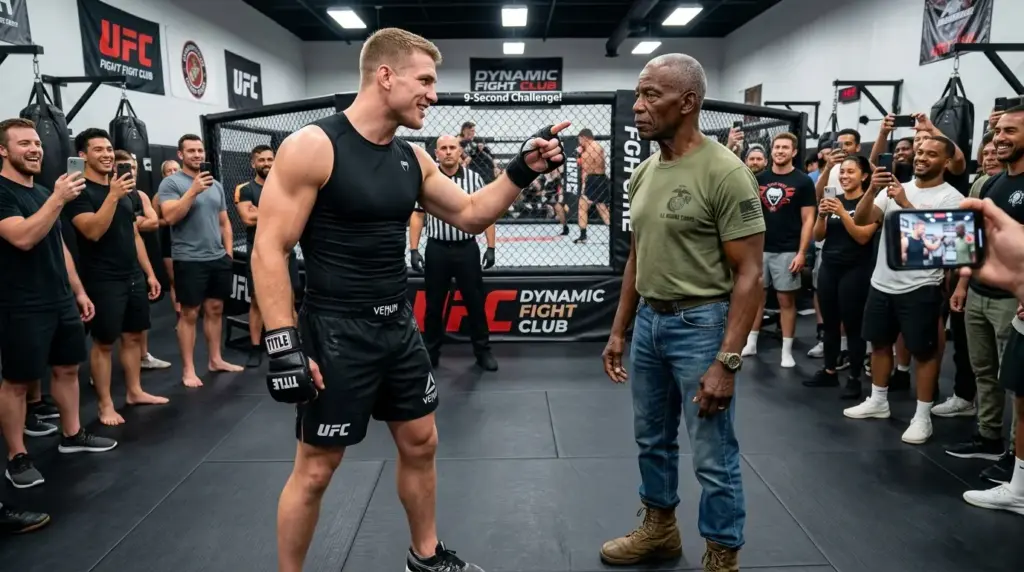
Colt Brennan arrived with a legal team of three. His lead attorney, Garrett Whitmore, was one of Charlotte’s most expensive litigators. Wade Prescott sat behind them in the gallery, arms crossed, jaw tight.
Colt wore a navy suit. His arm was still in a sling. His publicist had dressed him carefully, and his expression had been rehearsed.
Byron Fletcher arrived alone.
He wore the only suit he owned, charcoal gray, slightly too large in the shoulders, pressed that morning on an ironing board borrowed from a neighbor.
He carried no briefcase.
No folder.
No documents.
Judge Ruth Calloway presided. Fifty-eight years old, sharp-eyed, and known throughout the county for one thing: she did not tolerate performance.
Garrett Whitmore opened strong.
He played the edited security clip on the courtroom monitor. In it, Byron grabbed Colt’s arm, twisted it, swept his legs, and pinned him to the mat.
No context.
No lead-up.
Just violence.
“Your Honor,” Whitmore said, “what you see here is a premeditated assault by a man who clearly possesses advanced combat training. Mr. Fletcher targeted my client, an entertainer performing at a charity event, and used techniques designed to incapacitate. This was not self-defense. This was an attack.”
He turned toward Byron.
“Mr. Fletcher, do you have legal representation?”
“No, sir.”
Whitmore paused.
“You intend to represent yourself?”
“I do.”
A murmur moved through the gallery.
Judge Calloway silenced it with one look.
“Mr. Fletcher,” she said, “you understand the charges against you?”
“Yes, ma’am.”
“And you understand you have the right to counsel?”
“I do.”
“Why are you unrepresented today?”
“I couldn’t find anyone willing to take the case.”
The courtroom went quiet.
Judge Calloway made a note.
Byron stood when it was his turn. He did not pace. He did not gesture. He spoke the way he had been trained to speak under debrief: clear, factual, and without emotion.
“I was working security at Apex MMA Training Center on the night of the event. I was stationed at the emergency exit. Mr. Brennan called me into the ring on a live broadcast. I declined. He insulted me. He grabbed my arm and pulled me toward the ring. I entered under duress. He attacked first. I responded.”
“With a professional-grade combat technique,” Whitmore cut in.
“With what I know,” Byron said.
“And what exactly do you know, Mr. Fletcher?”
Byron did not answer him.
He looked at the judge.
“I’d like to show the court a different version of what happened that night.”
Nora Ashford was called as a witness. She walked to the stand carrying a tablet. On it was the full unedited video from her position near the east wall.
The video played from the beginning.
Colt pointing at Byron.
The insults.
“Old Black man by the door.”
The laughter.
“The most washed-up security guard in Charlotte.”
Colt grabbing Byron’s arm.
Byron unclipping his radio and setting it on the chair.
The slow walk to the ring.
The courtroom watched in silence.
Even Whitmore stopped writing.
When the takedown came, it looked completely different in context.
Not an attack.
A response.
Measured.
Controlled.
Minimum force.
Judge Calloway rewound the clip twice. Then she watched the moment Colt grabbed Byron’s arm three times.
“Mr. Whitmore,” she said, “why does your client’s submitted footage begin at the point of physical contact and not before?”
Whitmore hesitated.
“The security system only captured—”
“The security system captured everything,” Nora said from the stand.
Every head turned toward her.
Nora swallowed, then continued.
“Mr. Prescott deleted the original footage from the gym server the morning after the event. I heard him tell the front desk staff the system had crashed. It hadn’t.”
The gallery erupted.
Judge Calloway struck the gavel.
Wade shifted in his seat. Color drained from his face.
Whitmore tried another angle.
“Even if Mr. Brennan initiated physical contact, the level of force used by Mr. Fletcher was grossly disproportionate. A seventy-year-old security guard does not perform a wrist-lock takedown unless he has been trained. This was calculated violence.”
Byron looked toward the back of the courtroom.
“Your Honor, I have someone who can speak to that.”
The door opened.
Hank Caldwell walked in.
Seventy-three years old. Broad shoulders. Gray flat top. He carried a manila folder with a Department of Defense seal on the front.
Behind him walked four men, all former Marines. Three in suits. One in dress blues.
The courtroom went dead silent.
Hank took the witness stand. He opened the folder and placed its contents before the judge.
“My name is Hank Caldwell. I served three tours with the United States Marine Corps Force Reconnaissance Battalion. I served every one of those tours beside Byron Fletcher.”
He paused.
The courtroom seemed to stop breathing.
“Byron Fletcher is not a security guard who knows how to fight. He is a former Force Recon Marine. Three combat deployments. He held the rank of Master Sergeant. He was a certified MCMAP Master Instructor, level five, the highest tier. He trained hundreds of Marines in close-quarters combat, including me.”
Hank placed a photograph on the desk.
The same photograph Colt had once thrown across the gym floor.
“These are the men he served with. Three of them are dead. One died in his arms.”
Colt’s face went white.
His hand gripped the edge of the table. The sling suddenly looked less like evidence and more like costume.
Whitmore stood.
“Your Honor, this is irrelevant to—”
“Sit down, Mr. Whitmore,” Judge Calloway said.
She read the service record page by page.
Bronze Star with Valor.
Two commendations for exceptional service.
A letter of commendation from a two-star general.
A combat history that spanned three countries and fifteen years.
Then she looked at Byron.
“Mr. Fletcher, why didn’t you disclose any of this earlier?”
Byron stood.
“Because I didn’t think it mattered, Your Honor. I responded to an attack with the least force I could use. That is what I was trained to do.”





