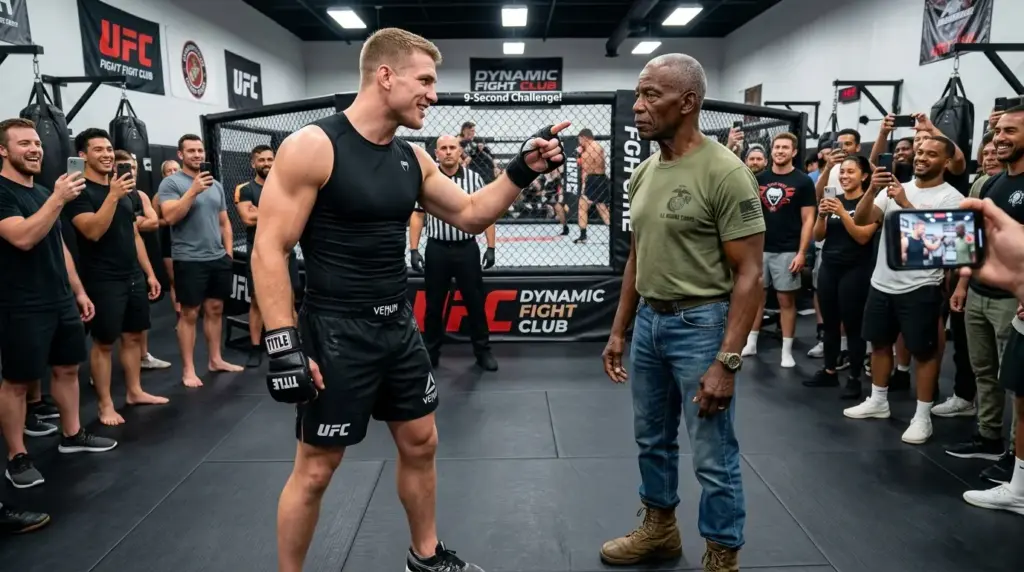
“That’s not budget,” she said. “That’s punishment.”
Wade looked at her with the bored patience of a man who knew he owned the room.
“It’s management, Nora. Stay in your lane.”
That night, Nora started keeping a record. Dates. Times. Screenshots. Links to every clip Colt posted. Notes on the wage cuts, the schedule changes, the insults, the threats.
She saved everything in a folder on her phone labeled:
Insurance.
She did not know when she would need it.
But she knew she would.
Byron said nothing about the schedule changes. He showed up at eleven. He entered through the loading dock. He stood his post and let the hours pass.
But something had shifted.
At home, Byron cleared the center of his garage. He pushed boxes of old uniforms against the wall. He hung a canvas bag from the ceiling beam, the same beam his wife had once used for a clothesline before she passed.
He hit the bag once.
Light.
Testing.
Then again.
Harder.
His left knee protested. His shoulder clicked. But his hands moved in patterns his body had memorized four decades ago.
Wrist rotation.
Elbow lock.
Strike.
Redirect.
Control.
MCMAP.
Marine Corps Martial Arts Program.
Master instructor level.
The kind of training that does not leave the body, even when everything else fades.
He trained for twenty minutes the first night, thirty the second. By the end of the week, he was moving for an hour straight, sweating through his undershirt in the dim yellow light of the garage.
He never told anyone.
One evening, just before his shift, Colt found something in Byron’s locker.
A photograph had slipped from Byron’s jacket.
The same faded photo from his apartment shelf.
Eight men in combat gear.
Young faces. Hard eyes.
Colt held it up.
“What’s this? Your bowling team?”
He flicked it across the room like a playing card. It spun through the air and slid under a bench.
Two fighters nearby went quiet.
Even they knew something had crossed a line.
Colt smiled.
“Pick it up. You’re good at picking things up.”
Byron walked to the bench. He knelt down slowly. He reached under it, pulled out the photograph, and wiped it carefully against his shirt.
He slipped it into his pocket.
He did not look at Colt when he stood.
But Colt saw his hands.
They were curled.
Shaking.
“Relax, old man,” Colt said, chewing gum with his mouth open. “It’s just a picture.”
It was not just a picture.
Three of those men were dead.
One had died in Byron’s arms on a rooftop in Ramadi.
Another had survived the war and lost to the silence that came after it.
Byron walked to his post and stood there for four hours without sitting down once.
That night, he did not train.
He sat in the garage under the single light bulb and held the photograph until he could hear their voices again. Then he folded it, placed it back into the wooden box on the shelf, and closed the lid.
His hands had stopped shaking.
That was the part that should have worried Colt the most.
Byron called Hank Caldwell on a Sunday morning.
Hank picked up on the second ring. Seventy-three years old, still sharp, still loud, and the only man alive who had served all three tours beside Byron and walked away standing.
“You sound different,” Hank said.
“Something’s building.”
“At the gym?”
“Yes.”
“Building how?”
Byron told him about the chair, the clips, the mouth guard, the photograph. He kept his voice flat the whole time, the way they had both been trained to report under pressure.
Hank was quiet for a long time.
Then he said, “You don’t owe those people a single thing.”
“I know.”
“No, you don’t. But I know you. If it comes to it, finish it. Don’t hesitate. Don’t play nice. You’re not a security guard when someone puts hands on you. You’re Force Recon.”
“I’m seventy, Hank.”
“And I watched you drop a man twice your size in Kandahar when you were fifty-two. Your knees are bad. Your hands aren’t.”
That night, Byron went back to the garage. He wrapped his knuckles with old athletic tape and worked the bag for ninety minutes.
Strikes.
Locks.
Takedowns against an invisible opponent.
His breathing was rough by the end, but every technique landed clean.
He was not preparing for a fight.
He was deciding whether to allow one.
By Wednesday, he had his answer.
The Nine-Second Challenge was Colt Brennan’s idea.
Wade loved it.
The concept was simple. Colt would pick someone from the crowd, a fan, a trainer, a random bystander, and take them down in under nine seconds on a live YouTube stream. Three sponsors were attached. Ninety thousand people were expected online. Wade printed T-shirts and charged thirty-five dollars each.
The event was held on a Saturday night inside Apex’s main arena.
Ring lights. Tripods. Handheld cameras. A rented PA system. A ring announcer who used to call amateur boxing matches in Raleigh.
Six hundred people packed the bleachers.
Another ninety thousand watched online.
Colt entered the ring shirtless, gloves on, mouth guard in. The crowd roared. He shadowboxed for the camera, throwing combinations at the air like he was warming up for a title fight.
His speed was real.
Whatever else he was, Colt Brennan could fight.
“All right,” he said into the microphone. “Nine-second challenge. I pick someone. They step up. I put them down. Simple.”
He scanned the crowd.
His eyes passed over trainers, fans, and two college wrestlers in the front row who looked eager to volunteer.
Then his gaze drifted to the back wall.
Byron Fletcher stood by the emergency exit in his security uniform, badge on his chest, radio on his belt, hands behind his back.
He looked like part of the building.
Colt pointed.
“You.”
The crowd turned.
Byron did not move.
“The old Black man by the door,” Colt called. “Get in the ring.”





