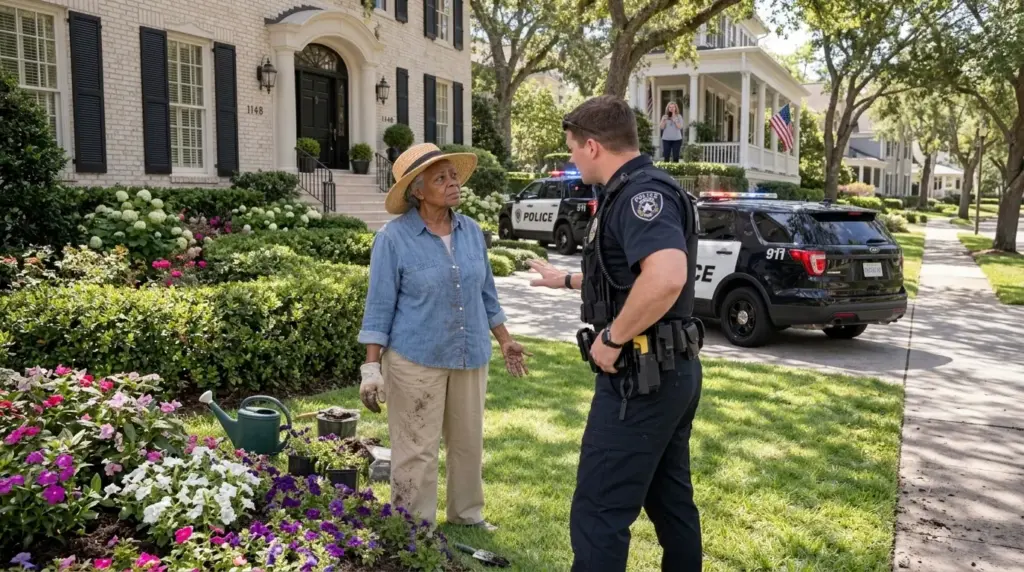
He was twenty-seven years old and aggressively fit, carrying himself with the forward-leaning energy of someone who was always slightly ahead of the moment he was actually in, always reaching toward the next thing. His right hand, specifically, was a kind of barometer of his internal state. At rest, it drifted toward his duty belt, resting on the smooth leather near the clasp that secured his sidearm: not drawing, not threatening, simply present there, as though the hand needed the reassurance of proximity to authority in the same way other people needed to fidget. That hand was always reaching for something. It had never, in three years on the job, learned how to simply rest.
He did not think of himself as prejudiced. This was important to understand, because it was the truest thing about how he thought of himself, and also the most dangerous. He thought of himself, instead, as someone who had developed through experience and observation a finely calibrated ability to identify patterns that other people were too timid or too politically conditioned to acknowledge. He called this “pattern recognition.” He was proud of it. In the privacy of his own thinking, he had built an entire identity around it: the identity of a man who saw clearly what others refused to see.
In practice, what this meant was that Derek Caulfield had filed three use-of-force complaints in three years, all of them involving non-white suspects, and all of them cleared by the department’s internal review process, which was administered by his direct supervisor, Lieutenant Gary Fenwick—a man who had mentored Caulfield since his first week on the job and who described him in his annual evaluations as having “strong situational awareness and sound operational instincts,” which was Fenwick’s way of saying that Caulfield’s instincts aligned with Fenwick’s own and therefore required no further scrutiny.
He was parked in the lot behind a dry-cleaning strip on the western edge of his patrol zone at 7:18 on Tuesday morning, eating a gas station breakfast sandwich that had been warm forty minutes ago and listening to a talk radio program about property crime in affluent suburban neighborhoods. He was nodding along in the particular way of a person hearing their own thoughts confirmed by an external voice.
The call came through dispatch at 7:23: “Suspicious person, possible trespasser. Whitfield Preserve, 402 Sycamore Lane. Caller reports the individual appears to be armed with a sharp implement.”
Caulfield had the cruiser in drive before the dispatcher finished the address. Whitfield Preserve was where the mayor lived, where the city council members lived, where the kinds of people who attended police fundraisers and made calls to the chief’s office lived. Responding effectively to a call in Whitfield Preserve was the kind of visibility that could define a career, and Caulfield understood this the way he understood all tactical information: as something to be used.
He did not run the property address through the county records database before leaving the lot. Checking the records might tell him that the address had a registered occupant; he did not want to know that yet. He also reached up with the practiced ease of a gesture made dozens of times and pressed the small button on his body camera before turning out of the parking lot. The indicator light blinked off. The device was manually powered down. He had done this before in situations where he anticipated the kind of contact that benefited from a particular kind of privacy, and he had done it with enough frequency that it no longer required a conscious decision.
The light bar went on. The cruiser accelerated north toward Whitfield Preserve.
He pulled to the curb in front of 402 Sycamore Lane at 7:29 with the kind of abruptness that was not operationally necessary, and that served primarily to announce himself as a force rather than a presence: the light bar strobing in the quiet morning air, and the tires emitting a brief, aggressive sound against the asphalt that sent a pair of mourning doves off a nearby feeder in a burst of startled wings.
The morning had been very still until that moment. The mockingbird in Dorothea’s oak had been singing without interruption since before 6:00. When the cruiser door slammed, the mockingbird went silent.
Dorothea startled and sat back on her heels, turning toward the sound. She saw the light bar first, the red and blue fracturing across the wet grass. And then she saw the officer moving toward her with his right hand already resting on his duty belt.
The cold, familiar feeling arrived in her chest—the one she recognized immediately, had recognized since she was a young woman: the particular internal drop that comes when law enforcement arrives unexpectedly and you understand from long experience that you are about to be required to prove something about yourself that should not need to be proved.
She set the trowel down in the soil beside the half-planted row. She kept her hands visible.
Caulfield came across the lawn fast, and when he spoke, his voice was already at command volume, already pitched for control, already operating on the assumption that what he was managing was a situation rather than a conversation. He told her to put the tool down and step away from the property.
She had already put it down. She told him this calmly, and she began the process of getting to her feet.
He told her to step away from the property again, as though she had not spoken.





