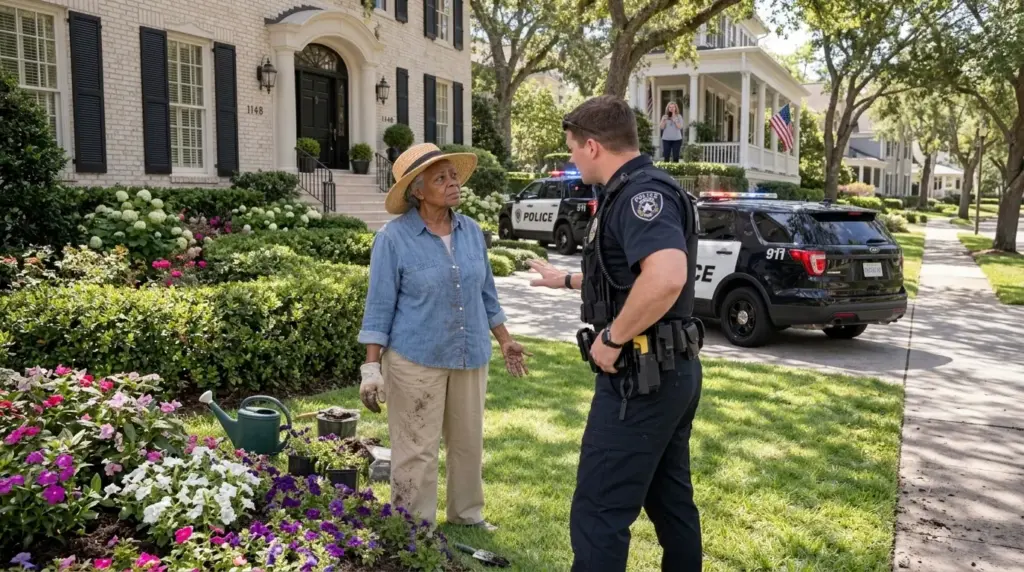
He attempted to locate the defense in the explanation: he said he hadn’t known; he said the call described a trespasser; he said she had refused to identify herself. Dorothea dismantled each point without raising her voice, with the same efficiency she had brought to hearing arguments from counsel for twenty-five years.
Captain Raymond Briggs arrived through the double doors at the far end of the booking area, moving faster than a man of his build typically moved, his uniform shirt untucked on the left side in a way that told you he had not taken the time to straighten it before leaving his office. He had been watching the booking camera feed from his desk upstairs. He had seen Hutchins’s reaction. He had been on his feet before Hutchins finished saying the title.
He came to a stop in front of Dorothea and looked at her wrists, and his face did something involuntary. He said her name, and then her title. He looked at Caulfield with the specific look of a person identifying a problem that is going to cost him a very great deal. He told Hutchins to get the first-aid kit. He told Caulfield to surrender his badge and his weapon to the desk immediately and leave the booking area.
Caulfield’s hands were visibly shaking as he unclipped his duty belt and set it on the edge of the desk. The silver shield landed on the wood with a flat, conclusive sound. Then he was walking away down the hall, and the sound of his footsteps retreated until the fluorescent hum was the only thing left of him.
Briggs’s instinct, which was the instinct of a man who had spent twenty-three years navigating the space between what institutions do and what they can admit to doing, was to move her off the floor. Get her into his office. Coffee. Paramedics for the wrists. He would personally drive her home. The whole thing was catastrophic, and he was going to make sure it was handled properly, starting with getting her out of the booking area and into somewhere private where they could talk about how to proceed.
Dorothea listened to him say all of this. She heard every word of it, because she had heard versions of it before: from police union representatives at civil rights hearings, from city attorneys in discovery proceedings, from precinct captains explaining why internal review processes were more appropriate venues than federal courts. And she recognized it for what it was without having to think about it: it was the offer of the private office as a substitute for the public record. It was the suggestion that the quiet resolution—the ride home, the handshake, and the apology delivered in a room without cameras—was the sensible choice for all concerned. What it actually was, she understood very well, was the door through which nothing changed.
She told Briggs that she was not going to his office. She told him that she had been brought into this facility in handcuffs, charged by his officer with criminal trespass, failure to identify, and resisting arrest. And that those charges needed to enter the official record of this department as the charges that had actually been filed this morning. Because the official record was the mechanism through which what had happened became permanently documented, publicly accessible, and legally verifiable.
Briggs looked at her with the expression of a man watching the calculation he thought he had made dissolve into something he hadn’t prepared for.
She told him she wanted her booking photograph taken. She wanted her fingerprints on file. She wanted a state-certified, permanent public record of exactly what had been done to her this morning, and she wanted it done correctly and completely before she left this building
Briggs understood the trap all at once, in a single moment of comprehension that was worse than the gradual version because there was no space in it for negotiation: if he refused to book her, she would file for denial of due process; if he complied, the booking photograph of the most respected retired judge in Harlan County—her wrists bruised and broken, her gardening clothes still soil-darkened, her straw hat still on her head in its slightly skewed position—would be entered into the public record and would be one document request away from any journalist in the county.
She did not fix her hair. She did not straighten the denim shirt. She adjusted absolutely nothing about her appearance, because her appearance was the truth, and the truth was what she wanted the camera to see. She walked to the position in front of the booking camera and looked directly into the lens with the expression she used when handing down sentences that needed to carry their full weight into the historical record: not rage, not grief, but a concentrated, composed, permanent defiance. It was the face of a woman who has decided that this moment will mean something.
Hutchins set up the camera system with the deliberateness of a man who understood exactly what he was participating in and had chosen to be accurate about it. He took the photograph. The record was entered. The timestamp read 8:47 on a Tuesday morning in early spring. Permanent. Undeniable. Exactly as she intended.
Derek Caulfield arrived at his apartment at 9:43 in the morning, still in uniform because he had not thought clearly enough to change before leaving the precinct. And he sat down in the chair that faced the television without turning it on.
The apartment was very quiet. He could hear the refrigerator running in the kitchen, and from somewhere above him, the muffled sound of a neighbor’s television.
He told himself for the first twenty minutes that it was going to be fine. He told himself that she was a retired judge, yes, but that the call had been legitimate, that he had responded to a legitimate emergency report, that any officer in his position would have done the same thing. He told himself that the union would handle it, because the union always handled it. Lieutenant Fenwick had told him that on his second week on the job, and it had proven true twice already. He told himself that she had refused to identify herself, and that refusal was a fact that would matter, and that the excessive force claim would be assessed in context, and the context was that she had been non-compliant. He was, in other words, doing what he always did when the outcome of a call wasn’t what he intended: he was running the story again from the beginning, looking for the version in which he was right.
By mid-morning, he had talked himself into something that felt almost like confidence. He made coffee. He turned on the television, found a sports highlight program, watched it without seeing it. He checked his phone. No messages from the union yet, but that was normal; they were probably reviewing the situation. They would call. He actually put his feet up on the coffee table. He thought about the fact that she had been in dirty clothes in a wealthy neighborhood with no ID and a digging tool, and he thought this was, when you stripped away everything else, what the call had looked like from the outside, and any reasonable review board would see that.





