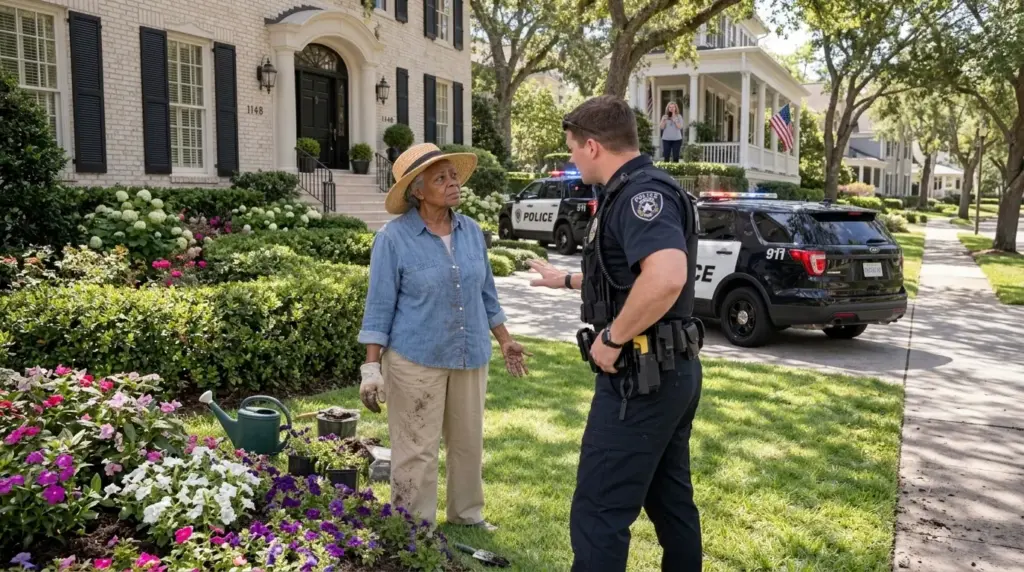
“Save it for the judge, lady.”
Across the street, Sandra Bellwether lowered her phone and nodded once with satisfaction. She went back inside to refill her coffee. She felt good about the morning. She had protected the neighborhood. She had done what needed to be done.
She had no idea. Not the faintest beginning of an idea.
The back seat of Caulfield’s cruiser smelled of industrial cleaning solution, and underneath it something older and more stubborn that the cleaning solution had never fully reached. And the vinyl was the hard, ungiving kind that had been wiped down hundreds of times and was smoother for it in the wrong direction—the smoothness of a surface that had been cleaned rather than cared for.
Dorothea sat as upright as her cuffed arms would allow and focused on her breathing: four counts in, four counts held, four counts out. It was not a technique for panic; it was a technique for precision, for keeping the instrument of her thinking clean and calibrated when everything around her was designed to produce the opposite. She cataloged the cruiser number visible through the partition, the in-car camera in the front of the vehicle still operational, the red recording light visible, its audio running, capturing whatever Caulfield chose to say during the drive.
She was aware of the wrists. She did not look at them, because looking at them would have been a concession to the pain. But she noted the skin was broken. There would be photographs taken within the next several hours that would be useful in ways Caulfield had not begun to think about.
She thought of Marcus. Not with grief in that moment, but with the specific clarity he had always given her in complicated moments. He had said to her once in the middle of a difficult period early in her career, when resistance to her presence on the bench had been coming from multiple directions: “Dorothea, the courtroom is anywhere you decide it is.”
She decided she was in a courtroom—a moving one with bad upholstery. The principles were the same.
She looked out the window and saw Sandra still on the porch, phone lowered now, watching the cruiser pull away with the expression of a woman who believed she had performed a service. Dorothea held eye contact through the tinted glass. It was unclear whether Sandra could see her clearly, but Dorothea could see Sandra, and she looked at her with the focused attention of a judge taking note of a witness. Sandra glanced away first.
From the front seat, Caulfield’s voice arrived through the partition, unhurried and slightly too loud. He was talking, explaining himself to the empty air, which was really explaining himself to himself, which was something men like him did when they needed to hear the story told in a way that made them the protagonist. He said that the neighbor who called in the report knew the neighborhood and knew something was wrong. He said that when a person refuses to identify themselves to a law enforcement officer, in his experience, there was always a reason. He used the phrase “getting smart” twice, both times in a tone that suggested using accurate legal citations in response to unlawful orders was a form of aggression he had the right to respond to. He said, “People like you, you think the rules don’t apply when they’re inconvenient.”
Then, a moment later, something shifted in his voice: not doubt, not remorse, but a particular quality of satisfaction—the pleasure of a man who believed he had done the right thing and was now settling into the comfort of that belief. He actually chuckled to himself, quietly, but clearly audible through the partition, and clearly audible, therefore, to the in-car camera whose audio was still running. He said, half under his breath, that some people just needed to learn that there were consequences for thinking they could walk into a neighborhood like Whitfield and do whatever they wanted. That was just the reality. That was just how it worked.
He was enjoying this. That was the truth of it. And the camera caught it, and the timestamp would later show that this moment of quiet enjoyment occurred approximately three minutes and forty seconds into the transport, and it would be submitted into evidence alongside everything else.
Dorothea said nothing. She composed the first paragraph of the civil complaint in her mind, and moved on to the second.
There were things in that cruiser on that Tuesday morning that Derek Caulfield did not know, and they were large things.
He did not know about the porch camera. He had registered no camera when he walked up the driveway, which was understandable, because the unit was a flush-mounted model installed at the top of the doorframe, painted the same cream color as the brick, angled at a slight downward tilt that covered a 140-degree view of the front lawn and the street. It had activated when his light bar hit the motion sensor at the edge of the property line, and it had been uploading to a cloud server in continuous 4K segments since before he stepped out of the cruiser. Everything he had said, including the sentence about “nobody who looks like you,” was already stored on servers two states away: timestamped, GPS-tagged, and inaccessible to anyone who did not have Dorothea Caldwell’s account credentials.
He did not know about Gregory Beaumont of Beaumont, Cross & Halloran, whose mobile number was in Dorothea’s phone under a contact labeled simply “Gregory,” and whom she had memorized in addition to storing, because she was the kind of person who did not rely on a single point of access for anything important.





