The sergeant was arrested at his home at 5:14 a.m. He was surrounded by partially shredded documents when the agents entered: a paper shredder running in the corner of his home office, a pile of material that had not yet been fed through it stacked on the desk beside him.
The agents photographed the shredder. They photographed the unshredded stack. They recovered what they could from the shredder’s output. The forensic reconstruction of the shredded documents would take six weeks and would ultimately produce enough readable content to fill an additional forty pages of evidence.
The officer was not at his home when agents arrived. He was at a diner three miles away, sitting at a corner table drinking coffee. He had been there since 3:00 a.m. One of the agents who brought him in said that he looked, when they entered, like a man who had been waiting to be found.
He was right.
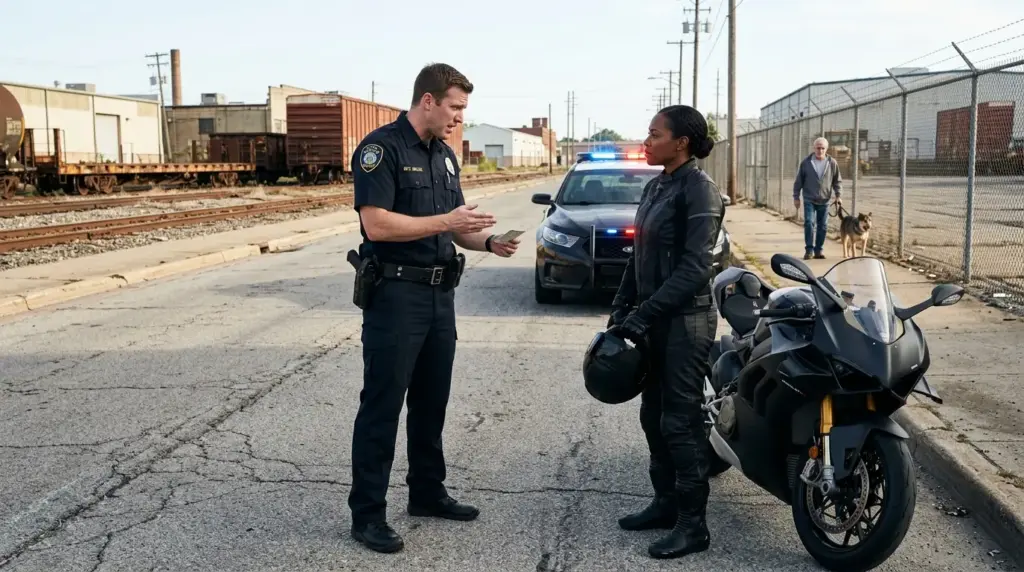
The officer had spent the seventy-two hours before the raids in a state that the people around him had noticed but not understood. He had missed a shift without explanation. He had not answered calls from the sergeant. He had driven twice to the industrial district and sat in his car near the stretch of road where he had stopped her, looking at the fence line and the cracked asphalt, not getting out.
He was not sentimental about the road. He was not capable of the kind of reflection that would have made the road mean something to him beyond its utility. What he was doing sitting there was calculating—running the numbers of his situation with the cold, frightened arithmetic of a man who has just understood that the math does not work in his favor.
He had not known when he stopped her that she was a federal judge. He had not stopped her because she was a federal judge; he had stopped her because she was a Black woman on an expensive motorcycle on a road that he had been using for three years as a tool. Not always explicitly, not always with full awareness of what he was participating in, but consistently enough that the pattern was there, and the money had flowed, and the complaints had gone away, and the system had continued to function.
He had not known the full scope of what the system was; he had known his part of it. He had known that certain stops on certain roads generated certain outcomes. He had known that the sergeant managed the administrative end. He had known that the complaints disappeared. He had chosen for three years to frame this knowledge in terms that allowed him to keep performing his job without examining too closely what the job in those moments actually was.
Now he sat in a federal building across a table from two prosecutors and a recorder, and explained in careful and complete detail how it worked.
He described how stops were selected—not randomly: vehicles of a certain value on roads with low civilian traffic, operated by drivers who were likely to be alone. He described how the stops were logged: not always as the pretext search they actually were, sometimes as routine welfare checks, sometimes as stolen vehicle responses, always with documentation that could survive a surface-level review. He described how reports were adjusted after the fact, and who performed the adjustments, and whose signature appeared at the bottom.
He named names: he named the sergeant; he named two other officers whose involvement had not yet been confirmed; he named a civilian dispatcher who had been routing database queries away from automated logging for six months; he named an officer in a neighboring precinct who had been running parallel stops under a similar arrangement.
He did not describe himself as a victim. He was given the opportunity by one of the prosecutors to characterize his own role and his own understanding of what he had been participating in. And he said, in a flat and level voice, that he had known it was wrong. That he had understood, not in the abstract, but concretely, that the stops he was conducting on that road were targeting people based on their appearance and their vehicle’s value, not on any genuine law enforcement basis.
That he had told himself, in the way that people tell themselves things they do not entirely believe, that the outcomes were minor. That nobody had been permanently harmed. That the system had larger targets. That his individual actions were a small part of something much larger.
He said that the morning he pulled her over and watched the database come back clean, and decided to keep going anyway, he had understood in the moment that he was making a choice: not acting on instinct, not following procedure—making a choice. And that he had made it.
He paused there. He looked at the table. He said nothing else about that.
The investigation had, by the time the federal case was fully documented, identified forty-one individuals with varying levels of involvement in the network. Not all of them were charged; not all of the charges were equal.
The network had operated in layers: the businessman at the center, the sergeant managing the police side of the operation, a handful of officers and civilian employees running specific functions, and a broader group of people at the margins who had received payments or overlooked irregularities without fully understanding, or choosing to understand, the full scope of what they were participating in.
The distinctions mattered. The investigation had taken care to make them, because the investigation was not interested in numbers of arrests; it was interested in accountability, which is a different thing, a harder thing, a thing that requires precision rather than volume.





