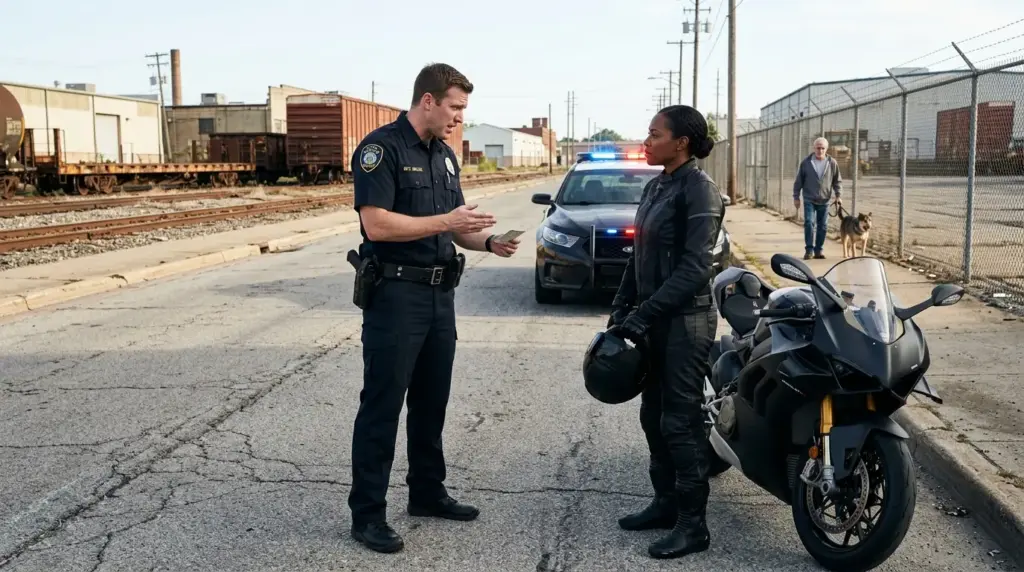
“Plate comes back clean,” he said. “No stolen vehicle report matching your registration.”
“Good,” she said. “Then we’re finished.”
He did not step back. “I need to take a look at the bike.”
The air between them changed.
“On what basis?” she asked.
“Investigative purposes. I’m not satisfied that the stop is fully resolved.”
“You just told me the plate comes back clean, no stolen report. My license, registration, and insurance are all valid. What specifically remains unresolved?”
His jaw tightened. “The model still matches the description we received.”
“You said ‘similar.’ And a similar description isn’t legal grounds for a search.”
The word “legal” landed somewhere in his expression, and she watched it land. She had seen that response before—in courtrooms, in depositions, in the hallways of buildings where people with authority suddenly realized the person in front of them was fluent in the same language they thought belonged only to them.
The response was always the same: a brief flash of something that wasn’t quite anger yet, but was moving steadily in that direction.
“Ma’am, I’m asking you to cooperate with a lawful investigation.”
“I have cooperated fully. I have provided every document you requested. The database confirms my ownership. I’m asking what legal basis justifies a search of my property.”
“Your attitude is making this more complicated than it needs to be.”
She looked at him for a long moment. Her voice did not change. “My attitude is to ask questions. That’s not an attitude. That’s a right.”
He stepped closer—not dramatically, just one step, enough to reduce the distance between them in a way that was meant to be felt.
“Where’d you get the money for a bike like this?”
The question sat in the open air between them like something that had been dropped.
She said nothing.
He repeated it as though she hadn’t heard: “I’m asking where you got the money for a motorcycle like this. It’s not a trick question.”
“It’s also not a legal question,” she said. “My finances are not part of this traffic stop.”
“I can make them part of it.”
“On what charge?”
He did not answer. He took out his radio instead.
Further up the road, the man walking his retriever had stopped completely. He was not recording yet; he was simply watching—the way people watch when they are trying to decide whether what they are seeing is as wrong as it appears, or whether they are missing something.
He would later say in his statement that the question about the money was the moment he knew that there was no missing something. That he had reached for his phone not because he thought it would help in that moment, but because he understood at a cellular level that documentation was the only defense that mattered in situations like this one.
She understood then. The question about the money had not been investigative. It had been a door, one he expected her to walk through in confusion or in anger—one that would give him the agitation he needed to justify whatever came next.
She had not walked through it. She had stood in the doorway and asked him to name his authority. And now he was calling for backup, not because he had found anything wrong, but because he had not found anything wrong and still was not prepared to let it end.
Two patrol units arrived within four minutes, then a third.
On the sidewalk across the road, an older man walking a large retriever stopped moving. He looked at the scene: at the motorcycle, at the woman sitting on it, at the three cruisers arranged behind her. And he turned slightly, raising his phone. A second bystander stopped near the fence line, then a third further up the road, also recording.
One of the new arrivals, a young officer with a careful expression, hung back near the second cruiser. He watched the situation with the particular stillness of someone who has learned that watching is safer than speaking. Beside him, another officer who appeared roughly the same age folded his arms and looked at the ground.
The first officer was now leaning against his cruiser with his arms crossed, performing patience for the audience he had accidentally assembled. He looked over at the young officer who had hung back.
“Run her name through the system. Full check.”
The young officer hesitated for a fraction of a second. Then he went to his cruiser.
A fourth vehicle arrived. This one was different. The man who got out moved with the slow authority of someone who did not need to hurry because everything that happened here would be measured against whatever he decided. He was fifty, heavy-set, with the face of a man who had been in rooms where difficult things were discussed and had never found those rooms particularly difficult.
He looked at the woman on the motorcycle. He looked at the officer who had made the stop. He looked at the bystanders.
“What are we doing here?”
The first officer briefed him quickly: “Similar description, possibly stolen, subject refusing consent to search, subject becoming argumentative.”
The older man listened. He looked at her again.
“Ma’am, I’m the sergeant. I’m the shift supervisor. I’m going to ask you to step off the motorcycle.”
“I’m happy to step off the motorcycle,” she said. “Can you tell me the reason?”
“There’s no charge at this time. I’m asking you to step off the vehicle while we complete our investigation.”
“Your officer told me the investigation was complete. Plate is clean, registration is valid, no stolen report. What remains to investigate?”
The sergeant looked at the first officer. The first officer looked at the sergeant. Something passed between them that had nothing to do with a stolen motorcycle.
“Step off the bike,” the sergeant said. His tone had changed. It was not louder; it was flatter—the kind of flat that comes just before something hard.





