The picture that emerged was not simple, and it was not dramatic in the way that television crime stories are dramatic; it was slow and granular, and in some ways more disturbing for being so, because it was the picture of a system that had been functioning invisibly for a long time.
Vehicles stolen in neighboring states would enter the county through a network of intermediary lots and private buyers, their identification numbers altered through a process that left the physical plates intact but changed the stamped chassis numbers to match numbers from legitimately totaled vehicles. Those numbers would then be run through a title processing company that generated clean paperwork showing the vehicle as a recovered and rebuilt total loss unit. The paperwork was not identical to legitimate title transfers, but it was close enough to pass through standard checks, particularly if the officer conducting the check had been coached on which fields to look at and which to overlook.
The title processing company, the federal advisor explained, was incorporated under a name that had no visible connection to the businessman. The connection ran through an intermediary: a property management firm that the businessman had acquired four years ago through a shell entity registered in a different state. The property management firm was listed as a co-investor in the title company. The shell entity had no employees, no physical address, and no tax filings beyond the minimum required to maintain its incorporation.
“The money flows in one direction,” the federal advisor said, “and the paperwork flows in the other. Vehicles come in dirty and go out clean. The profits are run through the title company, then through the property management firm, then through what appears on paper to be a series of legitimate real estate transactions. By the time it reaches the businessman’s public accounts, it looks like rental income.”
The investigator looked at the documents on the table. “And the officers?”
“The officers are the mechanism that keeps the machinery from stopping.” The federal advisor pulled a folder from the second box. “When a vehicle is stopped—a routine traffic check, an insurance verification, anything that might trigger a VIN query—the altered number needs to survive that check. The simplest way to ensure that is to have officers in the relevant precincts who know which vehicles to wave through and which VIN queries to close without flagging. They don’t necessarily know everything about the operation; they know what they’re paid to know, which is which questions not to ask.”
The investigator sat back. “The businessman has been paying officers to look the other way on VIN checks.”
“That’s the baseline,” the federal advisor said, “but it goes further. When a case starts building, when an investigator like me starts subpoenaing records, someone in the department identifies the request and routes it to the officers who can intercept it. The records get reclassified. The evidence log changes. The investigator ends up with an incomplete file and no clear proof of tampering, because the tampering happened at the administrative level, not the evidence level.” He looked at her steadily. “I have been trying to find the person who routes the intercepts for three years. I couldn’t get close enough to the precinct records to identify them.”
He looked at the document the investigator had pulled from the file: the internal complaint record showing the sergeant’s name beside three closed investigation flags.
“I think I may have just found them.”
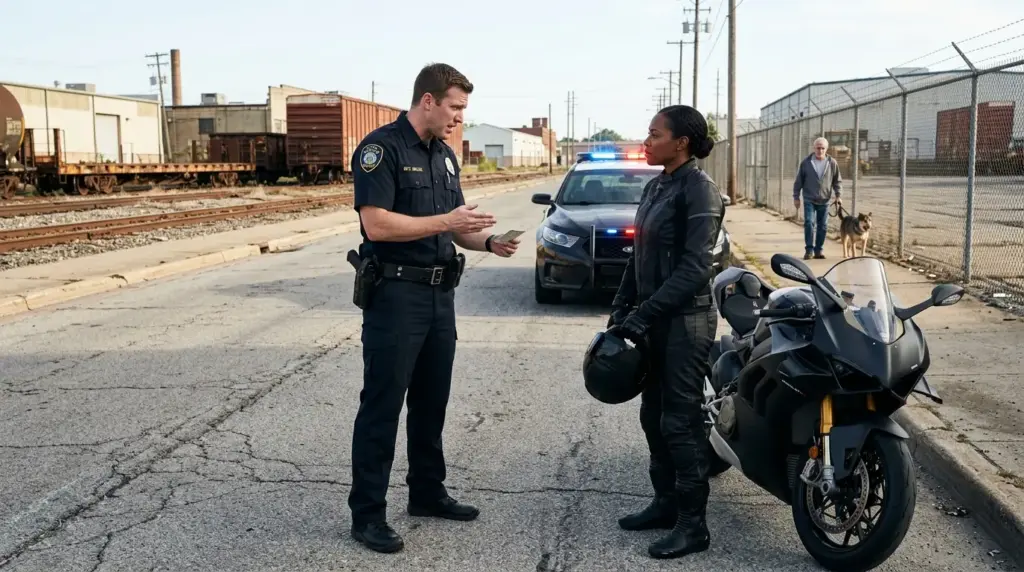
The investigator did not move. She looked at the sergeant’s name. She thought about the seventeen complaints that had been closed under his signature. She thought about the roadside scene three days ago: the sergeant arriving and, without any investigation of the actual facts, immediately escalating a situation that any supervisor with genuine interest in proper procedure would have de-escalated in under two minutes.
She thought about the tow truck. About the instruction to impound the motorcycle. About what would have happened to that motorcycle, to its title records, to its registration history, if a team of United States Marshals had not arrived when they did.
She thought about the fact that her motorcycle was legitimately registered and legitimately owned and had an entirely clean record, and that none of that would have mattered once the tow truck took it, because the chain of custody for the vehicle would then have passed through a system that the sergeant had spent years learning how to manipulate.
She opened a new page in her notes. “I’m going to request a meeting with the FBI field office,” she said. “Today.”
The federal advisor nodded. “Good. Because what I have in these boxes is enough to support a warrant request, but it’s not enough for the scope of what we’re actually looking at.” He paused. “And I want to find something specific before we move. Something I’ve been looking for for two years and haven’t been able to locate.”
“What is it?”
“There is a photograph,” he said, “from an old vehicle theft file. One of the earliest cases I flagged. The photograph shows a vehicle with an altered identification number. In the background of the photograph, partially visible, is a sign: part of a dealership name. I identified the dealership as belonging to the businessman, but the photograph itself was removed from the evidence file before I could submit it formally. I have a copy—a scan I made before it disappeared.”
He reached into the hard drive case and produced a single printed page. “This is it.”
The investigator looked at the photograph. The image was slightly grainy, a scan of a scan, several generations removed from the original, but the vehicle was clear enough. The altered number was visible on the dashboard plate. And in the upper right corner of the frame, partially cut off, were three letters of a sign.
The letters matched the first three letters of the name on one of the businessman’s dealerships.





