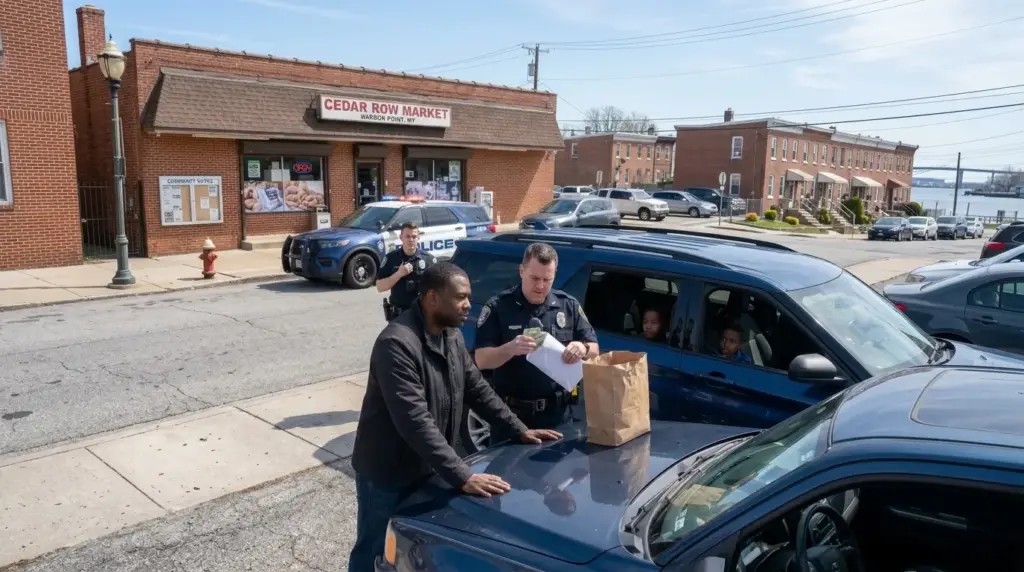
Briggs handed the documents back, but he did not step away. He stood at a distance that was 1 ft closer than any legitimate traffic stop required. “Here’s what I’m going to do for you. $360. You hand it over right now and I don’t write this up. You drive away, we both move on with our night.”
Desmond looked at him without expression. “I’d like a receipt for that,” he said.
What happened next took less than 4 seconds. Briggs moved around behind him, grabbed him by the shoulder, and turned him hard against the hood of the SUV. Desmond’s chest came down against the metal, the paper bag crumpling to the side. Briggs patted down his jacket, both sides, methodical, the kind of search that was slow enough to be deliberate and fast enough to look practiced.
He found the envelope in the inner breast pocket, the one Desmond was carrying for Marcus’s school registration, $400 in cash that he had withdrawn that morning because the office had specified no card payments for the initial enrollment fee. Briggs pulled the envelope free and stepped back. He counted the bills standing in the open air, right there on the sidewalk under a broken overhead light, with the patience of a man who had done this before and expected nothing to interrupt him. He counted them once, then folded the envelope and looked at Desmond, who had turned around and was watching him the way someone watches something they are going to need to describe in detail later.
“$360,” Briggs said. “The rest is yours.”
“There’s no law that allows you to collect a cash fee on a traffic stop,” Desmond said. His voice was level. He did not raise it. “That’s not a procedure. There’s no authorization for that.”
Briggs stepped closer. He dropped his voice to the register that was not quite a whisper and not quite a normal speaking tone. The one calibrated to travel only as far as the person it was aimed at. “I can let you go home tonight with a parking infraction on your record, or I can find something in that vehicle that means you don’t see your kid again until morning.” He let a moment pass. “Your call.”
Desmond said nothing. Behind Briggs, he saw Sykes lift his hand toward the body cam on his chest. The red indicator light went dark. Briggs tucked the money into his breast pocket. He handed back the empty envelope, then turned and walked toward the cruiser without looking back. At the door, he called over his shoulder, casual and quiet, in the tone of someone closing a business transaction. “Don’t try to be smart in my city.”
The cruiser pulled away from the curb. Desmond watched the tail lights until the vehicle turned the corner. Then he stood on the sidewalk for a moment in the silence and thought about nothing at all. Which was the way he had always processed things that needed to be processed carefully.
He picked up the paper bag, checked that the cereal was undamaged, and got in the SUV. Marcus was looking at him. The boy’s eyes went to the red mark on his father’s wrist where the edge of the hood had caught the skin during the push. He looked at it for a long moment.
“Did a cop do that?” Marcus asked.
Desmond kept his eyes on the road. “A man in a uniform did that,” he said. “That’s not the same thing as the uniform being wrong.”
Marcus looked out the window. He didn’t say anything else, but he didn’t put his headphones on either, which meant he was still thinking.
Desmond drove back to Clement Street and made sure his son ate and got to bed at a reasonable hour. He answered two questions about the new school, found Marcus’s phone charger at the bottom of the second bag, and said goodnight in the way he had said goodnight for 6 years. Firmly, without drama, in a way intended to signal that the world was still in reasonable order. Then he sat at the kitchen table and opened his phone.
He had everything he needed. The dash cam had been running from the moment he turned onto Cedar Row. He checked the time stamp before he went inside the store, a habit from years in the field. The audio was clean, direct, and fully usable. He had Briggs’ badge number memorized the moment he saw it. He had the unit number from the cruiser’s rear panel. He had Sykes’ name from the tag on his chest. He had the time down to the minute, and he had the location. And he had the exact sequence of events including the window in which the body cam indicator went dark.
What he did not have, and what he sat with for a long time, was certainty about what kind of thing he had just witnessed. One officer, one incident, one night. That could mean many things. He thought about the way Briggs had moved. The confidence of it. The practiced economy of the search. The specific dollar amount. The casual warning at the end. Those were not the movements of someone improvising. That was a man who had run this same sequence before and expected, based on experience, that it would end the same way it always ended. With someone too frightened or too uncertain to do anything but absorb the loss and drive home.





