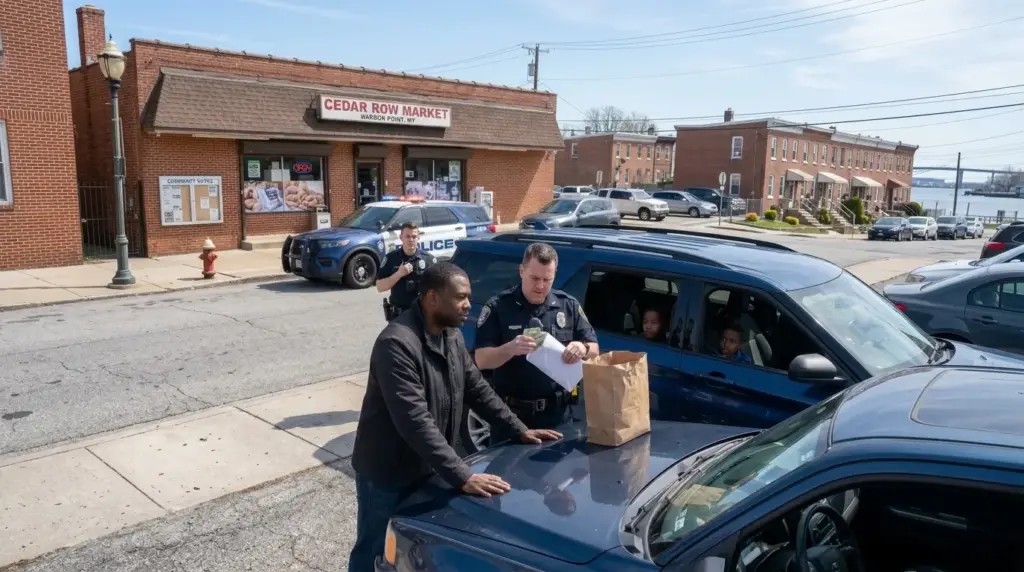
Desmond walked to the front and stood before the seal of the department without looking at any particular face in the crowd. He took the oath in a steady voice. He shook hands with the council chair and accepted the badge. Then he turned to address the room, and what he said was short, and it was not about Cedar Row, and it was not about Briggs.
He said, “Power isn’t given to us so we can find out how much people will tolerate. It’s given to us to find out whether we have the discipline not to abuse it.” He said nothing else.
He stepped back from the podium, and the ceremony concluded, and people began moving toward the refreshment tables at the sides of the room. Briggs sat in his chair and did not move. He had spent nine years understanding precisely one thing, that the people he chose had no way to reach him. He had been correct about that right up until four nights ago on Cedar Row, when he had looked at a man with an out-of-state plate and a fat envelope of cash and made a calculation that he now understood to have been the last calculation he would ever make with any confidence. The man he had told to stop being smart in his city was standing at the front of his precinct wearing the chief’s insignia, and he had not said Briggs’s name.
That was the part Briggs could not read. That was the part that meant the story was not finished. Whatever was coming had been in motion since before Desmond walked through that door. Was probably in motion since the moment Desmond had gotten back into the SUV on Cedar Row, and Briggs had been the last person in the building to understand it. He understood it now.
The attorney’s letter arrived at the city manager’s office on Friday morning, less than 18 hours after the swearing-in ceremony. It was four pages long and written in the precise, aggressive language of someone who had been retained quickly and instructed to move first. The core argument was straightforward. The newly appointed police chief of Harbor Point had a direct personal grievance against Sergeant Nolan Briggs predating his assumption of office, and any investigation conducted under his authority or initiated at his direction was therefore compromised by a conflict of interest that rose to the level of due process concern.
The letter named Cedar Row. It named the date. It named Desmond Avery as the complaining party and Briggs as the subject and it argued that a chief who had been physically handled and financially extorted by a subordinate officer could not be considered a neutral administrative authority over that officer’s fate. The letter was not wrong about the conflict. That was what made it dangerous.
Desmond read it once at his desk then set it down and looked out the window at the parking lot below for a long moment. He had anticipated this. He had anticipated it before he ever sent Dana the dashcam file because he had spent enough time inside accountability systems to understand how they got broken. Not usually by the people committing misconduct, but by the procedural vulnerabilities that misconduct could exploit when the person closest to the evidence was also the person with the most to gain from the outcome. Briggs’s attorney was trying to make Desmond the story.
If that worked, if the investigation became in any court or any public narrative about a chief settling a personal score rather than about what Briggs had actually done, then Briggs walked. Not because he was innocent but because the system had been maneuvered into a position where proving his guilt required depending on a witness whose credibility could be attacked at every turn by the simple fact of who he was.
Desmond called Dana Mercer before noon. He told her he was removing himself from all direct involvement in the criminal investigation. Not the administrative functions. He retained the obligation to protect witnesses, preserve department records, and prevent ongoing harm to the public. But the investigative process itself, the determinations of fact, the referrals to the prosecutor’s office, the decisions about what the evidence meant and what it warranted. All of that went to Dana’s office and to an independent special prosecutor that the county would appoint. Desmond’s name would not appear on any charging recommendation. His testimony, if required, would be given as a civilian witness, not as an administrative authority.
Dana was quiet for a moment after he said it. “That’s the right call,” she said. “It’s also the harder one.”
“I know,” Desmond said. “Make it count.” He hung up and went back to work. He had a department to run.
What Briggs had not accounted for, what the attorney’s letter had not accounted for, was that the evidence against him did not need Desmond Avery to hold its shape. The dashcam audio was the most direct piece. The recording was clean, direct, and fully usable. It captured the dollar amount, the refusal to provide documentation, and the specific threat about the child. Audio forensics confirmed it had not been altered. The timestamp matched the patrol log gap precisely.
The body cam data told its own story once the GPS records from the patrol unit were layered over it. The gap in Sykes’s camera corresponded exactly to the period when the vehicle’s GPS showed it stationary on Cedar Row with no physical disruption that could explain a malfunction. Someone had manually deactivated the camera, and the timing was not ambiguous.





