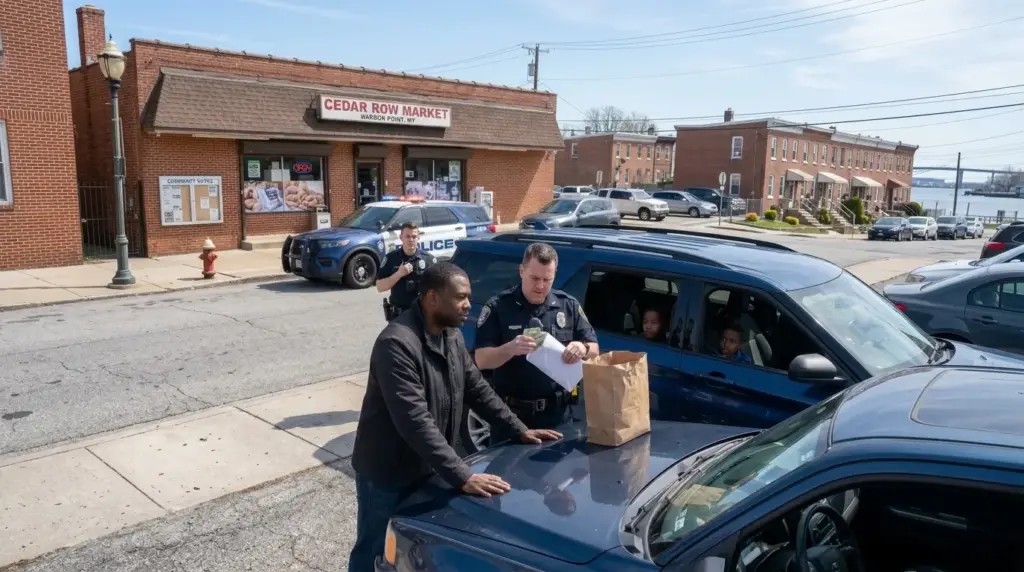
If that was true, then the question was not whether to report it. The question was how to report it in a way that actually held. Desmond had spent enough years inside accountability systems to understand their failure modes. He knew what happened when a complaint came in from someone with no video, no witnesses, and a story that contradicted an officer’s written report. He knew what happened to those files. He had, in other cities, opened those files and read what was written in the margins by supervisors who had decided quietly that the problem would not be worth the cost of solving it.
If he announced himself now, walked into the precinct tomorrow with his appointment letter and his dash cam footage, the investigation that followed would begin with his name attached to it. Briggs’ attorney, when the time came, would make that the story. The new chief settling a personal score before he was even sworn in. That narrative, even if untrue, could contaminate the case. It could protect Briggs precisely because of who Desmond was. He was not going to let that happen.
He opened his contacts and found the number for Dana Mercer, the county’s office of professional integrity director. He had met her twice during the appointment process. She was thorough, careful, and operated with a jurisdiction that overlapped with, but was independent of the precinct he was about to lead. He typed a short message asking if she was available for a confidential call in the next 24 hours. He attached a copy of the dashcam file, timestamped and unedited, along with three pages of typed notes he had written in the previous hour.
Before he sent it, he looked at what he had written. He had not written it as a chief. He had written it as a witness. He had included every detail he could verify and marked clearly the things he could not. He had not named what it meant. He had let the record speak. He sent it and put the phone face down on the table.
Through the wall, he could hear the low sound of Marcus’ ceiling fan running, which the boy had running every night regardless of temperature, because he claimed it helped him sleep. A habit he had started in the months after his mother died and had never stopped. Desmond listened to it for a moment. What had been done to him on Cedar Row was wrong, but it had not been done to him alone. He was certain of that now. And the way it had been done, efficiently, without hesitation, in the practiced dark of a disabled camera, told him that whatever was happening in Harbor Point had been happening for a long time before he arrived.
He was four days from being police chief. He intended to use those four days.
Dana Mercer had worked in professional integrity long enough to know that the most dangerous kind of misconduct was not the kind that left marks. It was the kind that left nothing at all. She called Desmond back within 2 hours of receiving his message, listened to the dashcam audio twice without interrupting, and then sat in silence for a moment before she spoke.
What she said was careful and deliberate, the language of someone who had learned to separate what she believed from what she could prove. She told him she would begin a quiet preliminary review before Thursday. She told him she would not route anything through the precinct’s internal chain. She told him the dashcam file would be preserved under her office’s custody from that moment forward. She did not tell him it would be easy. She had been in this work too long to say that to anyone.
Desmond thanked her and did not call again. He gave her the space to do what she did and spent the next 3 days doing what he had originally planned, walking Harbor Point, meeting members of the community leadership council, taking Marcus to orientation at the new school, and preparing for Thursday morning. He kept his phone close and said nothing to anyone about Cedar Row. The appointment letter stayed in his email. His name remained a piece of paper most people hadn’t read closely.
On Wednesday evening, Dana sent him a message with three words: “More than one.” He did not sleep well that night.
The first thing Dana found when she pulled the records was the absence of records. There was no citation issued to Desmond Avery on the evening in question. No traffic stop entered into the dispatch log under his plate number. No notation in the system of any property being searched or seized. The incident report for Briggs and Sykes’ shift that night described a routine community contact on Cedar Row, the kind of entry that took 30 seconds to write and was designed to be invisible among hundreds of identical entries filed every month.
In the officer narrative section, Briggs had written that a motorist was advised of a parking infraction and departed the scene voluntarily following the interaction. Sykes’ body cam showed a gap in the window that matched the Cedar Row encounter exactly. The device log listed the cause as a battery malfunction. There was no flag on the equipment record. There was no maintenance request filed afterward. The camera had, according to the paperwork, simply stopped working and then resumed, and no one had found that remarkable enough to question.





