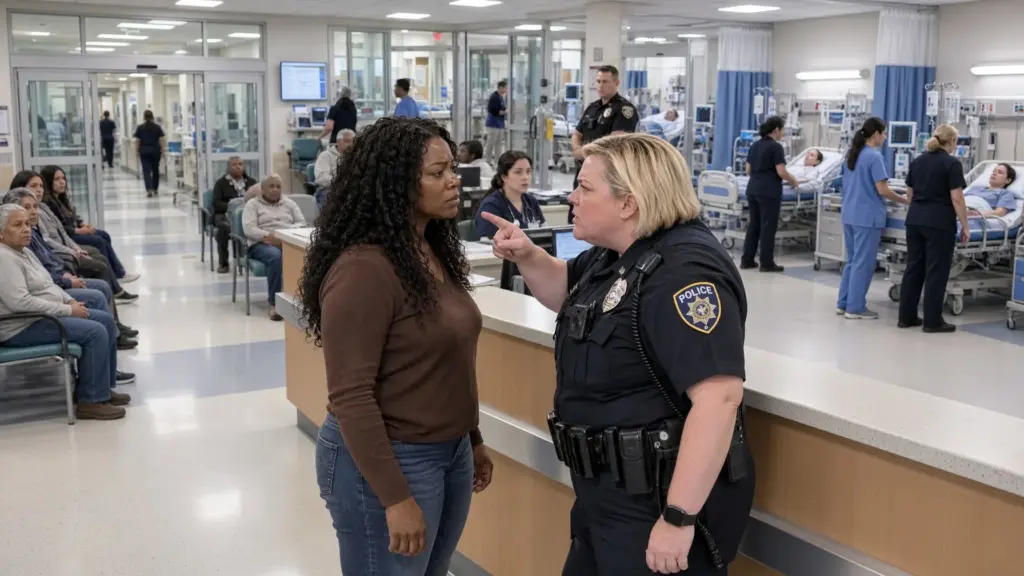
Noah hesitated. “I saw the lockdown. Then I saw the cameras move. Then I saw a police terminal querying archived video while officers were searching a patient’s property in a room without coverage.”
“That still doesn’t explain why you called her.”
“No, it doesn’t.” Noah looked down at his hands. “My wife spent years working hospital billing. When our insurance changed, we nearly lost coverage for her heart medication because one code was entered wrong. It took six weeks to fix something everybody admitted was a mistake.” Paul waited; Noah continued: “That taught me something about systems: if the paperwork says the wrong thing long enough, the wrong thing starts becoming reality. Last night, I watched people deliberately create that kind of paperwork.” He looked up. “So, I called the person they had pushed outside.”
Paul nodded slowly. “Your mortgage still needs paying?”
Noah almost laughed. “Yes.”
“Health insurance?”
“Yes.”
“Retirement account?”
“Not nearly enough in it.”
“Then you understand coming forward may become uncomfortable.”
“I do.”
“And you still want your name attached to the statement?”
Noah took a breath. “Yes.”
The formal interview lasted nearly an hour: every technical claim was separated from every assumption; Noah identified what the logs proved, what they suggested, and what they could not establish without additional evidence. By the time he signed the statement, Paul had something far more valuable than an anonymous tip: he had an independent digital trail.
Later that morning, Paul assembled the evidence summary:
* Turner’s authenticated USB established the source material.
* Noah’s hospital logs established the false lockdown, camera redirection, USB connection, and attempted deletion.
* Witness statements from Evelyn Reed and Liam Foster established what happened in the emergency department before and after Maya was removed.
Another statement was still missing; Samuel Cole provided it voluntarily.
He sat across from Paul with his uniform cap resting on the table. “I saw the blue drive opened,” Cole said. “I saw Harland’s reaction when it turned out to be schoolwork.”
“What reaction?”
“Fear.”
Paul looked up. “That’s an interpretation.”
Cole nodded. “Then write this instead: he became more concerned after learning the drive was harmless, not less concerned.”
“That I can use,” Paul said.
Cole continued. “I should have questioned it sooner.”
“Why didn’t you?”
“I’ve been doing this a long time. You learn which supervisors make problems disappear, and you convince yourself that staying out of their way is professionalism.”
Paul asked, “What changed?”
Cole looked toward the closed office door. “I kept telling myself staying out of it was the same as staying clean.” He paused. “Now I know silence leaves fingerprints, too.”
That afternoon, Dana Mercer received a copy of Harland’s preliminary defense position through her attorney. She read the section assigning responsibility for the camera shutdown twice; then the paragraph claiming the false lockdown had been implemented by Dana without direct supervisory instruction; then the statement suggesting any improper property movement had been her personal decision.
Dana lowered the pages. Her attorney watched her carefully. “You understand what he’s doing?”
Dana’s face had gone still. “He’s putting all of it on me. He’s separating himself from every decision he thinks we can’t prove.”
Dana looked down at the documents again. For years, loyalty had meant following Harland’s instructions without forcing him to write them down. Now, that same loyalty had become the space where he intended to leave her alone.
Dana pushed the papers aside. “I want to change my statement.”
Her attorney studied her. “Then, this time, Dana, you need to tell the whole truth.”
Dana Mercer’s second interview began with her attorney beside her and a digital recorder centered on the table. This time, she did not sit with her arms crossed or challenge every question. The anger was still there, but it had been replaced by something more useful to investigators: the realization that Charles Harland intended to survive by leaving her behind.
Paul Reeves sat across from her. “Before we begin, I need you to understand that cooperation does not erase your own conduct.”
Dana gave a tired nod. “I understand.”
“You disabled your body camera.”
“Yes.”
“You threatened Maya Williams with arrest.”
“Yes.”
“You participated in the false lockdown.”
Dana looked briefly at her attorney before answering. “Yes.”
Paul did not soften his voice. “And you searched Isaiah Williams’s property without a documented arrest or proper evidence intake.”
“Yes.”
“Whose instruction?”
“Harland’s.”
Paul waited; Dana continued: “He told me a black storage device had to be recovered before it left the hospital.”
“Did he explain what was on it?”
“Not everything. He said it contained internal material that could be taken out of context.”
“Did you believe that?”
“At first.”
“And later?”
Dana looked down at the table. “Later, I realized nobody puts an emergency department into lockdown over something harmless.”
Paul let the silence work; Dana finally continued: “This wasn’t the first time he used the hospital liaison office to keep property outside normal intake.”
“How often?”
“I don’t know the total number.”
“Give me what you do know.”
She described previous incidents in which property was temporarily held under hospital security classifications before being entered into the precinct system: complaints were sometimes rewritten before reaching supervisory review; language such as “interference,” “security concern,” and “temporary hold” replaced more specific descriptions that might have triggered outside scrutiny.
“Did Harland tell you to alter reports?” Paul asked.
“Sometimes directly. Sometimes he’d say the narrative needed to be cleaner. Everybody around him understood what that meant.”
“‘Everybody’?”
Dana shook her head. “Not everyone: the people he trusted.”
Paul leaned forward slightly. “Did you consider yourself one of those people?”
Dana looked toward her attorney again, but this time she answered without help: “I thought I was.”