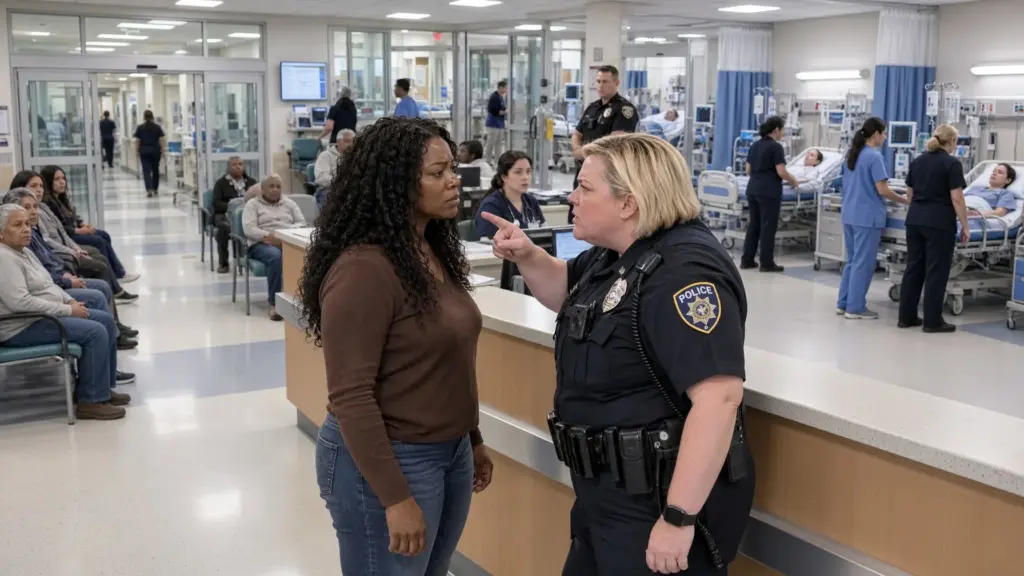
Isaiah took the inhaler with both hands and closed his eyes briefly after the first measured dose. His breathing was still labored, but the panic that had been tightening his chest was beginning to ease.
Then he saw Maya standing near the doorway. “Mom!”
For the first time since she had returned to the hospital, Maya’s composure weakened. She crossed the room quickly and stopped beside the bed. Her hand went to Isaiah’s shoulder, then to the side of his face, as if she needed physical proof that he was really there.
“I’m here.”
Isaiah looked past her toward the hallway where state investigators and hospital staff were moving through the corridor. “What happened out there?”
“We’ll talk about that later. How are you breathing?”
“Better.”
“Better isn’t the same as good.”
Dr. Caldwell answered for him. “His oxygen level is improving and the bronchospasm is responding to treatment. I want to keep watching him, but right now he’s moving in the right direction.”
Maya nodded. “Thank you, Doctor.”
Isaiah studied her face. “Why are there state people outside?”
Before Maya could respond, Paul Reeves appeared at the doorway. “Maya.”
She turned; his expression was gentle but firm. “We need a formal statement from Isaiah before everybody starts comparing stories.”
“I know.”
“And you can’t take it.”
Maya’s eyes moved back to her son.
Paul continued, “You’re his mother, and you were directly involved in what happened at the front desk. If you question him yourself, Harland’s attorney will say you shaped his account.”
Isaiah frowned. “Who is Harland’s attorney?”
Maya ignored the question for the moment. “I’m not going to shape anything.”
“I know that,” Paul said. “The issue is whether someone can argue that you did.”
That was enough. Maya slowly removed her hand from Isaiah’s shoulder and stepped back. “You’re right.”
Isaiah looked between them. “Can someone please tell me what’s going on?”
Maya pulled a chair closer to the bed, but did not sit in the position Paul would use for the interview. “You answer his questions exactly the way you remember things. If you don’t know something, say you don’t know. If you’re not sure, say you’re not sure.”
Isaiah gave her a tired look. “That sounds very official.”
Maya held his eyes for a moment. “Tonight needs to be.”
Paul sat down on the opposite side of the bed and activated a state-issued recorder after obtaining Isaiah’s consent. He started simply.
“Do you know why the officers stopped you?”
“They said my backpack might be connected to stolen property.”
“Did they tell you what property?”
“No.”
“Did you steal anything?”
“No.”
“Was there anything unusual in your backpack?”
Isaiah shook his head automatically, then stopped. “Maybe.”
Paul waited; Maya did not speak. Isaiah looked toward her, but she deliberately remained silent.
Paul asked, “What do you mean by ‘maybe’?”
“There was a flash drive.”
“What kind?”
“A USB drive.”
“Black?”
Paul glanced down at his notes. “Was it yours?”
“I thought it was at first.”
“What changed your mind?”
Isaiah took another careful breath before answering. “I was studying near campus earlier. There were a bunch of people sharing the long tables. I packed up fast, and there was a black drive beside my laptop. I picked it up because I thought it was mine.”
“Did you open it?”
“No. I put it in my bag.”
“Where?”
“In one of the small inside pockets.”
Paul’s pen stopped moving. “What does your own USB look like?”
Isaiah seemed confused by the question. “Blue.”
Maya’s eyes shifted toward Paul; neither of them interrupted.
Paul asked, “So, the black drive definitely wasn’t your normal school drive?”
“No.”
“Did you know what was on it?”
“I just said I never opened it.”
“I’m confirming.”
Isaiah leaned back against the pillow, clearly exhausted. “I didn’t even think about it again until the police started asking weird questions.”
“What kind of questions?”
“Whether I’d copied anything, whether I had uploaded files, whether I’d used a computer after leaving campus.”
Maya’s expression remained still, but her attention sharpened.
Paul asked, “Did they ever mention a USB?”
“Not directly.”
“Did they search your backpack in front of you?”
“Part of it.”
“Did you see them find the black drive?”
“No.”
Paul looked toward the investigator standing outside the door. “Have the property inventory brought here.”
Several minutes later, the documented list of Isaiah’s belongings arrived. Paul read through it carefully: laptop, charger, wallet, university identification, clothing, notebook, calculator. Then: one blue USB storage device. There was no black drive.
Isaiah stared at the list. “That’s not right.”
Paul looked up. “You’re certain?”
“Yes.”
Maya finally spoke, but only to clarify the boundary. “Paul, not from me.”
He understood. He turned back to Isaiah. “Where exactly did you last see the black drive?”
“I thought it was in the backpack.”
“You thought?”
Isaiah closed his eyes for a moment, trying to reconstruct the evening. “I’m not sure anymore.”
Paul closed the inventory and stood outside the room. The digital forensics specialist was waiting with a tablet.
“We have something from the hospital workstation,” she said.
Paul stepped into the hallway. Maya followed far enough to listen, but did not touch the tablet.
The specialist continued, “During the lockdown, a removable drive was connected to the police liaison computer. It contains ordinary university files: engineering coursework, spreadsheets, class documents.”
“The blue drive,” Paul said.
“That’s what it looks like.”
Maya looked through the glass at Isaiah, then down the corridor toward Harland, who was already speaking with department counsel. Harland had searched for something specific: he had opened Isaiah’s blue college drive, but the black one was missing.
Paul lowered his voice. “If we can’t find it, Harland will say Isaiah invented it after the fact.”
Maya watched Harland continue talking as though the night had already become a legal argument instead of a medical emergency. “That’s exactly what he’s going to say.”