* Complaint summaries had been rewritten in language that softened or obscured what citizens originally reported.
* In a handful of cases, evidence had passed through the hospital liaison office before appearing in ordinary precinct intake records.
What had looked like isolated administrative mistakes began forming a documented pattern.
Dana Mercer remained off duty while disciplinary proceedings continued. Her cooperation did not erase what she had done at the reception desk, nor did it excuse her participation in earlier incidents; it simply gave investigators another account to compare with evidence they already possessed.
Charles Harland remained stripped of operational authority while independent agencies reviewed possible obstruction, evidence manipulation, record falsification, and other misconduct connected to the files. Maya did not decide his punishment; that mattered to her: the case had become stronger precisely because it no longer depended on what Maya wanted.
Captain Daniel Ruiz ordered a review of the entire hospital liaison program and opened records that had previously been treated as routine internal matters. He also accepted responsibility for allowing Harland too much freedom to resolve sensitive incidents without meaningful supervision.
When one investigator asked why he had trusted Harland for so long, Ruiz did not defend himself.
“He made difficult problems disappear,” he said.
The investigator waited; Ruiz looked down at the files on his desk. “I should have asked where they went.”
At St. Matthew Regional, the changes were more immediate:
* Hospital leadership rewrote its law enforcement access policy: police officers could request security restrictions, but they could no longer activate a clinical area lockdown without documented approval from hospital emergency management or an authorized medical administrator.
* Any restriction affecting a patient’s medical access now required a written legal and clinical basis.
* If police took possession of patient property, the transfer required a receipt stating the time, purpose, receiving officer, and chain of custody.
* Camera overrides generated automatic audit records stored outside the local liaison system; no single police terminal could quietly erase them.
Evelyn Reed read the new policy after it was posted near the nurse’s station. Dr. Caldwell stood beside her with a cup of coffee.
“Think it’ll make a difference?”
Evelyn adjusted her glasses. “It won’t make people better.”
“No. But it’ll make it harder for bad decisions to hide.”
Caldwell nodded. “Sometimes that’s enough to start.”
Isaiah recovered without permanent injury: his breathing returned to normal, his medication was adjusted, and after several days away from classes, he went back to the university.
He declined interview requests from local media: once word of the investigation began circulating, he had no interest in becoming the public face of anything. He wanted to finish his engineering coursework, replace the sleep he had lost, and stop receiving messages from classmates asking whether the story they had heard was really about him. Maya respected that.
Several months later, she drove him back to St. Matthew Regional for a routine asthma follow-up. It was a quiet afternoon: there were no state investigators in the parking structure, no lawyers waiting near the emergency department, and no police officers controlling the treatment corridor.
Isaiah stepped out of the car carrying a backpack over one shoulder. Maya noticed it. “So, you trust backpacks again?”
He looked at her. “I check the table before I leave now.”
“That seems wise.”
“And I only carry one USB.”
“What color?”
“Bright orange.”
Maya smiled despite herself.
They crossed the parking lot together. As they approached the emergency entrance, Isaiah slowed: the automatic doors opened normally. For a moment, he simply looked inside.
“You know what’s strange?” he asked.
“What?”
“It looks exactly the same.”
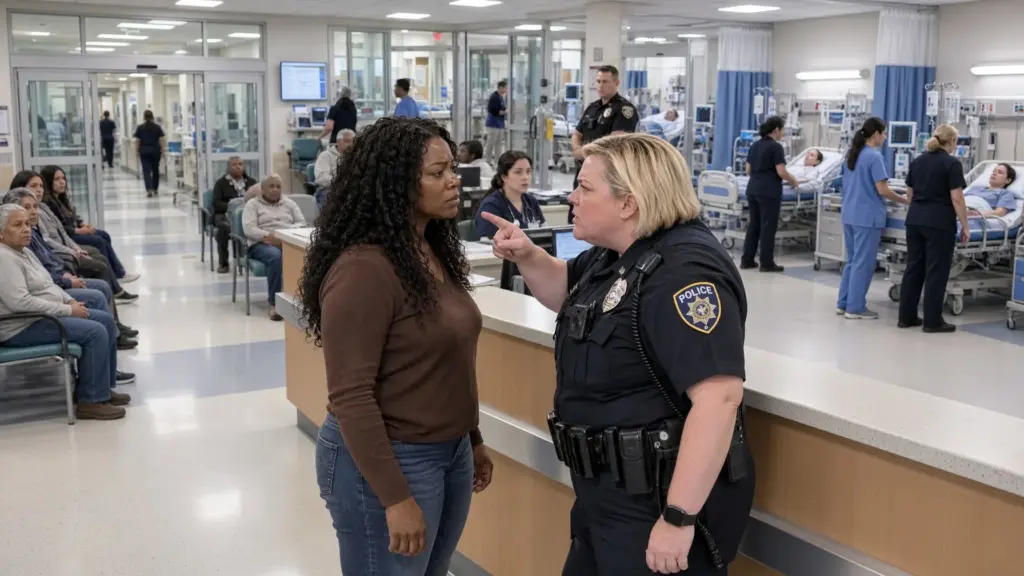
Maya understood what he meant: the same reception desk stood beneath the same ceiling lights; the television in the waiting area still played with the volume low; someone was arguing quietly with an insurance company on the phone; an elderly man sat holding a paper cup of coffee while his wife filled out forms beside him. Ordinary life had returned—maybe it had never stopped.
Isaiah looked at Maya as they walked farther inside. “Did you know what was on the drive when you came here that night?”
“No. Not even a guess.”
“None?”
“Then how did you know something was wrong?”
Maya considered the question. “Because I asked simple questions.” Isaiah waited. “And they wouldn’t answer. People telling the truth usually answer simple questions. People hiding something start deciding who is allowed to ask.”
Isaiah nodded slowly.
Near the security desk, something new caught his attention: a printed policy notice had been mounted beneath a clear protective cover:
*Patient medical access may not be restricted by law enforcement without documented legal and clinical authorization.*
Isaiah read it twice. “So all that became this?”
“Not all of it.”
“It doesn’t look like much.”
Maya looked at the notice. “It doesn’t have to.”
They continued toward the outpatient elevators. Behind them, the automatic doors opened again: a woman in her late 50s entered quickly, clutching her purse against her side. Anxiety showed plainly on her face as she approached the reception desk.
“I’m looking for my son,” she said. “They told me he was brought into the emergency room.”
The receptionist looked up immediately. “Of course, ma’am. What’s his name?”
The woman gave it; the receptionist began checking the system. “I found him. Let me call the treatment desk and see what information we can give you.”
Maya heard every word. She did not turn around.
Isaiah pressed the elevator button, and the doors opened a moment later. As they stepped inside, Maya thought about:
* The badge Dana had surrendered.
* Harland’s access card lying useless on a conference room table.
* Turner’s tiny black USB.
* Noah’s preserved logs.
* Evelyn’s statement.
* Foster’s memory.
* Cole’s decision to finally speak.
* And Paul’s insistence that the case survive without depending on Maya’s authority.