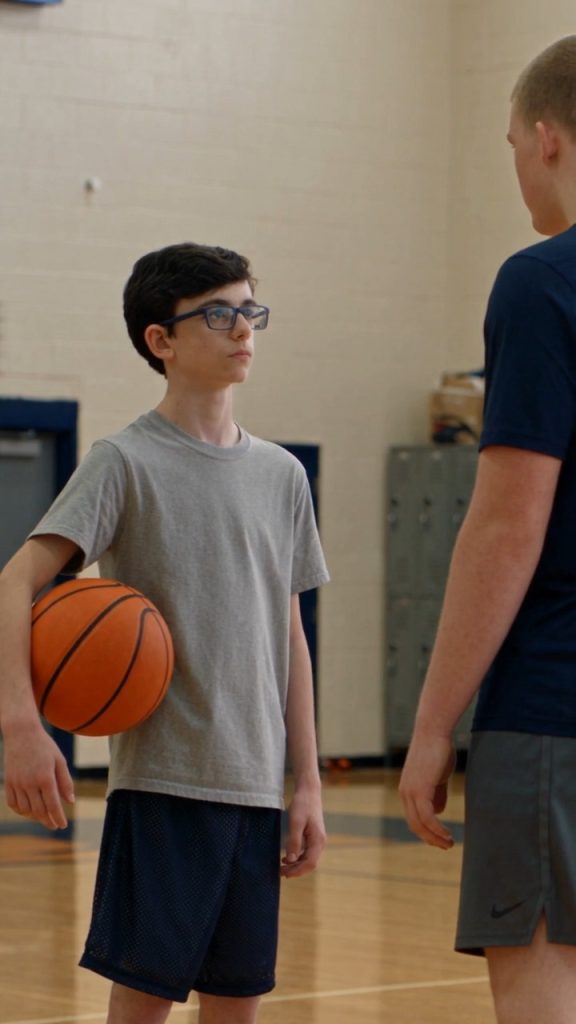
“Eventually, if you want to tell me. But I think the school needs to hear them from you. I don’t want to be the person who repeats them before you have.”
She nodded. They stood in silence that wasn’t comfortable but didn’t demand performance. Eli had imagined a witness appearing with perfect courage and a finished statement. The real person in front of him seemed tired and afraid of her friends. That didn’t make her testimony less valuable. It made her decision harder.
After she left, Eli went to his next class with the knowledge that at least one more person possessed a piece of the story he hadn’t heard. He was tempted to fill the gap with whatever made Mason look worst. Instead he wrote a short note in his planner: Tessa said she spoke to Brooks about something before game. I do not know her exact words. He underlined the second sentence.
The following class that Thursday was a group science session, the sort of lesson in which students were expected to make quick decisions together. Eli’s group had to compare two sets of measurements and agree on a short explanation. One member kept looking toward the door while another tapped a pencil against the desk. Eli proposed dividing the work by the measurements each person had already checked. The others accepted. For twenty minutes they argued only about numbers and whether the graph’s scale was sensible.
It reminded him that cooperation was not a grand declaration of loyalty. Sometimes it was someone handing over a ruler without making a joke of the person who needed it. He noticed how his own body relaxed when nobody tried to turn the project into a contest. He offered a correction on the graph, and the student beside him thanked him without any performance attached. Eli wanted to hold onto the feeling, because the crowded hallways were still full of uncertainty.
When the group finished, one student lingered while the others packed their bags. “Can I ask about gym?” he said. Eli paused. The boy had been on a different practice station during the challenge and had seen only the final shots. “I didn’t see the beginning. Somebody told me you two were just messing around.”
Eli could feel himself preparing the longest possible defense. Instead he said, “We played. I didn’t choose the way it started. I’ve talked to the school about the parts I experienced.”
The boy looked thoughtful. “I thought if you won, you probably weren’t bothered.”
“I was bothered before the score was three-two,” Eli said. “Winning didn’t change that.”
The student nodded uncertainly. He didn’t apologize or announce a change of opinion. “I didn’t think about it like that,” he said, and left for class.
Eli was surprised by how much the exchange mattered. He hadn’t convinced an entire crowd; he’d answered one person without calling him foolish for a question based on incomplete information. He could tell the truth without reenacting Mason’s habit of embarrassing whoever was on the other side. He could also stop at the limits of what he knew. The boy hadn’t been there for the opening, and Eli didn’t need him to pretend otherwise.
Back in the hallway, Eli saw a group of students laughing near the lockers and felt his first instinctive flush of suspicion. He caught only the end of a joke about a broken umbrella. None of them was looking at him. He continued walking, allowing the laugh to belong to something else. That was a kind of freedom he hadn’t expected to value: not every sound in school had to carry his name.
At midafternoon, Mr. Price called to update him. The coach’s written observation had been received. It supported that a group gathered and the ending was tense, but it did not establish the opening challenge. Mason’s denial remained in the record. Independent recollections were being considered, and final interviews would take place on Monday, October 26. Mr. Price did not reveal who had agreed to speak or what they had said. Eli heard how deliberately he made those limits clear.
“So you might decide it was a joke,” Eli said.
“We will decide what the available information supports,” Mr. Price answered. “We don’t make a finding because a student is popular or unpopular, and we don’t disregard your concern because you won a game. We have more work to do.”
Eli said he understood, although the uncertainty left him feeling hollow. He had wanted a fair review. Fairness meant allowing a denial to exist long enough to be examined. It also meant living several days with the possibility that the other students would decide speaking up had made everything worse.
When school ended, Noah was sitting near the library steps with his backpack at his feet. Eli sat beside him, leaving a little space between them. They watched buses pull into the loop. Noah said he hadn’t slept much after speaking to Ms. Brooks. A friend had asked him whether he was trying to get Mason suspended. He’d said he was trying to explain what happened to him. The friend had rolled his eyes.
“I thought once I told somebody I’d feel better,” Noah said.
“Do you?”
“Some of the time. Then I remember other people might be angry.”
Eli looked across the parking lot. “I felt good when that third shot went in. I thought everybody saw what happened. Then by the next morning people were saying it hadn’t happened that way.”
“Maybe a basketball game isn’t a very good way to decide who’s telling the truth,” Noah said.
Eli laughed once. “Apparently not.”
Noah turned toward him. “But it wasn’t nothing. Seeing you say no to the joke made me remember that I could say what happened to me. I don’t know whether it’ll work.”





