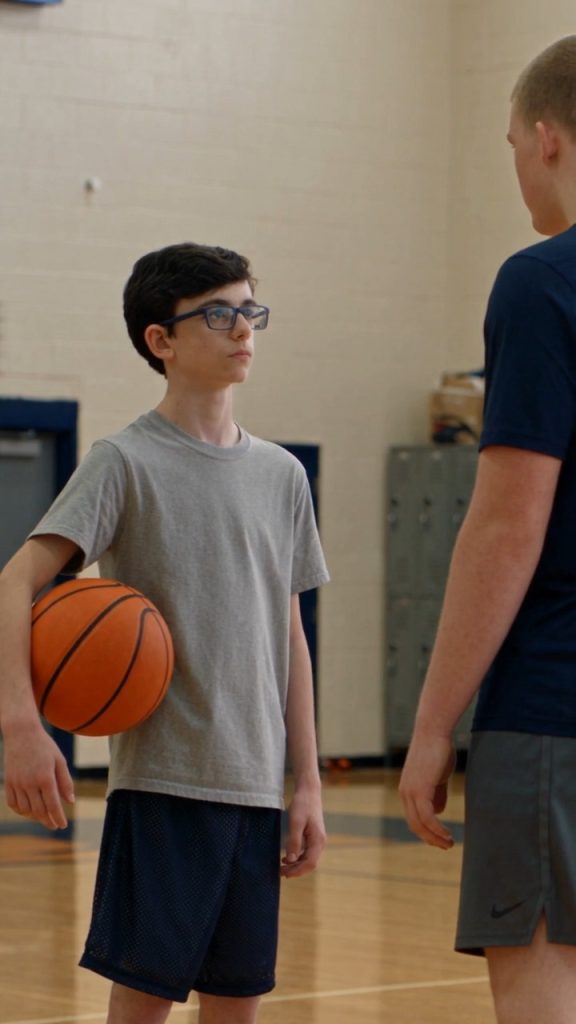
The ball went in.
Mason caught it after it dropped to the floor. For a moment no one said the score. No one needed to. Three-two. The tall boy held the ball with both hands and stared, and the smaller boy stood several paces away beneath the north hoop, trying not to shake.
“I’m not your show,” Eli said.
That was when the gym went truly quiet.
The silence didn’t feel like victory at first. It felt like stepping into a room after an argument and discovering everyone inside had heard every word. Eli noticed the humming overhead lights, a sneaker squeak farther downcourt, the thin patter of drizzle against a high window. Mason’s expression settled into something flat and private. Eli was afraid of that expression, though he refused to look down.
“What’s happening over here?”
Coach Avery Parker crossed from the equipment alcove near the east wall, where he’d been helping a separate station untangle a rotation of balls and cones. He looked from the gathered students to the basket, then to Mason holding the ball. He had plainly caught the end of an unscheduled game, not its beginning.
“We were playing,” Mason said before anyone else could speak.
“I can see that.” Coach Parker’s voice was firm without being loud. “The open-ball interval was supposed to be individual practice. Why’s everybody stopped?”
No one volunteered an explanation. Zoe half raised her hand, then lowered it when the coach looked directly at Eli.
“Eli, are you all right?”
The question nearly undid him. It wasn’t an accusation. It wasn’t even a particularly dramatic question. But for weeks nobody in that gym had asked whether he was all right while Mason was deciding what Eli should do next.
“I want him to leave me alone,” Eli said.
Coach Parker’s eyes moved toward Mason. “Then we’re going to give you space. Everybody back to the assigned stations. Mason, put that ball away on the east rack, please. Both of you, talk to me before you leave today if there’s more I should know.”
Mason turned so sharply the soles of his orange sneakers rasped. He crossed the court with the ball and shoved it into an open slot on the rack. The coach directed the other students toward their work. The semicircle broke apart, but Eli could feel people’s attention trailing him.
He joined the footwork station near the west wall. His legs felt astonishingly unreliable for legs that had just carried him through a game. Zoe moved to an adjacent lane. They did the required side steps and changes of direction without talking. Every now and then Mason laughed too loudly at something across the gym. Each time Eli’s shoulders tightened.
A win, he realized, could turn a spotlight on a person just as easily as a defeat. It didn’t tell him what would happen after the lights went out.
On September 29, Mason had ordered him to fetch a cluster of stray balls during a station change. Eli remembered crossing the court again and again while Mason lounged by the wall and said, “We’ve got a volunteer.” It was easier to do the errand than to argue while twenty people watched. Afterward Eli had told himself that retrieving equipment was a normal part of gym class. He had nearly succeeded in believing it.
On October 6, Mason had made a smaller joke of a different kind. Noah had been finishing a timed drill, breathing hard, when Mason told him he had to run it again because he’d supposedly done it wrong. Eli hadn’t seen the entire exchange, and he couldn’t say exactly what Noah thought. He did remember Noah starting over while Mason watched. Later that period Mason had looked at Eli carrying cones and called him “extra equipment.” Eli heard it clearly; the people around him had laughed as if the phrase were clever.
The strange thing about humiliation was how much time it borrowed from the person receiving it. A remark lasted five seconds. Eli spent a week figuring out whether to call it cruel, whether everyone thought so, whether mentioning it would make him seem weak. His mother often asked what was on his mind as he picked at dinner, and he said homework. Homework was easier to name.
Eli considered the faces that had watched him fetch those balls in September. A few students had looked sympathetic. Others had kept their eyes on the floor. He himself had watched Noah begin that extra drill in October and done nothing, telling himself he didn’t understand enough to interfere. The memory didn’t make Mason’s choices somebody else’s responsibility. It did make the crowd more complicated than a single cruel creature. Most students were fifteen or sixteen, frightened of becoming the next joke and eager for a class period to pass without trouble. The trouble was that silence had become part of Mason’s routine. It had made his demands feel more official than they were. When Eli remembered the hush after his last basket, he wanted to believe the routine might have cracked, even if none of them yet knew what to put in its place.
Now he had answered in front of everybody. That should have simplified things. Instead, as the class resumed its ordinary rhythm, the quiet after his last shot began to feel less like agreement and more like a pause before a different problem.
At the water fountain outside the gym’s east doors, the line moved slowly. Coach Parker passed Eli a few minutes later on his way to check a class station. “I heard you say you wanted to be left alone,” he said. “I take that seriously. I didn’t hear what happened at the start, and I won’t pretend I did. Can you tell me?”
Eli stared at the silver fountain spout. Other students were close enough to overhear. “He wanted a game.”
“Did you want one?”





