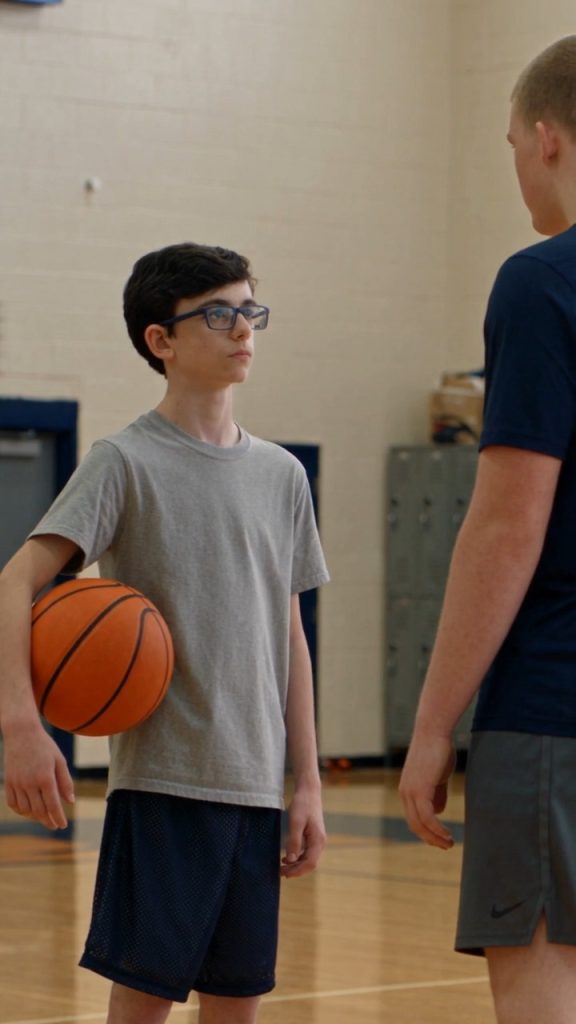
Eli opened his mouth and found he couldn’t answer with an easy yes or no. He had accepted it. He had also felt that refusing would become another public humiliation. He didn’t have words ready for that difference.
“Not really,” he said.
Coach Parker’s expression changed. “Then that’s something I need to understand better. You can speak to me privately after class, or to Ms. Brooks. You don’t have to explain it here in line.”
Eli nodded. The offer was there, but taking it felt enormous. An adult who wasn’t certain what he had seen was still asking. Eli wasn’t used to deciding whether to trust that.
The remaining stations passed in measured circles: stretch, shuffle, shoot at a different hoop, collect, repeat. Mason stayed on the far side after the coach redirected assignments. Zoe managed a brief glance at Eli when she crossed the court. Her expression said she had watched, but it didn’t tell him whether she would say so aloud. Tessa’s eyes met his only once. She looked uneasy and quickly turned toward the equipment shelf.
Eli wondered if the class would talk about the game in the hallway, and which pieces would survive retelling. Two short shots and a set shot could become some impossible display of talent. The challenge could become a friendly bet. The silence could become laughter. Even his one sentence might be repeated as an insult instead of a request to be treated like a person.
Before the clock reached dismissal, Coach Parker had them work through a final round of station cards. Eli’s card called for receiving a pass, taking two controlled dribbles and shooting from a marked spot. It was exactly the kind of thing he enjoyed when the gym wasn’t arranged around one person’s opinion of him. He kept his attention on the taped square, on the weight of the ball and the sound of his feet. He missed the first attempt, retrieved it and tried again. Nobody called out the miss. The next attempt went in.
Across the lane, a student asked Zoe how many turns they had left. She checked the card and answered. Eli was struck by the uncomplicated exchange. The student hadn’t turned Zoe into a referee or a witness; she’d simply been asked for information. He couldn’t remember the last time Mason asked a question like that without making it sound like a test.
When his turn ended, Eli moved back in line beside Noah. Noah had been careful not to stare at him since the game. Now he shifted his weight and said, “That last one was pretty clean.” Eli wasn’t sure whether he meant the final basket against Mason or the station shot. He chose not to ask.
“Thanks,” he said.
Noah nodded. His eyes moved toward the other side of the gym, where Mason was laughing with two students as they gathered cones. Noah turned away first. Something in that small movement reminded Eli of the morning on October 6. He had seen Noah finish a drill and then start again under Mason’s watch, but he had never asked Noah afterward whether he’d been all right. Eli had been busy feeling fortunate that, on that particular day, the joke had passed to someone else. Remembering this was uncomfortable. It made him aware that silence could feel like protection from inside it, even when the person being watched was somebody else.
Eli adjusted his glasses and concentrated on collecting his own station’s equipment. He didn’t know whether Noah wanted company, an apology for not speaking earlier, or nothing at all. He decided that when the moment came, he could ask rather than deciding for him. The thought was small, but it moved him out of the endless calculations about Mason and toward another person in the room.
Coach Parker stopped beside the west station and asked whether all the balls were accounted for. Three students checked the rack and reported the number together. Mason wasn’t assigned to command the count; the coach was. Eli noticed how ordinary the task became when responsibility was clear. He could help return equipment without becoming somebody else’s assistant for amusement.
By the time the last cones had been stacked, the class was talking again. Somebody mentioned the upcoming home football game. Another student asked whether Friday’s forecast would ruin the walk between buildings. A few still glanced at Eli, but more were thinking about the next period. The world had not frozen around his third basket. He was grateful for that. He was also disappointed, because some part of him had hoped the entire class would remain in the exact second when Mason had no answer. In that second, everyone seemed to understand. Outside it, understanding had to compete with habit, convenience and the simple desire to get on with the day.
Eli knew a basketball could end a game with a visible score. He was beginning to suspect that the other kind of ending would require much more than one perfect moment.
At 11:20, Coach Parker dismissed them to change and head for their next class. Eli packed his gray PE shirt into his gym bag and put on the sweatshirt he’d worn in the morning. His glasses fogged briefly in the warmer locker-room air. He wiped the lenses with the edge of a clean cloth from his backpack, moving carefully because replacing them would mean explaining another expense at home. It struck him that he’d worried more about dropping those glasses in the gym than about losing a game. They were part of how he moved through the world; Mason had treated the person behind them as optional.
Eli reached the main corridor as the bell traffic began to thicken. At the vending machines, two students were arguing good-naturedly about the score, each insisting he had called the last shot before it fell. Someone else said Mason had let him win. The conversation stopped when Eli approached. He kept walking.





