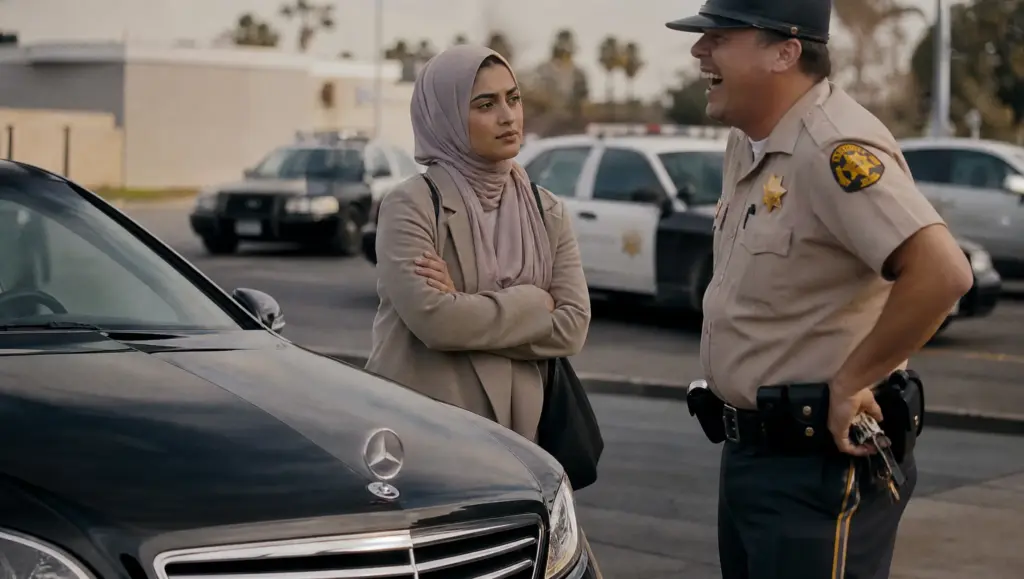
“When you looked at me,” she said, “before the radio. When you held my card up to the light. What did you think I was?”
It was a long time before he answered. She watched him decide not to lie. She watched it happen on his face, the way she had watched the bow come up into the wind on the screen, slow, and against something, and then all the way.
“I thought you couldn’t be what you said,” he said. “That’s the God’s honest truth. I couldn’t get a picture of it in my head. A pilot, and a woman, and in a, in that. All three. The pictures I had didn’t go together. So I figured somebody was messing with me, because that was easier than… than figuring I didn’t know what I was looking at.” He rubbed his face with one hand. “I been on this channel twenty-six years and I thought I knew everybody who belonged on it. Turns out I just knew everybody who looked like me.”
She nodded slowly.
“My father used to take me to the Lynchburg Ferry,” she said. “In Houston. On Saturdays, when I was little. We’d ride it back and forth across the ship channel and watch the pilot boats come alongside, and the pilot would climb up the ladder on the side of the ship, way up, and go over the rail. My father would say, that’s the one who knows the river. I asked him once if a girl could do that. He said, why not.” She looked at Wade. “That’s all it was. Somebody asking why not, for a very long time. Thirty years. There’s no trick in it. I’m not anybody’s joke, Mr. Toups. I’m the one who knows the river.”
“Yes ma’am,” he said quietly. “I know that now.”
“Good.” She put her hard hat back on her head and adjusted the chinstrap. “Open the gate, please. My car’s at Berth Four. I’d like to go home and see my daughter before she wakes up.”
He pressed the button. The arm went up.
She walked through it, not fast this time, down the long wet lane between the storage lots toward the berths, with her bag on her shoulder and the rain falling soft and light and silver in the sodium lights, and she did not look back, and Wade Toups watched her until she turned the corner at the end of the row of white pickup trucks, and then he picked up the black radio she’d returned and held it for a while, and then put it back in its charger.
Her report, which she wrote the next afternoon at her kitchen table while Yasmin did fractions across from her and complained about them, was four pages long. Three and a half of them were about wind speeds and line loads and tug positions and times. Half a page was about Gate Two. She wrote it the way she would have written up a failed winch brake: what happened, in what order, at what time. She wrote down that she had been asked to remove her hijab, and that she had declined, and why. She wrote down the word joke, in quotation marks, and the sentence it had come in, as close to verbatim as she could remember, which was very close. She wrote down that the guard had returned her credential and provided her with a terminal radio, and that the radio had allowed her to clear the line crew from the forward snap-back zone approximately two minutes before the number two forward breast line parted. She did not write down that the guard’s son had been one of the line crew. That was not hers to put in a report. She wrote down that she had no further comment on what disciplinary action, if any, should be taken, as that was not within her authority, and that she recommended the terminal repair its TWIC reader and equip its gates with handheld biometric verification units as a priority.
The association president, a soft-spoken senior pilot named Clint Daigle who had signed her first night trip eight years before, read it and called her and said, “You want me to push on this, Rania? Gulfline’ll do whatever we tell them right now. We nearly lost a ship and a line gang on their dock. One phone call and that man’s done everywhere on this coast.”
She thought about it for a long time with the phone against her ear, looking out the window at the crepe myrtle, which had lost half its flowers in the storm.
“He’s already done at Gulfline,” she said. “That’s between him and his company. I wrote down what happened, Clint. I want it written down. I want the next woman who comes through that gate to have a reader that works and a guard who’s read my report. I don’t need to be the one who finishes him.”
“That’s generous.”
“It isn’t,” she said. “It’s just that it’s not my job. My job is the river.”
The letter came to the pilot station three weeks later, addressed by hand in blue ballpoint to CAPTAIN RANIA MANSOUR, BAYARD PILOTS, with no return address, and Hap Landry held it out to her across the dispatch desk between two fingers, the same way Wade Toups had once held her card, and raised his eyebrows, and said nothing.
She did not open it right away. She put it in the inside pocket of her bag, next to the green prayer rug, and carried it for two days. She opened it finally at five in the morning on the deck of the pilot boat, riding out through the jetties toward the sea buoy in a long, easy, gray swell, with a loaded tanker waiting for her out there in the dawn, its anchor lights still burning.





