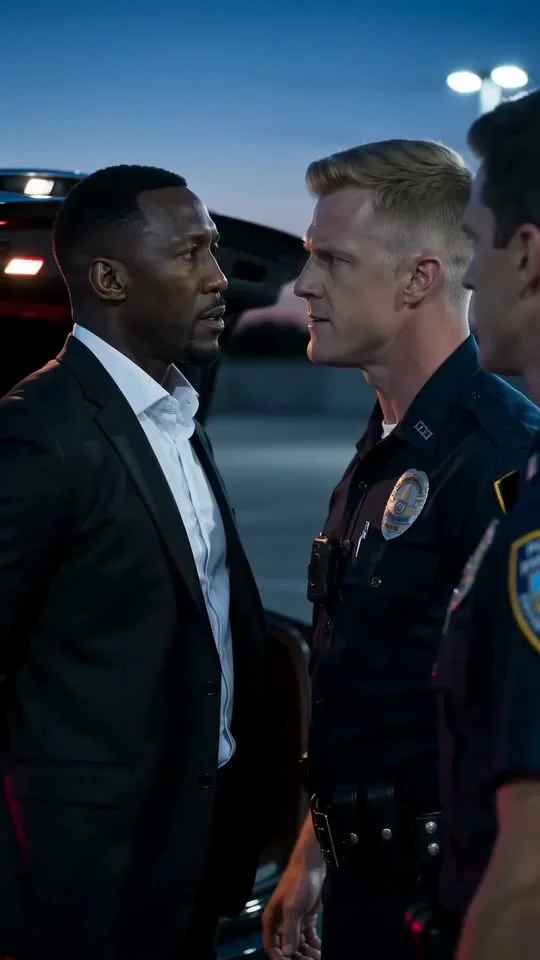
The answer arrived as a distant surge of engines.
Black vehicles turned onto the street at both ends, moving fast but controlled. Blue lights flashed behind dark windshields. Doors opened almost before the vehicles stopped, and men and women in federal vests spread across the pavement.
Cole released the case.
A woman with silver threaded through her dark hair approached with her weapon lowered but ready. “Damian?”
“I am unharmed, Director Ortiz.”
She looked at the handcuffs cutting into his wrists.
Damian corrected himself. “Mostly.”
CHAPTER 3 – The Preservation Order
Director Lena Ortiz stopped in front of Cole. She was compact, calm, and carried the kind of authority that required no volume.
“Place your hands where I can see them.”
Cole obeyed slowly. “This is a misunderstanding.”
“No,” Damian said. “It is evidence.”
Harris removed Damian’s handcuffs. The instant the second cuff opened, Damian brought his arms forward and winced. Deep red bands circled both wrists. Harris stared at them.
“I’m sorry,” he whispered.
Damian flexed his fingers, waiting for the numbness to ease. “Keep your camera running.”
Harris’s gaze lifted.
“That is what you can do now,” Damian said.
Ortiz assigned two agents to secure the case. A third photographed the trunk, the cuffs, Damian’s wrists, and the scrape left on the sedan when Cole shoved him into it. Nothing was hurried. Every movement was recorded.
Cole watched the process with contempt stretched too tightly across his face.
“You came here looking for a scene,” he said to Damian. “You wanted one of us to react.”
“I came here to serve a lawful order.”
“In an unmarked car.”
“My arrival was confidential.”
Cole gave a short laugh. “Not very confidential.”
Damian went still.
Ortiz heard it too. “How did you know he was arriving?”
“I didn’t.”
“Then why did you stop this specific vehicle?”
Cole looked toward Harris. “Routine patrol.”
Harris’s face tightened. “You told me dispatch had flagged the plate.”
“I said it might be connected to a theft.”
“No. You said dispatch flagged it.”
Cole took one step toward him. Federal agents immediately closed the distance.
“You’re confused, Nathan.”
Harris flinched at the use of his first name. Cole’s tone had softened into something almost paternal, and that made the threat inside it worse.
“You’ve had a stressful morning,” Cole continued. “Turn off the camera, and we’ll straighten out your memory.”
Harris placed his palm over the body camera—not to cover its lens, but to protect it.
“My memory is fine.”
The warmth disappeared from Cole’s expression.
Damian watched the exchange, then looked at Ortiz. “The order needs to be served now. Someone inside the department knew our route.”
Ortiz nodded. “We lock down the building, isolate the servers, and preserve every device.”
Cole laughed again, but no one joined him. “You can’t seize a police department because some lawyer got his feelings hurt.”
Damian picked up the court order from where Harris had placed it on the sedan’s roof. He held it by the edges.
“For eleven months, the Civil Rights Division has investigated unlawful stops, fabricated probable cause, evidence theft, coercive interrogations, and retaliatory arrests in Oakdale. Thirty-eight complaints disappeared before reaching internal affairs. Twelve body-camera files were altered. Four men were imprisoned after drugs were entered into evidence under your badge number.”
Traffic had stopped beyond the federal vehicles. Neighbors stood on porches, watching in silence.
Cole’s face did not change, but a pulse began beating in his temple.
Damian continued. “At six this morning, Judge Evelyn Shaw signed an emergency order placing Oakdale’s evidence systems under federal preservation. The original encryption keys and chain-of-custody records are inside that case.”
“So open it,” Cole said.
“Not here.”
“Why not?”
“Because you tried too hard to make me do it.”
A gust pushed dry leaves along the curb. Cole’s eyes flicked toward the case, then toward his patrol car.
Ortiz saw the movement. “Secure Officer Cole’s vehicle.”
Two agents opened the patrol car. One inspected the computer while the other photographed the mobile data terminal. Within seconds, the first agent raised his hand.
“Director. There is an active remote session.”
The screen showed a deletion window running against the department’s evidence archive.
Cole bolted.
He made it three strides.
Harris caught him around the waist, and they struck the pavement together. Cole twisted beneath him, driving an elbow backward. Harris grunted but held on until agents pinned Cole’s arms and pulled him upright.
Cole’s cheek was scraped raw. His composure was gone.
“You stupid kid,” he spat at Harris. “I made you.”
Harris stood bent over, one hand pressed to his ribs.
“No,” he said between breaths. “You trained me to obey you. That’s not the same thing.”
Ortiz removed Cole’s badge herself and sealed it in a clear evidence bag.
For a moment, Cole stared at the empty place on his uniform.
Then every radio on the street crackled at once.
“All units, federal agents have entered headquarters. Do not access department terminals. Repeat, do not access department terminals.”
Cole closed his eyes.
The sound he made was not quite a laugh and not quite a groan.
Damian looked at the man who had shoved him, cuffed him, and treated his warning as insolence. There was no triumph in his face.
“It’s over,” Damian said.
Cole opened his eyes. “You have no idea what you opened.”
“No,” Damian replied. “You did.”
At headquarters, fluorescent lights washed the lobby in a cold, sleepless glare. Officers surrendered phones and access cards while federal technicians moved through the halls carrying sealed drives. The usual noise of ringing phones and shouted names had collapsed into whispers.
Damian entered with Ortiz. His wrists had been bandaged, but every turn of his hands pulled pain across the swollen skin.
Harris followed several paces behind.
At the end of the central corridor, Cole sat in an interview room with one wrist chained to the table. Through the glass, he watched them pass.
His smile returned when he saw Harris.





